

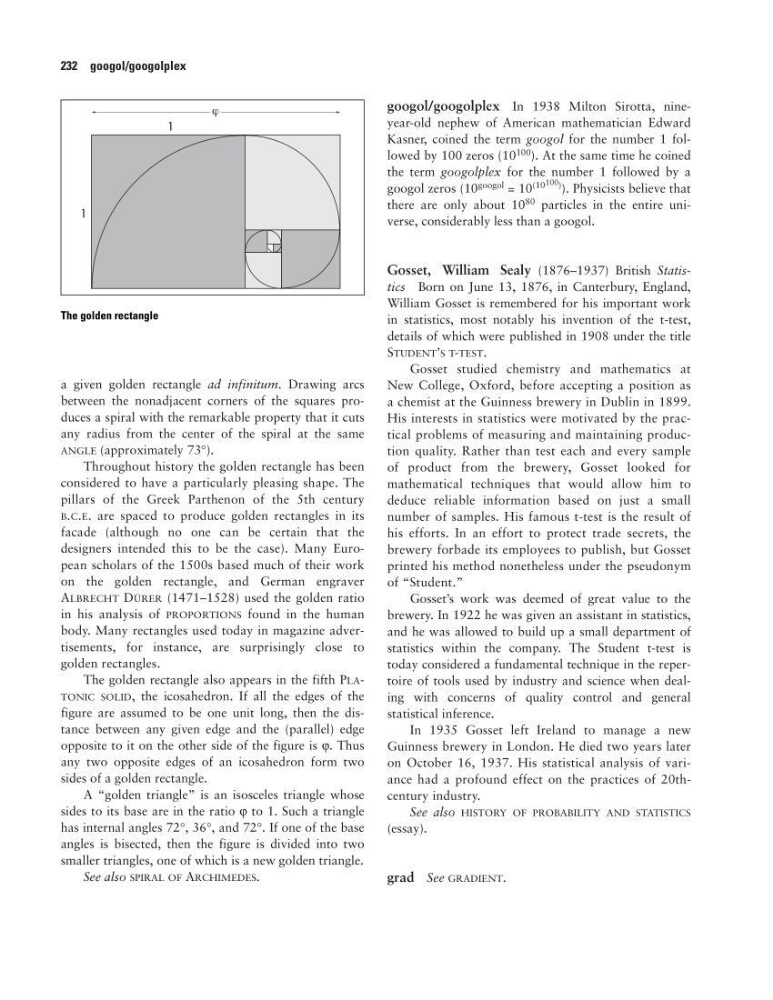
a given golden rectangle ad infinitum. Drawing arcs
between the nonadjacent corners of the squares produces a spiral with the remarkable property that it cuts
any radius from the center of the spiral at the same
ANGLE (approximately 73°).
Throughout history the golden rectangle has been
considered to have a particularly pleasing shape. The
pillars of the Greek Parthenon of the 5th century
B.C.E. are spaced to produce golden rectangles in its
facade (although no one can be certain that the
designers intended this to be the case). Many European scholars of the 1500s based much of their work
on the golden rectangle, and German engraver
ALBRECHT DÜRER (1471–1528) used the golden ratio
in his analysis of PROPORTIONS found in the human
body. Many rectangles used today in magazine advertisements, for instance, are surprisingly close to
golden rectangles.
The golden rectangle also appears in the fifth PLATONIC SOLID, the icosahedron. If all the edges of the
figure are assumed to be one unit long, then the distance between any given edge and the (parallel) edge
opposite to it on the other side of the figure is ϕ. Thus
any two opposite edges of an icosahedron form two
sides of a golden rectangle.
A “golden triangle” is an isosceles triangle whose
sides to its base are in the ratio ϕ to 1. Such a triangle
has internal angles 72°, 36°, and 72°. If one of the base
angles is bisected, then the figure is divided into two
smaller triangles, one of which is a new golden triangle.
See also SPIRAL OF ARCHIMEDES.
googol/googolplex In 1938 Milton Sirotta, nineyear-old nephew of American mathematician Edward
Kasner, coined the term googol for the number 1 followed by 100 zeros (10
100
). At the same time he coined
the term googolplex for the number 1 followed by a
googol zeros (10
googol = 10
(10 100 )
). Physicists believe that
there are only about 10
80 particles in the entire universe, considerably less than a googol.
Gosset, William Sealy (1876–1937) British Statistics Born on June 13, 1876, in Canterbury, England,
William Gosset is remembered for his important work
in statistics, most notably his invention of the t-test,
details of which were published in 1908 under the title
STUDENT’S T-TEST.
Gosset studied chemistry and mathematics at
New College, Oxford, before accepting a position as
a chemist at the Guinness brewery in Dublin in 1899.
His interests in statistics were motivated by the practical problems of measuring and maintaining production quality. Rather than test each and every sample
of product from the brewery, Gosset looked for
mathematical techniques that would allow him to
deduce reliable information based on just a small
number of samples. His famous t-test is the result of
his efforts. In an effort to protect trade secrets, the
brewery forbade its employees to publish, but Gosset
printed his method nonetheless under the pseudonym
of “Student.”
Gosset’s work was deemed of great value to the
brewery. In 1922 he was given an assistant in statistics,
and he was allowed to build up a small department of
statistics within the company. The Student t-test is
today considered a fundamental technique in the repertoire of tools used by industry and science when dealing with concerns of quality control and general
statistical inference.
In 1935 Gosset left Ireland to manage a new
Guinness brewery in London. He died two years later
on October 16, 1937. His statistical analysis of variance had a profound effect on the practices of 20thcentury industry.
See also HISTORY OF PROBABILITY AND STATISTICS
(essay).
grad See GRADIENT.
232 googol/googolplex
The golden rectangle
between the nonadjacent corners of the squares produces a spiral with the remarkable property that it cuts
any radius from the center of the spiral at the same
ANGLE (approximately 73°).
Throughout history the golden rectangle has been
considered to have a particularly pleasing shape. The
pillars of the Greek Parthenon of the 5th century
B.C.E. are spaced to produce golden rectangles in its
facade (although no one can be certain that the
designers intended this to be the case). Many European scholars of the 1500s based much of their work
on the golden rectangle, and German engraver
ALBRECHT DÜRER (1471–1528) used the golden ratio
in his analysis of PROPORTIONS found in the human
body. Many rectangles used today in magazine advertisements, for instance, are surprisingly close to
golden rectangles.
The golden rectangle also appears in the fifth PLATONIC SOLID, the icosahedron. If all the edges of the
figure are assumed to be one unit long, then the distance between any given edge and the (parallel) edge
opposite to it on the other side of the figure is ϕ. Thus
any two opposite edges of an icosahedron form two
sides of a golden rectangle.
A “golden triangle” is an isosceles triangle whose
sides to its base are in the ratio ϕ to 1. Such a triangle
has internal angles 72°, 36°, and 72°. If one of the base
angles is bisected, then the figure is divided into two
smaller triangles, one of which is a new golden triangle.
See also SPIRAL OF ARCHIMEDES.
googol/googolplex In 1938 Milton Sirotta, nineyear-old nephew of American mathematician Edward
Kasner, coined the term googol for the number 1 followed by 100 zeros (10
100
). At the same time he coined
the term googolplex for the number 1 followed by a
googol zeros (10
googol = 10
(10 100 )
). Physicists believe that
there are only about 10
80 particles in the entire universe, considerably less than a googol.
Gosset, William Sealy (1876–1937) British Statistics Born on June 13, 1876, in Canterbury, England,
William Gosset is remembered for his important work
in statistics, most notably his invention of the t-test,
details of which were published in 1908 under the title
STUDENT’S T-TEST.
Gosset studied chemistry and mathematics at
New College, Oxford, before accepting a position as
a chemist at the Guinness brewery in Dublin in 1899.
His interests in statistics were motivated by the practical problems of measuring and maintaining production quality. Rather than test each and every sample
of product from the brewery, Gosset looked for
mathematical techniques that would allow him to
deduce reliable information based on just a small
number of samples. His famous t-test is the result of
his efforts. In an effort to protect trade secrets, the
brewery forbade its employees to publish, but Gosset
printed his method nonetheless under the pseudonym
of “Student.”
Gosset’s work was deemed of great value to the
brewery. In 1922 he was given an assistant in statistics,
and he was allowed to build up a small department of
statistics within the company. The Student t-test is
today considered a fundamental technique in the repertoire of tools used by industry and science when dealing with concerns of quality control and general
statistical inference.
In 1935 Gosset left Ireland to manage a new
Guinness brewery in London. He died two years later
on October 16, 1937. His statistical analysis of variance had a profound effect on the practices of 20thcentury industry.
See also HISTORY OF PROBABILITY AND STATISTICS
(essay).
grad See GRADIENT.
232 googol/googolplex
The golden rectangle