

and radius AD to find this point.) Then point
P divides the segment AB in the golden ratio.
(To see why this works, suppose that the line segment
AB is of unit length, and the length of AP is x. Then
triangle ABC is a right triangle with hypotenuse
+ x. PYTHAGORAS’S THEOREM now shows that x =
ϕ – 1 =
, giving
= ϕ.)
Noting that the construction of midpoints, circles,
and perpendicular lines can all be accomplished with a
straight edge (that is, a ruler with no markings) and a
compass alone, the above procedure shows that the
golden ratio is a CONSTRUCTIBLE number.
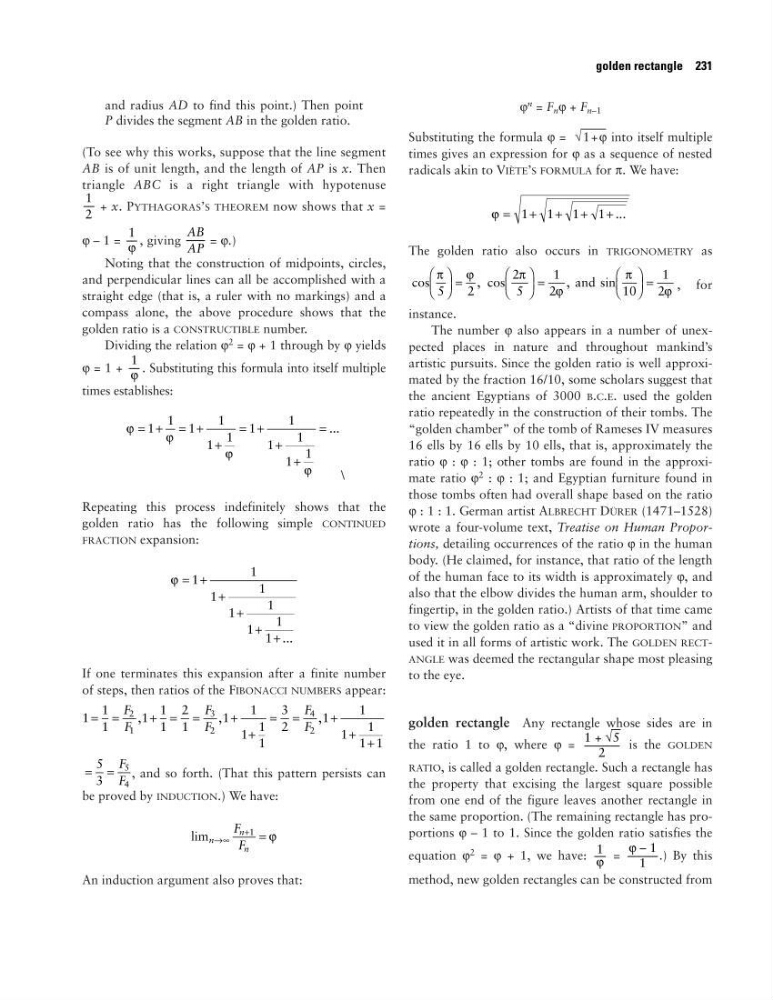
Dividing the relation ϕ
2 = ϕ + 1 through by ϕ yields
ϕ = 1 +
. Substituting this formula into itself multiple
times establishes:
\
Repeating this process indefinitely shows that the
golden ratio has the following simple CONTINUED
FRACTION expansion:
If one terminates this expansion after a finite number
of steps, then ratios of the FIBONACCI NUMBERS appear:
, and so forth. (That this pattern persists can
be proved by INDUCTION.) We have:
An induction argument also proves that:
ϕ
n = F n ϕ + F n–1
Substituting the formula ϕ = √
–
1+ϕ into itself multiple
times gives an expression for ϕ as a sequence of nested
radicals akin to VIÈTE’S FORMULA for π. We have:
The golden ratio also occurs in TRIGONOMETRY as
, for
instance.
The number ϕ also appears in a number of unexpected places in nature and throughout mankind’s
artistic pursuits. Since the golden ratio is well approximated by the fraction 16/10, some scholars suggest that
the ancient Egyptians of 3000 B.C.E. used the golden
ratio repeatedly in the construction of their tombs. The
“golden chamber” of the tomb of Rameses IV measures
16 ells by 16 ells by 10 ells, that is, approximately the
ratio ϕ : ϕ : 1; other tombs are found in the approximate ratio ϕ
2 : ϕ : 1; and Egyptian furniture found in
those tombs often had overall shape based on the ratio
ϕ : 1 : 1. German artist ALBRECHT DÜRER (1471–1528)
wrote a four-volume text, Treatise on Human Proportions, detailing occurrences of the ratio ϕ in the human
body. (He claimed, for instance, that ratio of the length
of the human face to its width is approximately ϕ, and
also that the elbow divides the human arm, shoulder to
fingertip, in the golden ratio.) Artists of that time came
to view the golden ratio as a “divine PROPORTION” and
used it in all forms of artistic work. The GOLDEN RECTANGLE was deemed the rectangular shape most pleasing
to the eye.
golden rectangle Any rectangle whose sides are in
the ratio 1 to ϕ, where ϕ =
is the GOLDEN
RATIO, is called a golden rectangle. Such a rectangle has
the property that excising the largest square possible
from one end of the figure leaves another rectangle in
the same proportion. (The remaining rectangle has proportions ϕ – 1 to 1. Since the golden ratio satisfies the
equation ϕ
2 = ϕ + 1, we have:
=
.) By this
method, new golden rectangles can be constructed from
ϕ – 1
––––
1
1
–– ϕ
1 + √
–
5
––––
2
cos
, cos
,
sin
π
ϕ
π
ϕ
π
ϕ
5
2
2
5
1
2
1 0
1
2
⎛
⎝
⎜
⎞
⎠
⎟ =
⎛
⎝
⎜
⎞
⎠
⎟ =
⎛
⎝
⎜
⎞
⎠
⎟ =
and
ϕ =
+ + + +
1 1 1 1 ...
lim n
n
n
F
F
→∞
+
=
1
ϕ
5
3
5
4
= =
F
F
1
1
1
1
1
1
2
1
1
1
1
1
1
3
2
1
1
1
1
1 1
2
1
3
2
4
2
= =
+ = =
+
+
= =
+
+ +
F
F
F
F
F
F
,
,
,
ϕ = +
+
+
+ +
1
1
1
1
1
1
1
1
1 ...
ϕ
ϕ
ϕ
ϕ
= + = +
+
= +
+
+
=
1
1 1
1
1
1
1
1
1
1
1
1
...
1
––
ϕ
AB
––
AP
1
––
ϕ
1
––
2
golden rectangle 231
P divides the segment AB in the golden ratio.
(To see why this works, suppose that the line segment
AB is of unit length, and the length of AP is x. Then
triangle ABC is a right triangle with hypotenuse
+ x. PYTHAGORAS’S THEOREM now shows that x =
ϕ – 1 =
, giving
= ϕ.)
Noting that the construction of midpoints, circles,
and perpendicular lines can all be accomplished with a
straight edge (that is, a ruler with no markings) and a
compass alone, the above procedure shows that the
golden ratio is a CONSTRUCTIBLE number.
Dividing the relation ϕ
2 = ϕ + 1 through by ϕ yields
ϕ = 1 +
. Substituting this formula into itself multiple
times establishes:
\
Repeating this process indefinitely shows that the
golden ratio has the following simple CONTINUED
FRACTION expansion:
If one terminates this expansion after a finite number
of steps, then ratios of the FIBONACCI NUMBERS appear:
, and so forth. (That this pattern persists can
be proved by INDUCTION.) We have:
An induction argument also proves that:
ϕ
n = F n ϕ + F n–1
Substituting the formula ϕ = √
–
1+ϕ into itself multiple
times gives an expression for ϕ as a sequence of nested
radicals akin to VIÈTE’S FORMULA for π. We have:
The golden ratio also occurs in TRIGONOMETRY as
, for
instance.
The number ϕ also appears in a number of unexpected places in nature and throughout mankind’s
artistic pursuits. Since the golden ratio is well approximated by the fraction 16/10, some scholars suggest that
the ancient Egyptians of 3000 B.C.E. used the golden
ratio repeatedly in the construction of their tombs. The
“golden chamber” of the tomb of Rameses IV measures
16 ells by 16 ells by 10 ells, that is, approximately the
ratio ϕ : ϕ : 1; other tombs are found in the approximate ratio ϕ
2 : ϕ : 1; and Egyptian furniture found in
those tombs often had overall shape based on the ratio
ϕ : 1 : 1. German artist ALBRECHT DÜRER (1471–1528)
wrote a four-volume text, Treatise on Human Proportions, detailing occurrences of the ratio ϕ in the human
body. (He claimed, for instance, that ratio of the length
of the human face to its width is approximately ϕ, and
also that the elbow divides the human arm, shoulder to
fingertip, in the golden ratio.) Artists of that time came
to view the golden ratio as a “divine PROPORTION” and
used it in all forms of artistic work. The GOLDEN RECTANGLE was deemed the rectangular shape most pleasing
to the eye.
golden rectangle Any rectangle whose sides are in
the ratio 1 to ϕ, where ϕ =
is the GOLDEN
RATIO, is called a golden rectangle. Such a rectangle has
the property that excising the largest square possible
from one end of the figure leaves another rectangle in
the same proportion. (The remaining rectangle has proportions ϕ – 1 to 1. Since the golden ratio satisfies the
equation ϕ
2 = ϕ + 1, we have:
=
.) By this
method, new golden rectangles can be constructed from
ϕ – 1
––––
1
1
–– ϕ
1 + √
–
5
––––
2
cos
, cos
,
sin
π
ϕ
π
ϕ
π
ϕ
5
2
2
5
1
2
1 0
1
2
⎛
⎝
⎜
⎞
⎠
⎟ =
⎛
⎝
⎜
⎞
⎠
⎟ =
⎛
⎝
⎜
⎞
⎠
⎟ =
and
ϕ =
+ + + +
1 1 1 1 ...
lim n
n
n
F
F
→∞
+
=
1
ϕ
5
3
5
4
= =
F
F
1
1
1
1
1
1
2
1
1
1
1
1
1
3
2
1
1
1
1
1 1
2
1
3
2
4
2
= =
+ = =
+
+
= =
+
+ +
F
F
F
F
F
F
,
,
,
ϕ = +
+
+
+ +
1
1
1
1
1
1
1
1
1 ...
ϕ
ϕ
ϕ
ϕ
= + = +
+
= +
+
+
=
1
1 1
1
1
1
1
1
1
1
1
1
...
1
––
ϕ
AB
––
AP
1
––
ϕ
1
––
2
golden rectangle 231