

gradient The SLOPE of a line is sometimes called its
gradient or grade. For example, the gradient of the line
connecting the two points A = (a 1 ,a 2 ) and B = (b 1 ,b 2 ),
denoted m AB , is given by:
Three points A, B, and C in the plane are COLLINEAR if
the gradients m AB and m AC are equal.
In the setting of multivariable calculus—the study
of CALCULUS applied to FUNCTIONS of more than one
variable—the gradient of a function f(x,y,z) of three
VARIABLES, also called the “grad of f,” is defined to be
the VECTOR of its PARTIAL DERIVATIVEs. It is denoted
grad(f) or ᭞f and is given by:
Such a quantity proves to be useful in computing the
DIRECTIONAL DERIVATIVE of a function. In physics, ᭞f
is also used to describe the spatial variation in the magnitude of a force, such as a gravitational force or a
magnetic force. The study of directional derivatives
shows that the quantity ᭞f calculated at a point represents the direction from that point in which the rate of
change of the force f is a maximum.
See also DIV.
graph (network) Any diagram of points and line segments connecting pairs of points is called a graph. The
points are usually called vertices or nodes, and the line
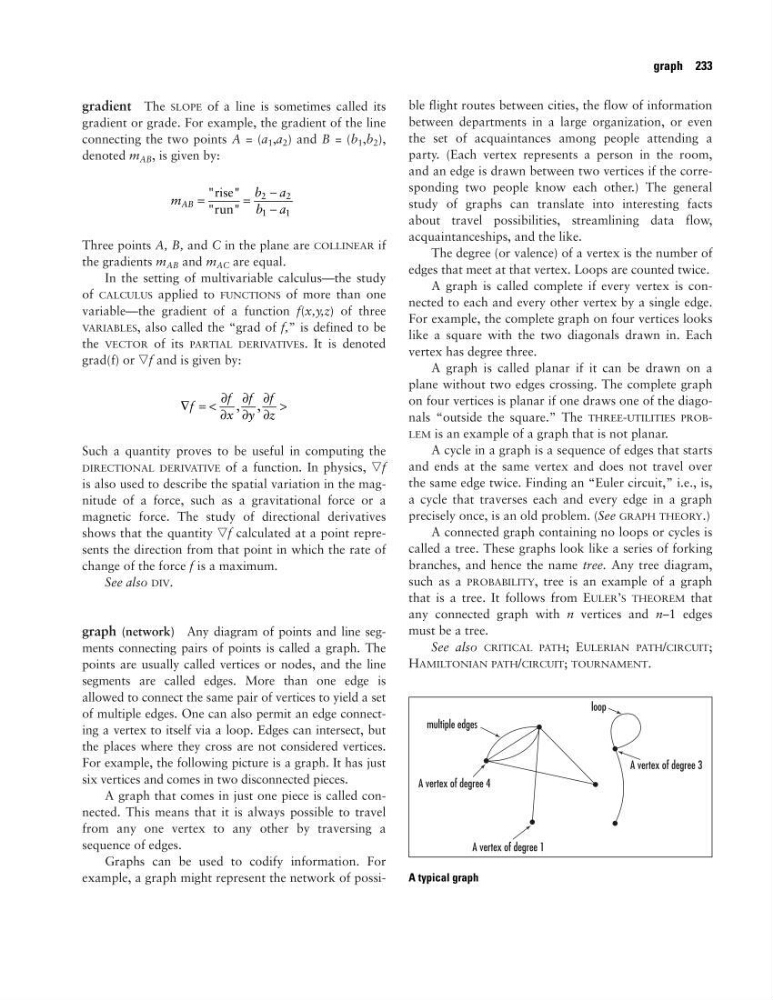
segments are called edges. More than one edge is
allowed to connect the same pair of vertices to yield a set
of multiple edges. One can also permit an edge connecting a vertex to itself via a loop. Edges can intersect, but
the places where they cross are not considered vertices.
For example, the following picture is a graph. It has just
six vertices and comes in two disconnected pieces.
A graph that comes in just one piece is called connected. This means that it is always possible to travel
from any one vertex to any other by traversing a
sequence of edges.
Graphs can be used to codify information. For
example, a graph might represent the network of possible flight routes between cities, the flow of information
between departments in a large organization, or even
the set of acquaintances among people attending a
party. (Each vertex represents a person in the room,
and an edge is drawn between two vertices if the corresponding two people know each other.) The general
study of graphs can translate into interesting facts
about travel possibilities, streamlining data flow,
acquaintanceships, and the like.
The degree (or valence) of a vertex is the number of
edges that meet at that vertex. Loops are counted twice.
A graph is called complete if every vertex is connected to each and every other vertex by a single edge.
For example, the complete graph on four vertices looks
like a square with the two diagonals drawn in. Each
vertex has degree three.
A graph is called planar if it can be drawn on a
plane without two edges crossing. The complete graph
on four vertices is planar if one draws one of the diagonals “outside the square.” The THREE-UTILITIES PROBLEM is an example of a graph that is not planar.
A cycle in a graph is a sequence of edges that starts
and ends at the same vertex and does not travel over
the same edge twice. Finding an “Euler circuit,” i.e., is,
a cycle that traverses each and every edge in a graph
precisely once, is an old problem. (See GRAPH THEORY.)
A connected graph containing no loops or cycles is
called a tree. These graphs look like a series of forking
branches, and hence the name tree. Any tree diagram,
such as a PROBABILITY, tree is an example of a graph
that is a tree. It follows from EULER’S THEOREM that
any connected graph with n vertices and n–1 edges
must be a tree.
See also CRITICAL PATH; EULERIAN PATH/CIRCUIT;
HAMILTONIAN PATH/CIRCUIT; TOURNAMENT.
∇ = <
∂
∂
∂
∂
∂
∂
>
f
f
x
f
y
f
z
, ,
m
b a
b a
AB =
=
−
−
"rise"
"run"
2
2
1
1
graph 233
A typical graph
gradient or grade. For example, the gradient of the line
connecting the two points A = (a 1 ,a 2 ) and B = (b 1 ,b 2 ),
denoted m AB , is given by:
Three points A, B, and C in the plane are COLLINEAR if
the gradients m AB and m AC are equal.
In the setting of multivariable calculus—the study
of CALCULUS applied to FUNCTIONS of more than one
variable—the gradient of a function f(x,y,z) of three
VARIABLES, also called the “grad of f,” is defined to be
the VECTOR of its PARTIAL DERIVATIVEs. It is denoted
grad(f) or ᭞f and is given by:
Such a quantity proves to be useful in computing the
DIRECTIONAL DERIVATIVE of a function. In physics, ᭞f
is also used to describe the spatial variation in the magnitude of a force, such as a gravitational force or a
magnetic force. The study of directional derivatives
shows that the quantity ᭞f calculated at a point represents the direction from that point in which the rate of
change of the force f is a maximum.
See also DIV.
graph (network) Any diagram of points and line segments connecting pairs of points is called a graph. The
points are usually called vertices or nodes, and the line
segments are called edges. More than one edge is
allowed to connect the same pair of vertices to yield a set
of multiple edges. One can also permit an edge connecting a vertex to itself via a loop. Edges can intersect, but
the places where they cross are not considered vertices.
For example, the following picture is a graph. It has just
six vertices and comes in two disconnected pieces.
A graph that comes in just one piece is called connected. This means that it is always possible to travel
from any one vertex to any other by traversing a
sequence of edges.
Graphs can be used to codify information. For
example, a graph might represent the network of possible flight routes between cities, the flow of information
between departments in a large organization, or even
the set of acquaintances among people attending a
party. (Each vertex represents a person in the room,
and an edge is drawn between two vertices if the corresponding two people know each other.) The general
study of graphs can translate into interesting facts
about travel possibilities, streamlining data flow,
acquaintanceships, and the like.
The degree (or valence) of a vertex is the number of
edges that meet at that vertex. Loops are counted twice.
A graph is called complete if every vertex is connected to each and every other vertex by a single edge.
For example, the complete graph on four vertices looks
like a square with the two diagonals drawn in. Each
vertex has degree three.
A graph is called planar if it can be drawn on a
plane without two edges crossing. The complete graph
on four vertices is planar if one draws one of the diagonals “outside the square.” The THREE-UTILITIES PROBLEM is an example of a graph that is not planar.
A cycle in a graph is a sequence of edges that starts
and ends at the same vertex and does not travel over
the same edge twice. Finding an “Euler circuit,” i.e., is,
a cycle that traverses each and every edge in a graph
precisely once, is an old problem. (See GRAPH THEORY.)
A connected graph containing no loops or cycles is
called a tree. These graphs look like a series of forking
branches, and hence the name tree. Any tree diagram,
such as a PROBABILITY, tree is an example of a graph
that is a tree. It follows from EULER’S THEOREM that
any connected graph with n vertices and n–1 edges
must be a tree.
See also CRITICAL PATH; EULERIAN PATH/CIRCUIT;
HAMILTONIAN PATH/CIRCUIT; TOURNAMENT.
∇ = <
∂
∂
∂
∂
∂
∂
>
f
f
x
f
y
f
z
, ,
m
b a
b a
AB =
=
−
−
"rise"
"run"
2
2
1
1
graph 233
A typical graph