

These statements are proved through a study of the
median of a triangle, the altitude of a triangle, and the
consideration of EQUIDISTANT points, respectively.
In the mid-1700s LEONHARD EULER (1707–83)
made the astounding discovery that furthermore, for
any triangle, the three points G, H, and O are
COLLINEAR, that is, lie on a straight line. This line is
called the Euler line of the triangle.
Euler proved this observation as follows: If, by
chance, the points O and G coincide, then each median
of the triangle is also an altitude. This means that the
triangle is symmetric about each median, and so must
be equilateral. Consequently, the point H occurs at the
same location as O and G, and the three points, trivially, lie on a straight line. If, as is more likely the case,
O and G do not coincide, then draw a line through
them and consider a point J on this line that is situated
so that the length of the segment GJ is twice that of
OG. Let M be the midpoint of the base of the triangle.
From a study of the medians of a triangle, we know
that length of the segment AG to that of GM in the diagram above is in ratio of 2 to 1. Consequently, the two
shaded triangles are similar, and, in particular, angles
AJG and GOM match. By the converse of the PARALLEL
POSTULATE, lines OM and AJ are parallel. Since OM
makes an angle of 90° to the base of the triangle, so too
must line AJ, making this line an altitude to the triangle.
Nothing in this argument thus far has relied on
vertex A being the object of focus. The same reasoning
shows that the altitude from vertex B also passes
through the point J, as does the altitude from vertex C.
This shows that the point J is in fact the orthocenter H
of the triangle. Consequently, O, G, and H do indeed
all lie on the same straight line.
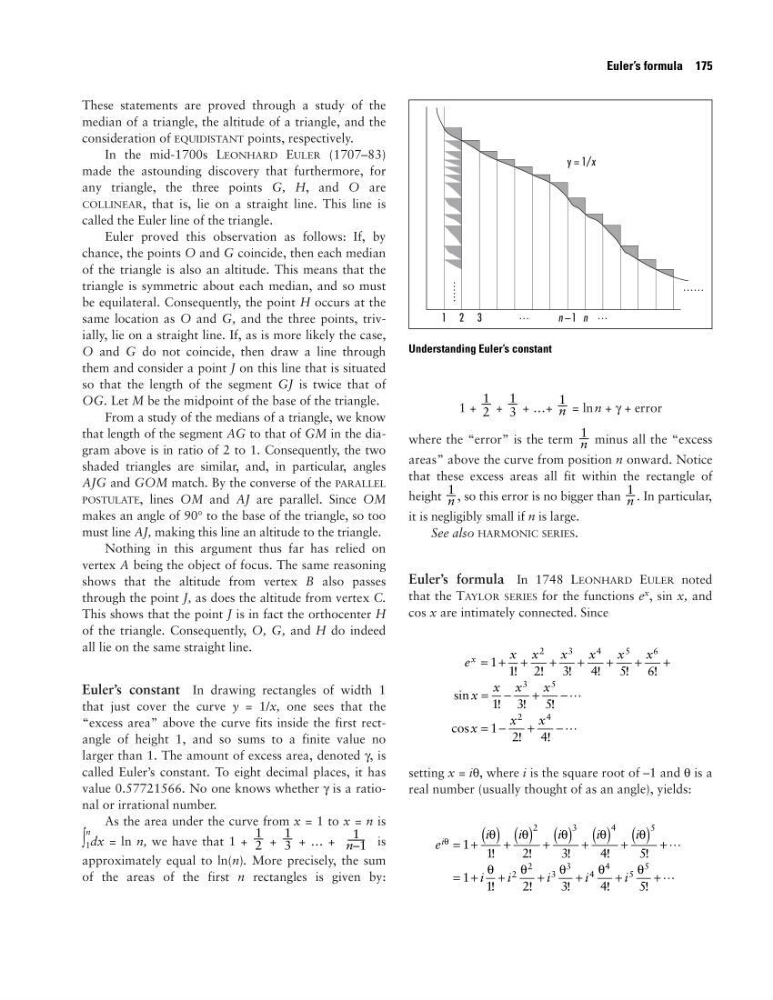
Euler’s constant In drawing rectangles of width 1
that just cover the curve y = 1/x, one sees that the
“excess area” above the curve fits inside the first rectangle of height 1, and so sums to a finite value no
larger than 1. The amount of excess area, denoted γ, is
called Euler’s constant. To eight decimal places, it has
value 0.57721566. No one knows whether γ is a rational or irrational number.
As the area under the curve from x = 1 to x = n is
∫
n
1 dx = ln n, we have that 1 +
+
+ … +
is
approximately equal to ln(n). More precisely, the sum
of the areas of the first n rectangles is given by:
1 +
+
+ …+
= ln n + γ + error
where the “error” is the term
minus all the “excess
areas” above the curve from position n onward. Notice
that these excess areas all fit within the rectangle of
height , so this error is no bigger than . In particular,
it is negligibly small if n is large.
See also HARMONIC SERIES.
Euler’s formula In 1748 LEONHARD EULER noted
that the TAYLOR SERIES for the functions e
x
, sin x, and
cos x are intimately connected. Since
setting x = iθ, where i is the square root of –1 and θ is a
real number (usually thought of as an angle), yields:
e
i
i
i
i
i
i
i
i
i
i
iθ
θ
θ
θ
θ
θ
θ
θ
θ
θ
θ
= +
( ) + ( ) + ( ) + ( ) + ( ) +
= +
+
+
+
+
+
1 1
2
3
4
5
1 1
2
3
4
5
2
3
4
5
2
2
3
3
4
4
5
5
!
!
!
!
!
!
!
!
!
!
L
L
e
x x
x
x
x
x
x
x x
x
x
x
x
x
= + +
+
+
+
+
+
= −
+
−
= −
+
−
1 1 2
3
4
5
6
1 3
5
1 2
4
2
3
4
5
6
3
5
2
4
!
!
!
!
!
!
sin
!
!
!
cos
!
!
L
L
1
– n
1
– n
1
– n
1
– n
1
–
3
1
–
2
1
–
n–1
1
–
3
1
–
2
Euler’s formula 175
Understanding Euler’s constant
median of a triangle, the altitude of a triangle, and the
consideration of EQUIDISTANT points, respectively.
In the mid-1700s LEONHARD EULER (1707–83)
made the astounding discovery that furthermore, for
any triangle, the three points G, H, and O are
COLLINEAR, that is, lie on a straight line. This line is
called the Euler line of the triangle.
Euler proved this observation as follows: If, by
chance, the points O and G coincide, then each median
of the triangle is also an altitude. This means that the
triangle is symmetric about each median, and so must
be equilateral. Consequently, the point H occurs at the
same location as O and G, and the three points, trivially, lie on a straight line. If, as is more likely the case,
O and G do not coincide, then draw a line through
them and consider a point J on this line that is situated
so that the length of the segment GJ is twice that of
OG. Let M be the midpoint of the base of the triangle.
From a study of the medians of a triangle, we know
that length of the segment AG to that of GM in the diagram above is in ratio of 2 to 1. Consequently, the two
shaded triangles are similar, and, in particular, angles
AJG and GOM match. By the converse of the PARALLEL
POSTULATE, lines OM and AJ are parallel. Since OM
makes an angle of 90° to the base of the triangle, so too
must line AJ, making this line an altitude to the triangle.
Nothing in this argument thus far has relied on
vertex A being the object of focus. The same reasoning
shows that the altitude from vertex B also passes
through the point J, as does the altitude from vertex C.
This shows that the point J is in fact the orthocenter H
of the triangle. Consequently, O, G, and H do indeed
all lie on the same straight line.
Euler’s constant In drawing rectangles of width 1
that just cover the curve y = 1/x, one sees that the
“excess area” above the curve fits inside the first rectangle of height 1, and so sums to a finite value no
larger than 1. The amount of excess area, denoted γ, is
called Euler’s constant. To eight decimal places, it has
value 0.57721566. No one knows whether γ is a rational or irrational number.
As the area under the curve from x = 1 to x = n is
∫
n
1 dx = ln n, we have that 1 +
+
+ … +
is
approximately equal to ln(n). More precisely, the sum
of the areas of the first n rectangles is given by:
1 +
+
+ …+
= ln n + γ + error
where the “error” is the term
minus all the “excess
areas” above the curve from position n onward. Notice
that these excess areas all fit within the rectangle of
height , so this error is no bigger than . In particular,
it is negligibly small if n is large.
See also HARMONIC SERIES.
Euler’s formula In 1748 LEONHARD EULER noted
that the TAYLOR SERIES for the functions e
x
, sin x, and
cos x are intimately connected. Since
setting x = iθ, where i is the square root of –1 and θ is a
real number (usually thought of as an angle), yields:
e
i
i
i
i
i
i
i
i
i
i
iθ
θ
θ
θ
θ
θ
θ
θ
θ
θ
θ
= +
( ) + ( ) + ( ) + ( ) + ( ) +
= +
+
+
+
+
+
1 1
2
3
4
5
1 1
2
3
4
5
2
3
4
5
2
2
3
3
4
4
5
5
!
!
!
!
!
!
!
!
!
!
L
L
e
x x
x
x
x
x
x
x x
x
x
x
x
x
= + +
+
+
+
+
+
= −
+
−
= −
+
−
1 1 2
3
4
5
6
1 3
5
1 2
4
2
3
4
5
6
3
5
2
4
!
!
!
!
!
!
sin
!
!
!
cos
!
!
L
L
1
– n
1
– n
1
– n
1
– n
1
–
3
1
–
2
1
–
n–1
1
–
3
1
–
2
Euler’s formula 175
Understanding Euler’s constant