

joined the Berlin Academy of Science in 1741. He
remained there for 25 years, assuming the leadership of
the academy in 1759.
During his time at Berlin, Euler wrote over 350
articles and several influential books on a wide variety
of topics in both pure and applied mathematics. In
1753 he invented the paddle wheel and the screw propeller as means of propelling ships without wind. In
1761 he developed a method of using observational
data about the planet Venus to determine the distance
of the Earth from the Sun, and also to make measurements of longitude on the Earth’s surface.
In 1766 Euler returned to St. Petersburg, but soon
afterward fell ill and lost his eyesight. Despite being
blind, Euler continued to produce significant pieces of
work. (He published approximately 500 books and
papers while blind.) Euler also worked to popularize the
scientific method and wrote, between the years 1768
and 1772, his famous three-volume piece Letters to a
German Princess on the topic of popular science. Euler
remained at St. Petersburg until his death in 1783.
Euler’s name is attached to at least one fundamental concept in nearly every branch of mathematics. For
instance, EULER’S THEOREM is a key result in GRAPH
THEORY, linking the number of vertices and edges of a
graph to the number of regions it produces. The number e plays a fundamental role in the theory of differential calculus, differential equations, PROBABILITY theory,
STATISTICS, the theory of SUBFACTORIALs and derangements, the study of COMPOUND INTEREST, and the
study of COMPLEX NUMBERS through EULER’S
FORMULA, for instance. In number theory, EULER’S
CONSTANT plays a key role in the study of the HARMONIC SERIES, for instance. Euler found a formula for
the “Euler totient function” that provides, for a number n, the count of numbers less than n that are RELATIVELY PRIME to n and showed its importance in the
theory of MODULAR ARITHMETIC. Euler’s name is intimately associated with the study of the ZETA
FUNCTION, with the gamma function in the examination of the FACTORIAL function, with the study of
LATIN SQUARES, and with the construction of even PERFECT NUMBERS. (No one to this day knows whether or
not examples of odd perfect numbers exist.)
Less well known is Euler’s polynomial, n
2 – n + 41,
which produces a PRIME output for every integer input
from –39 through to 40. The 40 × 117 × 240 rectangular block, called “Euler’s brick,” has the property that
any diagonal drawn on the face of this solid also has
integer length. Euler showed that there are infinitely
many such blocks with integer side-lengths and integer
face diagonals. (No one to this day knows whether or
not there exists an Euler brick with internal space diagonals also of integer length.)
Euler died in St. Petersburg, Russia, on September
18, 1783. It is not an exaggeration to say that Euler
offered profound insights on practically every branch
of mathematics and mathematical physics studied at his
time and, moreover, paved the way for many new
branches of mathematics research. In 1915 the Euler
Committee of the Swiss Academy of Science began collating and publishing his complete works. Divided into
four series—mathematics, mechanics and astronomy,
optics and sound, and letters and notebooks—76 volumes of work have been released thus far (covering
approximately 25,000 pages of written material), and
the committee projects another eight volumes of material still to be released.
Eulerian path/circuit See GRAPH THEORY.
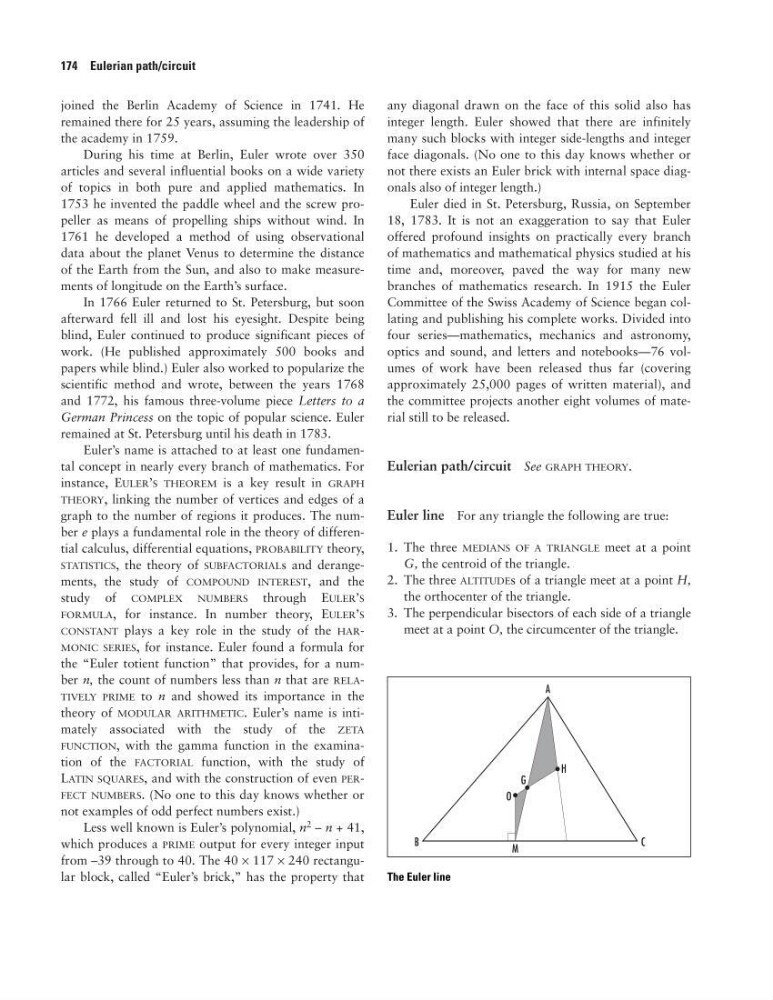
Euler line For any triangle the following are true:
1. The three MEDIANS OF A TRIANGLE meet at a point
G, the centroid of the triangle.
2. The three ALTITUDEs of a triangle meet at a point H,
the orthocenter of the triangle.
3. The perpendicular bisectors of each side of a triangle
meet at a point O, the circumcenter of the triangle.
174 Eulerian path/circuit
The Euler line
remained there for 25 years, assuming the leadership of
the academy in 1759.
During his time at Berlin, Euler wrote over 350
articles and several influential books on a wide variety
of topics in both pure and applied mathematics. In
1753 he invented the paddle wheel and the screw propeller as means of propelling ships without wind. In
1761 he developed a method of using observational
data about the planet Venus to determine the distance
of the Earth from the Sun, and also to make measurements of longitude on the Earth’s surface.
In 1766 Euler returned to St. Petersburg, but soon
afterward fell ill and lost his eyesight. Despite being
blind, Euler continued to produce significant pieces of
work. (He published approximately 500 books and
papers while blind.) Euler also worked to popularize the
scientific method and wrote, between the years 1768
and 1772, his famous three-volume piece Letters to a
German Princess on the topic of popular science. Euler
remained at St. Petersburg until his death in 1783.
Euler’s name is attached to at least one fundamental concept in nearly every branch of mathematics. For
instance, EULER’S THEOREM is a key result in GRAPH
THEORY, linking the number of vertices and edges of a
graph to the number of regions it produces. The number e plays a fundamental role in the theory of differential calculus, differential equations, PROBABILITY theory,
STATISTICS, the theory of SUBFACTORIALs and derangements, the study of COMPOUND INTEREST, and the
study of COMPLEX NUMBERS through EULER’S
FORMULA, for instance. In number theory, EULER’S
CONSTANT plays a key role in the study of the HARMONIC SERIES, for instance. Euler found a formula for
the “Euler totient function” that provides, for a number n, the count of numbers less than n that are RELATIVELY PRIME to n and showed its importance in the
theory of MODULAR ARITHMETIC. Euler’s name is intimately associated with the study of the ZETA
FUNCTION, with the gamma function in the examination of the FACTORIAL function, with the study of
LATIN SQUARES, and with the construction of even PERFECT NUMBERS. (No one to this day knows whether or
not examples of odd perfect numbers exist.)
Less well known is Euler’s polynomial, n
2 – n + 41,
which produces a PRIME output for every integer input
from –39 through to 40. The 40 × 117 × 240 rectangular block, called “Euler’s brick,” has the property that
any diagonal drawn on the face of this solid also has
integer length. Euler showed that there are infinitely
many such blocks with integer side-lengths and integer
face diagonals. (No one to this day knows whether or
not there exists an Euler brick with internal space diagonals also of integer length.)
Euler died in St. Petersburg, Russia, on September
18, 1783. It is not an exaggeration to say that Euler
offered profound insights on practically every branch
of mathematics and mathematical physics studied at his
time and, moreover, paved the way for many new
branches of mathematics research. In 1915 the Euler
Committee of the Swiss Academy of Science began collating and publishing his complete works. Divided into
four series—mathematics, mechanics and astronomy,
optics and sound, and letters and notebooks—76 volumes of work have been released thus far (covering
approximately 25,000 pages of written material), and
the committee projects another eight volumes of material still to be released.
Eulerian path/circuit See GRAPH THEORY.
Euler line For any triangle the following are true:
1. The three MEDIANS OF A TRIANGLE meet at a point
G, the centroid of the triangle.
2. The three ALTITUDEs of a triangle meet at a point H,
the orthocenter of the triangle.
3. The perpendicular bisectors of each side of a triangle
meet at a point O, the circumcenter of the triangle.
174 Eulerian path/circuit
The Euler line