

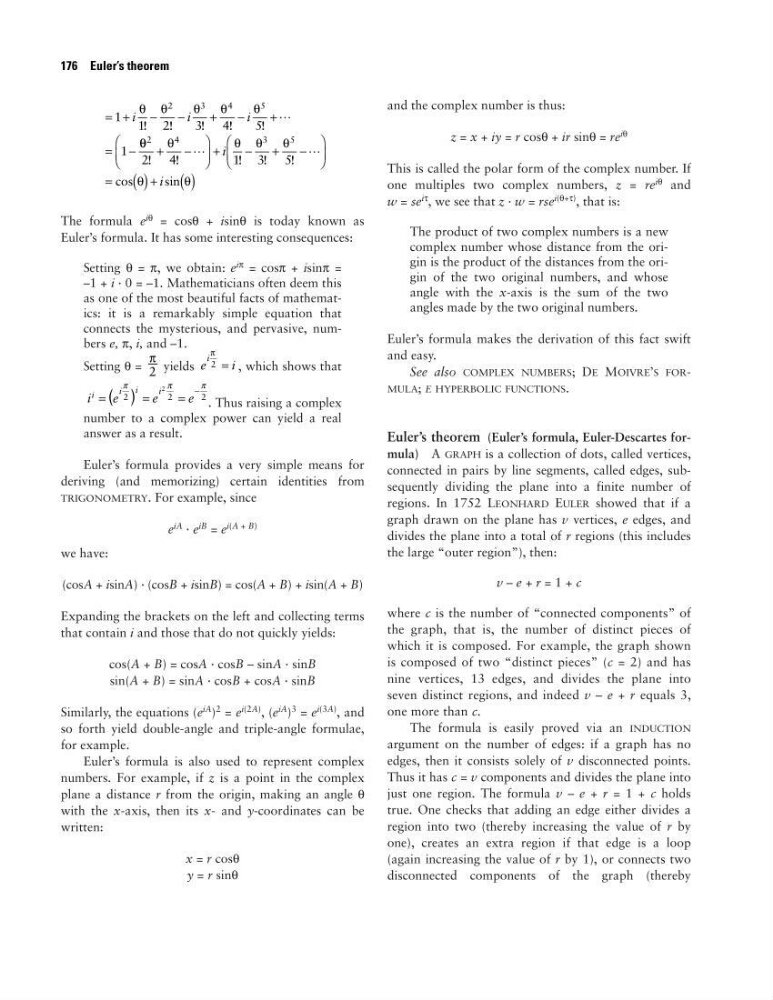
The formula e
iθ = cosθ + isinθ is today known as
Euler’s formula. It has some interesting consequences:
Setting θ = π, we obtain: e
iπ = cosπ + isinπ =
–1 + i · 0 = –1. Mathematicians often deem this
as one of the most beautiful facts of mathematics: it is a remarkably simple equation that
connects the mysterious, and pervasive, numbers e, π, i, and –1.
Setting θ =
yields
, which shows that
. Thus raising a complex
number to a complex power can yield a real
answer as a result.
Euler’s formula provides a very simple means for
deriving (and memorizing) certain identities from
TRIGONOMETRY. For example, since
e
iA · e
iB = e
i(A + B)
we have:
(cosA + isinA) · (cosB + isinB) = cos(A + B) + isin(A + B)
Expanding the brackets on the left and collecting terms
that contain i and those that do not quickly yields:
cos(A + B) = cosA · cosB – sinA · sinB
sin(A + B) = sinA · cosB + cosA · sinB
Similarly, the equations (e iA )
2 = e
i(2A) , (e
iA )
3 = e
i(3A) , and
so forth yield double-angle and triple-angle formulae,
for example.
Euler’s formula is also used to represent complex
numbers. For example, if z is a point in the complex
plane a distance r from the origin, making an angle θ
with the x-axis, then its x- and y-coordinates can be
written:
x = r cosθ
y = r sinθ
and the complex number is thus:
z = x + iy = r cosθ + ir sinθ = re
iθ
This is called the polar form of the complex number. If
one multiples two complex numbers, z = re
iθ and
w = se
iτ
, we see that z · w = rse
i(θ+τ)
, that is:
The product of two complex numbers is a new
complex number whose distance from the origin is the product of the distances from the origin of the two original numbers, and whose
angle with the x-axis is the sum of the two
angles made by the two original numbers.
Euler’s formula makes the derivation of this fact swift
and easy.
See also COMPLEX NUMBERS; DE MOIVRE’S FORMULA; E HYPERBOLIC FUNCTIONS.
Euler’s theorem (Euler’s formula, Euler-Descartes formula) A GRAPH is a collection of dots, called vertices,
connected in pairs by line segments, called edges, subsequently dividing the plane into a finite number of
regions. In 1752 LEONHARD EULER showed that if a
graph drawn on the plane has v vertices, e edges, and
divides the plane into a total of r regions (this includes
the large “outer region”), then:
v – e + r = 1 + c
where c is the number of “connected components” of
the graph, that is, the number of distinct pieces of
which it is composed. For example, the graph shown
is composed of two “distinct pieces” (c = 2) and has
nine vertices, 13 edges, and divides the plane into
seven distinct regions, and indeed v – e + r equals 3,
one more than c.
The formula is easily proved via an INDUCTION
argument on the number of edges: if a graph has no
edges, then it consists solely of v disconnected points.
Thus it has c = v components and divides the plane into
just one region. The formula v – e + r = 1 + c holds
true. One checks that adding an edge either divides a
region into two (thereby increasing the value of r by
one), creates an extra region if that edge is a loop
(again increasing the value of r by 1), or connects two
disconnected components of the graph (thereby
i
e
e
e
i
i
i
i
=
=
=
−
( )
π
π
π
2
2
2
2
e
i
i
π
2 =
π
–
2
i
i
i
θ θ
θ
θ
θ
= +
−
−
+
−
+
= −
1 1 2
3
4
5
1
2
3
4
5
!
!
!
!
!
L
θ θ
θ
θ θ
θ
θ
θ
2
4
3
5
2
4
1 3
5
!
!
!
!
!
cos
sin
+
−
⎛
⎝
⎜
⎞
⎠
⎟ +
−
+
−
⎛
⎝
⎜
⎞
⎠
⎟
=
( ) + ( )
L
L
i
i
176 Euler’s theorem
iθ = cosθ + isinθ is today known as
Euler’s formula. It has some interesting consequences:
Setting θ = π, we obtain: e
iπ = cosπ + isinπ =
–1 + i · 0 = –1. Mathematicians often deem this
as one of the most beautiful facts of mathematics: it is a remarkably simple equation that
connects the mysterious, and pervasive, numbers e, π, i, and –1.
Setting θ =
yields
, which shows that
. Thus raising a complex
number to a complex power can yield a real
answer as a result.
Euler’s formula provides a very simple means for
deriving (and memorizing) certain identities from
TRIGONOMETRY. For example, since
e
iA · e
iB = e
i(A + B)
we have:
(cosA + isinA) · (cosB + isinB) = cos(A + B) + isin(A + B)
Expanding the brackets on the left and collecting terms
that contain i and those that do not quickly yields:
cos(A + B) = cosA · cosB – sinA · sinB
sin(A + B) = sinA · cosB + cosA · sinB
Similarly, the equations (e iA )
2 = e
i(2A) , (e
iA )
3 = e
i(3A) , and
so forth yield double-angle and triple-angle formulae,
for example.
Euler’s formula is also used to represent complex
numbers. For example, if z is a point in the complex
plane a distance r from the origin, making an angle θ
with the x-axis, then its x- and y-coordinates can be
written:
x = r cosθ
y = r sinθ
and the complex number is thus:
z = x + iy = r cosθ + ir sinθ = re
iθ
This is called the polar form of the complex number. If
one multiples two complex numbers, z = re
iθ and
w = se
iτ
, we see that z · w = rse
i(θ+τ)
, that is:
The product of two complex numbers is a new
complex number whose distance from the origin is the product of the distances from the origin of the two original numbers, and whose
angle with the x-axis is the sum of the two
angles made by the two original numbers.
Euler’s formula makes the derivation of this fact swift
and easy.
See also COMPLEX NUMBERS; DE MOIVRE’S FORMULA; E HYPERBOLIC FUNCTIONS.
Euler’s theorem (Euler’s formula, Euler-Descartes formula) A GRAPH is a collection of dots, called vertices,
connected in pairs by line segments, called edges, subsequently dividing the plane into a finite number of
regions. In 1752 LEONHARD EULER showed that if a
graph drawn on the plane has v vertices, e edges, and
divides the plane into a total of r regions (this includes
the large “outer region”), then:
v – e + r = 1 + c
where c is the number of “connected components” of
the graph, that is, the number of distinct pieces of
which it is composed. For example, the graph shown
is composed of two “distinct pieces” (c = 2) and has
nine vertices, 13 edges, and divides the plane into
seven distinct regions, and indeed v – e + r equals 3,
one more than c.
The formula is easily proved via an INDUCTION
argument on the number of edges: if a graph has no
edges, then it consists solely of v disconnected points.
Thus it has c = v components and divides the plane into
just one region. The formula v – e + r = 1 + c holds
true. One checks that adding an edge either divides a
region into two (thereby increasing the value of r by
one), creates an extra region if that edge is a loop
(again increasing the value of r by 1), or connects two
disconnected components of the graph (thereby
i
e
e
e
i
i
i
i
=
=
=
−
( )
π
π
π
2
2
2
2
e
i
i
π
2 =
π
–
2
i
i
i
θ θ
θ
θ
θ
= +
−
−
+
−
+
= −
1 1 2
3
4
5
1
2
3
4
5
!
!
!
!
!
L
θ θ
θ
θ θ
θ
θ
θ
2
4
3
5
2
4
1 3
5
!
!
!
!
!
cos
sin
+
−
⎛
⎝
⎜
⎞
⎠
⎟ +
−
+
−
⎛
⎝
⎜
⎞
⎠
⎟
=
( ) + ( )
L
L
i
i
176 Euler’s theorem