

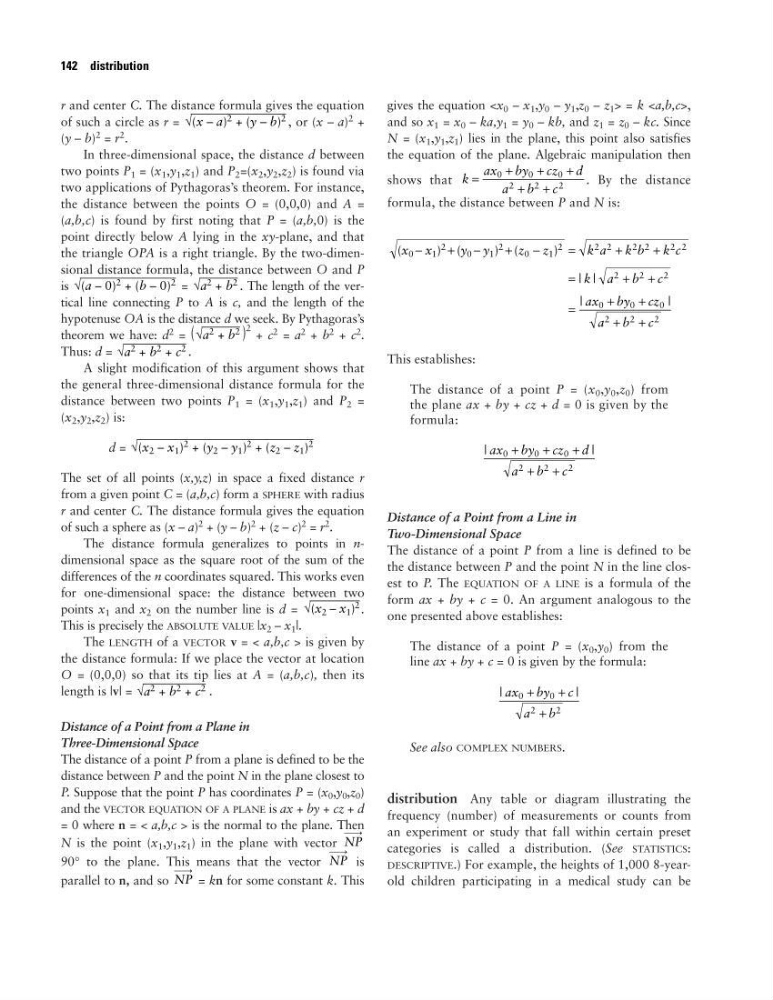
r and center C. The distance formula gives the equation
of such a circle as r =
, or (x – a)
2 +
(y – b)
2 = r
2
.
In three-dimensional space, the distance d between
two points P 1 = (x 1 ,y 1 ,z 1 ) and P 2 =(x 2 ,y 2 ,z 2 ) is found via
two applications of Pythagoras’s theorem. For instance,
the distance between the points O = (0,0,0) and A =
(a,b,c) is found by first noting that P = (a,b,0) is the
point directly below A lying in the xy-plane, and that
the triangle OPA is a right triangle. By the two-dimensional distance formula, the distance between O and P
is
=
. The length of the vertical line connecting P to A is c, and the length of the
hypotenuse OA is the distance d we seek. By Pythagoras’s
theorem we have: d
2 = (
)
2 + c
2 = a
2 + b
2 + c
2
.
Thus: d =
.
A slight modification of this argument shows that
the general three-dimensional distance formula for the
distance between two points P 1 = (x 1 ,y 1 ,z 1 ) and P 2 =
(x 2 ,y 2 ,z 2 ) is:
d =
The set of all points (x,y,z) in space a fixed distance r
from a given point C = (a,b,c) form a SPHERE with radius
r and center C. The distance formula gives the equation
of such a sphere as (x – a)
2 + (y – b)
2 + (z – c)
2 = r
2
.
The distance formula generalizes to points in ndimensional space as the square root of the sum of the
differences of the n coordinates squared. This works even
for one-dimensional space: the distance between two
points x 1 and x 2 on the number line is d =
.
This is precisely the ABSOLUTE VALUE |x 2 – x 1 |.
The LENGTH of a VECTOR v = < a,b,c > is given by
the distance formula: If we place the vector at location
O = (0,0,0) so that its tip lies at A = (a,b,c), then its
length is |v| =
.
Distance of a Point from a Plane in
Three-Dimensional Space
The distance of a point P from a plane is defined to be the
distance between P and the point N in the plane closest to
P. Suppose that the point P has coordinates P = (x 0 ,y 0 ,z 0 )
and the VECTOR EQUATION OF A PLANE is ax + by + cz + d
= 0 where n = < a,b,c > is the normal to the plane. Then
N is the point (x 1 ,y 1 ,z 1 ) in the plane with vector
90° to the plane. This means that the vector
is
parallel to n, and so
= kn for some constant k. This
gives the equation = k ,
and so x 1 = x 0 – ka,y 1 = y 0 – kb, and z 1 = z 0 – kc. Since
N = (x 1 ,y 1 ,z 1 ) lies in the plane, this point also satisfies
the equation of the plane. Algebraic manipulation then
shows that
. By the distance
formula, the distance between P and N is:
This establishes:
The distance of a point P = (x 0 ,y 0 ,z 0 ) from
the plane ax + by + cz + d = 0 is given by the
formula:
Distance of a Point from a Line in
Two-Dimensional Space
The distance of a point P from a line is defined to be
the distance between P and the point N in the line closest to P. The EQUATION OF A LINE is a formula of the
form ax + by + c = 0. An argument analogous to the
one presented above establishes:
The distance of a point P = (x 0 ,y 0 ) from the
line ax + by + c = 0 is given by the formula:
See also COMPLEX NUMBERS.
distribution Any table or diagram illustrating the
frequency (number) of measurements or counts from
an experiment or study that fall within certain preset
categories is called a distribution. (See STATISTICS:
DESCRIPTIVE.) For example, the heights of 1,000 8-yearold children participating in a medical study can be
|
|
ax by c
a b
0
0
2
2
+
+
+
|
|
ax by cz d
a b c
0
0
0
2
2
2
+
+
+
+ +
(
) (
) (
)
| |
|
|
x x
y y
z z
k a k b k c
k a b c
ax by cz
a b c
0
1
2
0
1
2
0
1
2
2 2
2 2
2 2
2
2
2
0
0
0
2
2
2
−
+
−
+
−
=
+
+
=
+ +
=
+
+
+ +
k
ax by cz d
a b c
=
+
+
+
+ +
0
0
0
2
2
2
NP
NP
NP
√a
2 + b
2 + c
2
√(x 2 – x 1 )
2
√(x 2 – x 1 )
2 + (y 2 – y 1 )
2 + (z 2 – z 1 )
2
√a
2 + b
2 + c
2
√a
2 + b
2
√a
2 + b
2
√(a – 0)
2 + (b – 0)
2
√(x – a)
2 + (y – b)
2
142 distribution
of such a circle as r =
, or (x – a)
2 +
(y – b)
2 = r
2
.
In three-dimensional space, the distance d between
two points P 1 = (x 1 ,y 1 ,z 1 ) and P 2 =(x 2 ,y 2 ,z 2 ) is found via
two applications of Pythagoras’s theorem. For instance,
the distance between the points O = (0,0,0) and A =
(a,b,c) is found by first noting that P = (a,b,0) is the
point directly below A lying in the xy-plane, and that
the triangle OPA is a right triangle. By the two-dimensional distance formula, the distance between O and P
is
=
. The length of the vertical line connecting P to A is c, and the length of the
hypotenuse OA is the distance d we seek. By Pythagoras’s
theorem we have: d
2 = (
)
2 + c
2 = a
2 + b
2 + c
2
.
Thus: d =
.
A slight modification of this argument shows that
the general three-dimensional distance formula for the
distance between two points P 1 = (x 1 ,y 1 ,z 1 ) and P 2 =
(x 2 ,y 2 ,z 2 ) is:
d =
The set of all points (x,y,z) in space a fixed distance r
from a given point C = (a,b,c) form a SPHERE with radius
r and center C. The distance formula gives the equation
of such a sphere as (x – a)
2 + (y – b)
2 + (z – c)
2 = r
2
.
The distance formula generalizes to points in ndimensional space as the square root of the sum of the
differences of the n coordinates squared. This works even
for one-dimensional space: the distance between two
points x 1 and x 2 on the number line is d =
.
This is precisely the ABSOLUTE VALUE |x 2 – x 1 |.
The LENGTH of a VECTOR v = < a,b,c > is given by
the distance formula: If we place the vector at location
O = (0,0,0) so that its tip lies at A = (a,b,c), then its
length is |v| =
.
Distance of a Point from a Plane in
Three-Dimensional Space
The distance of a point P from a plane is defined to be the
distance between P and the point N in the plane closest to
P. Suppose that the point P has coordinates P = (x 0 ,y 0 ,z 0 )
and the VECTOR EQUATION OF A PLANE is ax + by + cz + d
= 0 where n = < a,b,c > is the normal to the plane. Then
N is the point (x 1 ,y 1 ,z 1 ) in the plane with vector
90° to the plane. This means that the vector
is
parallel to n, and so
= kn for some constant k. This
gives the equation
and so x 1 = x 0 – ka,y 1 = y 0 – kb, and z 1 = z 0 – kc. Since
N = (x 1 ,y 1 ,z 1 ) lies in the plane, this point also satisfies
the equation of the plane. Algebraic manipulation then
shows that
. By the distance
formula, the distance between P and N is:
This establishes:
The distance of a point P = (x 0 ,y 0 ,z 0 ) from
the plane ax + by + cz + d = 0 is given by the
formula:
Distance of a Point from a Line in
Two-Dimensional Space
The distance of a point P from a line is defined to be
the distance between P and the point N in the line closest to P. The EQUATION OF A LINE is a formula of the
form ax + by + c = 0. An argument analogous to the
one presented above establishes:
The distance of a point P = (x 0 ,y 0 ) from the
line ax + by + c = 0 is given by the formula:
See also COMPLEX NUMBERS.
distribution Any table or diagram illustrating the
frequency (number) of measurements or counts from
an experiment or study that fall within certain preset
categories is called a distribution. (See STATISTICS:
DESCRIPTIVE.) For example, the heights of 1,000 8-yearold children participating in a medical study can be
|
|
ax by c
a b
0
0
2
2
+
+
+
|
|
ax by cz d
a b c
0
0
0
2
2
2
+
+
+
+ +
(
) (
) (
)
| |
|
|
x x
y y
z z
k a k b k c
k a b c
ax by cz
a b c
0
1
2
0
1
2
0
1
2
2 2
2 2
2 2
2
2
2
0
0
0
2
2
2
−
+
−
+
−
=
+
+
=
+ +
=
+
+
+ +
k
ax by cz d
a b c
=
+
+
+
+ +
0
0
0
2
2
2
NP
NP
NP
√a
2 + b
2 + c
2
√(x 2 – x 1 )
2
√(x 2 – x 1 )
2 + (y 2 – y 1 )
2 + (z 2 – z 1 )
2
√a
2 + b
2 + c
2
√a
2 + b
2
√a
2 + b
2
√(a – 0)
2 + (b – 0)
2
√(x – a)
2 + (y – b)
2
142 distribution