

x
2 + x + 1 = 0, with discriminant –3, has solutions
and
.
More generally, the discriminant of any POLYNOMIAL equation is defined to be the product of the differences squared of all the possible pairs of roots of the
equation. For example, if a CUBIC EQUATION has three
roots r 1 , r 2 , and r 3 (possibly repeated), then the discriminant of cubic is the product:
(r 1 – r 2 )
2 (r 2 – r 3 )
2 (r 3 – r 1 )
2
It is possible to find a formula for the discriminant in
terms of the coefficients appearing in the equation. For
the case of a quadratic, it turns out to be precisely the
quantity b
2 – 4ac described above.
disjunction (“or” statement) A compound statement
of the form “p or q” is known as a disjunction. For
example, “I visited Sydney or Melbourne” is an example of a disjunction.
Disjunctions can be interpreted in one of two ways.
If a disjunction “p or q” is read as
p or q, but not both
(“I visited just one of the two cities”), then it is said to
be “exclusive,” and the disjunction is called an “exclusive or” (sometimes denoted XOR). Interpreted as
p or q, or possibly both
(“I visited at least one of the cities”), then the disjunction is said to be “inclusive” and is called an “inclusive
or.” In FORMAL LOGIC (and in most of mathematics),
disjunctions are always used in the inclusive sense. It is
denoted in symbols by p ∨ q and has the following
TRUTH TABLE:
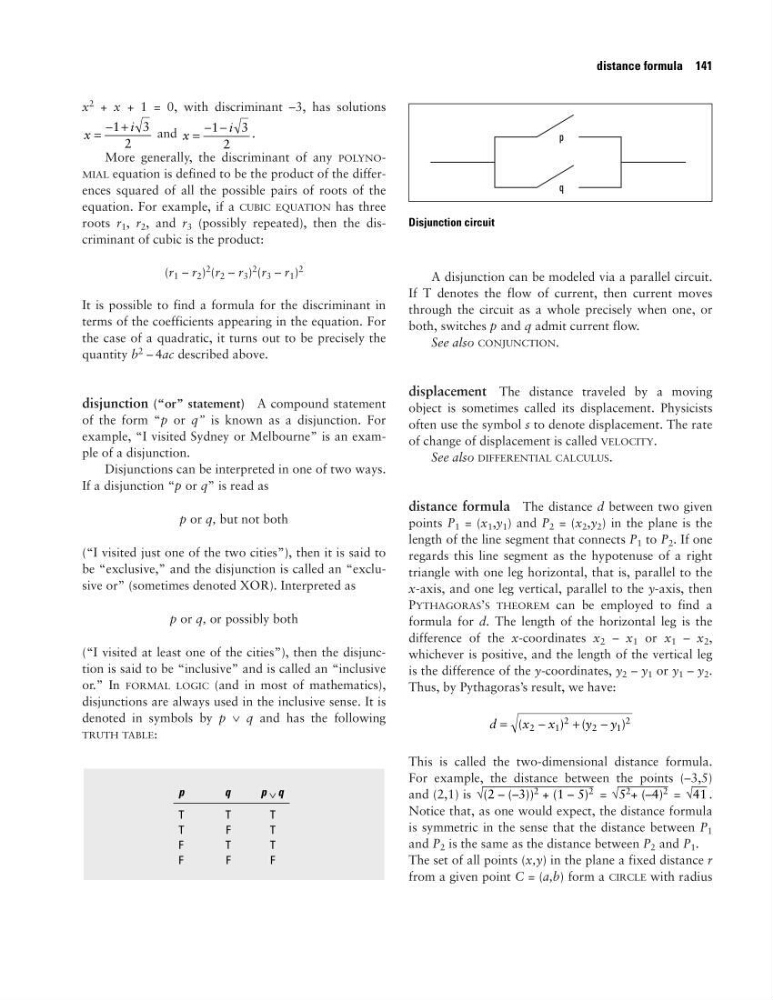
A disjunction can be modeled via a parallel circuit.
If T denotes the flow of current, then current moves
through the circuit as a whole precisely when one, or
both, switches p and q admit current flow.
See also CONJUNCTION.
displacement The distance traveled by a moving
object is sometimes called its displacement. Physicists
often use the symbol s to denote displacement. The rate
of change of displacement is called VELOCITY.
See also DIFFERENTIAL CALCULUS.
distance formula The distance d between two given
points P 1 = (x 1 ,y 1 ) and P 2 = (x 2 ,y 2 ) in the plane is the
length of the line segment that connects P 1 to P 2 . If one
regards this line segment as the hypotenuse of a right
triangle with one leg horizontal, that is, parallel to the
x-axis, and one leg vertical, parallel to the y-axis, then
PYTHAGORAS’S THEOREM can be employed to find a
formula for d. The length of the horizontal leg is the
difference of the x-coordinates x 2 – x 1 or x 1 – x 2 ,
whichever is positive, and the length of the vertical leg
is the difference of the y-coordinates, y 2 – y 1 or y 1 – y 2 .
Thus, by Pythagoras’s result, we have:
This is called the two-dimensional distance formula.
For example, the distance between the points (–3,5)
and (2,1) is
=
=
.
Notice that, as one would expect, the distance formula
is symmetric in the sense that the distance between P 1
and P 2 is the same as the distance between P 2 and P 1 .
The set of all points (x,y) in the plane a fixed distance r
from a given point C = (a,b) form a CIRCLE with radius
√41
√5
2
+ (–4)
2
√(2 – (–3))
2 + (1 – 5)
2
d
x x
y y
=
−
+
−
(
) (
)
2
1
2
2
1
2
p
q
p ∨ q
T
T
T
T
F
T
F
T
T
F
F
F
x
i
=
− −
1
3
2
x
i
=
− +
1
3
2
distance formula 141
Disjunction circuit
2 + x + 1 = 0, with discriminant –3, has solutions
and
.
More generally, the discriminant of any POLYNOMIAL equation is defined to be the product of the differences squared of all the possible pairs of roots of the
equation. For example, if a CUBIC EQUATION has three
roots r 1 , r 2 , and r 3 (possibly repeated), then the discriminant of cubic is the product:
(r 1 – r 2 )
2 (r 2 – r 3 )
2 (r 3 – r 1 )
2
It is possible to find a formula for the discriminant in
terms of the coefficients appearing in the equation. For
the case of a quadratic, it turns out to be precisely the
quantity b
2 – 4ac described above.
disjunction (“or” statement) A compound statement
of the form “p or q” is known as a disjunction. For
example, “I visited Sydney or Melbourne” is an example of a disjunction.
Disjunctions can be interpreted in one of two ways.
If a disjunction “p or q” is read as
p or q, but not both
(“I visited just one of the two cities”), then it is said to
be “exclusive,” and the disjunction is called an “exclusive or” (sometimes denoted XOR). Interpreted as
p or q, or possibly both
(“I visited at least one of the cities”), then the disjunction is said to be “inclusive” and is called an “inclusive
or.” In FORMAL LOGIC (and in most of mathematics),
disjunctions are always used in the inclusive sense. It is
denoted in symbols by p ∨ q and has the following
TRUTH TABLE:
A disjunction can be modeled via a parallel circuit.
If T denotes the flow of current, then current moves
through the circuit as a whole precisely when one, or
both, switches p and q admit current flow.
See also CONJUNCTION.
displacement The distance traveled by a moving
object is sometimes called its displacement. Physicists
often use the symbol s to denote displacement. The rate
of change of displacement is called VELOCITY.
See also DIFFERENTIAL CALCULUS.
distance formula The distance d between two given
points P 1 = (x 1 ,y 1 ) and P 2 = (x 2 ,y 2 ) in the plane is the
length of the line segment that connects P 1 to P 2 . If one
regards this line segment as the hypotenuse of a right
triangle with one leg horizontal, that is, parallel to the
x-axis, and one leg vertical, parallel to the y-axis, then
PYTHAGORAS’S THEOREM can be employed to find a
formula for d. The length of the horizontal leg is the
difference of the x-coordinates x 2 – x 1 or x 1 – x 2 ,
whichever is positive, and the length of the vertical leg
is the difference of the y-coordinates, y 2 – y 1 or y 1 – y 2 .
Thus, by Pythagoras’s result, we have:
This is called the two-dimensional distance formula.
For example, the distance between the points (–3,5)
and (2,1) is
=
=
.
Notice that, as one would expect, the distance formula
is symmetric in the sense that the distance between P 1
and P 2 is the same as the distance between P 2 and P 1 .
The set of all points (x,y) in the plane a fixed distance r
from a given point C = (a,b) form a CIRCLE with radius
√41
√5
2
+ (–4)
2
√(2 – (–3))
2 + (1 – 5)
2
d
x x
y y
=
−
+
−
(
) (
)
2
1
2
2
1
2
p
q
p ∨ q
T
T
T
T
F
T
F
T
T
F
F
F
x
i
=
− −
1
3
2
x
i
=
− +
1
3
2
distance formula 141
Disjunction circuit