

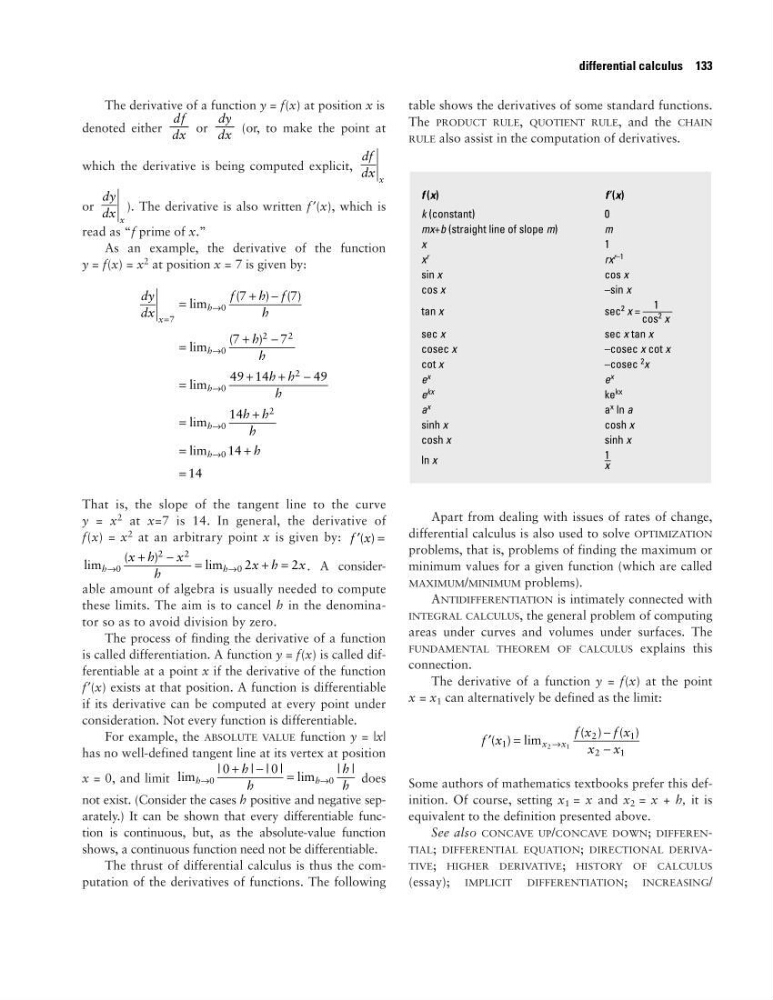
The derivative of a function y = f(x) at position x is
denoted either
or
(or, to make the point at
which the derivative is being computed explicit,
or
). The derivative is also written f ′(x), which is
read as “f prime of x.”
As an example, the derivative of the function
y = f(x) = x
2 at position x = 7 is given by:
That is, the slope of the tangent line to the curve
y = x
2 at x=7 is 14. In general, the derivative of
f(x) = x
2 at an arbitrary point x is given by:
. A considerable amount of algebra is usually needed to compute
these limits. The aim is to cancel h in the denominator so as to avoid division by zero.
The process of finding the derivative of a function
is called differentiation. A function y = f(x) is called differentiable at a point x if the derivative of the function
f′(x) exists at that position. A function is differentiable
if its derivative can be computed at every point under
consideration. Not every function is differentiable.
For example, the ABSOLUTE VALUE function y = |x|
has no well-defined tangent line at its vertex at position
x = 0, and limit
does
not exist. (Consider the cases h positive and negative separately.) It can be shown that every differentiable function is continuous, but, as the absolute-value function
shows, a continuous function need not be differentiable.
The thrust of differential calculus is thus the computation of the derivatives of functions. The following
table shows the derivatives of some standard functions.
The PRODUCT RULE, QUOTIENT RULE, and the CHAIN
RULE also assist in the computation of derivatives.
Apart from dealing with issues of rates of change,
differential calculus is also used to solve OPTIMIZATION
problems, that is, problems of finding the maximum or
minimum values for a given function (which are called
MAXIMUM/MINIMUM problems).
ANTIDIFFERENTIATION is intimately connected with
INTEGRAL CALCULUS, the general problem of computing
areas under curves and volumes under surfaces. The
FUNDAMENTAL THEOREM OF CALCULUS explains this
connection.
The derivative of a function y = f(x) at the point
x = x 1 can alternatively be defined as the limit:
Some authors of mathematics textbooks prefer this definition. Of course, setting x 1 = x and x 2 = x + h, it is
equivalent to the definition presented above.
See also CONCAVE UP/CONCAVE DOWN; DIFFERENTIAL; DIFFERENTIAL EQUATION; DIRECTIONAL DERIVATIVE; HIGHER DERIVATIVE; HISTORY OF CALCULUS
(essay); IMPLICIT DIFFERENTIATION; INCREASING/
′
=
−
−
→
f x
f x
f x
x x
x
x
( ) lim
( ) ( )
1
2
1
2
1
2
1
f (x)
f′(x)
k (constant)
0
mx+b (straight line of slope m)
m
x
1
x r
rx
r–1
sin x
cos x
cos x
–sin x
1
tan x
sec 2 x = ——–
cos
2 x
sec x
sec x tan x
cosec x
–cosec x cot x
cot x
–cosec 2 x
e x
e
x
e
kx
ke
kx
a
x
a
x ln a
sinh x
cosh x
cosh x
sinh x
1
ln x
– x
lim
|
| | | lim
| |
h
h
h
h
h
h
→
→
+ −
=
0
0
0
0
+
−
=
+ =
→
→
x h
x
h
x h
x
h
h
lim
(
)
lim
0
2
2
0 2
2
′ =
f x
( )
dy
dx
f
h f
h
h
h
h h
h
h h
h
h
x
h
h
h
h
h
=
→
→
→
→
→
=
+ −
=
+
−
=
+
+ −
=
+
=
+
=
7
0
0
2
2
0
2
0
2
0
7
7
7
7
49 14
49
14
14
14
lim
(
) ( )
lim
(
)
lim
lim
lim
dy
dx x
df
dx x
dy
––
dx
df
––
dx
differential calculus 133
denoted either
or
(or, to make the point at
which the derivative is being computed explicit,
or
). The derivative is also written f ′(x), which is
read as “f prime of x.”
As an example, the derivative of the function
y = f(x) = x
2 at position x = 7 is given by:
That is, the slope of the tangent line to the curve
y = x
2 at x=7 is 14. In general, the derivative of
f(x) = x
2 at an arbitrary point x is given by:
. A considerable amount of algebra is usually needed to compute
these limits. The aim is to cancel h in the denominator so as to avoid division by zero.
The process of finding the derivative of a function
is called differentiation. A function y = f(x) is called differentiable at a point x if the derivative of the function
f′(x) exists at that position. A function is differentiable
if its derivative can be computed at every point under
consideration. Not every function is differentiable.
For example, the ABSOLUTE VALUE function y = |x|
has no well-defined tangent line at its vertex at position
x = 0, and limit
does
not exist. (Consider the cases h positive and negative separately.) It can be shown that every differentiable function is continuous, but, as the absolute-value function
shows, a continuous function need not be differentiable.
The thrust of differential calculus is thus the computation of the derivatives of functions. The following
table shows the derivatives of some standard functions.
The PRODUCT RULE, QUOTIENT RULE, and the CHAIN
RULE also assist in the computation of derivatives.
Apart from dealing with issues of rates of change,
differential calculus is also used to solve OPTIMIZATION
problems, that is, problems of finding the maximum or
minimum values for a given function (which are called
MAXIMUM/MINIMUM problems).
ANTIDIFFERENTIATION is intimately connected with
INTEGRAL CALCULUS, the general problem of computing
areas under curves and volumes under surfaces. The
FUNDAMENTAL THEOREM OF CALCULUS explains this
connection.
The derivative of a function y = f(x) at the point
x = x 1 can alternatively be defined as the limit:
Some authors of mathematics textbooks prefer this definition. Of course, setting x 1 = x and x 2 = x + h, it is
equivalent to the definition presented above.
See also CONCAVE UP/CONCAVE DOWN; DIFFERENTIAL; DIFFERENTIAL EQUATION; DIRECTIONAL DERIVATIVE; HIGHER DERIVATIVE; HISTORY OF CALCULUS
(essay); IMPLICIT DIFFERENTIATION; INCREASING/
′
=
−
−
→
f x
f x
f x
x x
x
x
( ) lim
( ) ( )
1
2
1
2
1
2
1
f (x)
f′(x)
k (constant)
0
mx+b (straight line of slope m)
m
x
1
x r
rx
r–1
sin x
cos x
cos x
–sin x
1
tan x
sec 2 x = ——–
cos
2 x
sec x
sec x tan x
cosec x
–cosec x cot x
cot x
–cosec 2 x
e x
e
x
e
kx
ke
kx
a
x
a
x ln a
sinh x
cosh x
cosh x
sinh x
1
ln x
– x
lim
|
| | | lim
| |
h
h
h
h
h
h
→
→
+ −
=
0
0
0
0
+
−
=
+ =
→
→
x h
x
h
x h
x
h
h
lim
(
)
lim
0
2
2
0 2
2
′ =
f x
( )
dy
dx
f
h f
h
h
h
h h
h
h h
h
h
x
h
h
h
h
h
=
→
→
→
→
→
=
+ −
=
+
−
=
+
+ −
=
+
=
+
=
7
0
0
2
2
0
2
0
2
0
7
7
7
7
49 14
49
14
14
14
lim
(
) ( )
lim
(
)
lim
lim
lim
dy
dx x
df
dx x
dy
––
dx
df
––
dx
differential calculus 133