

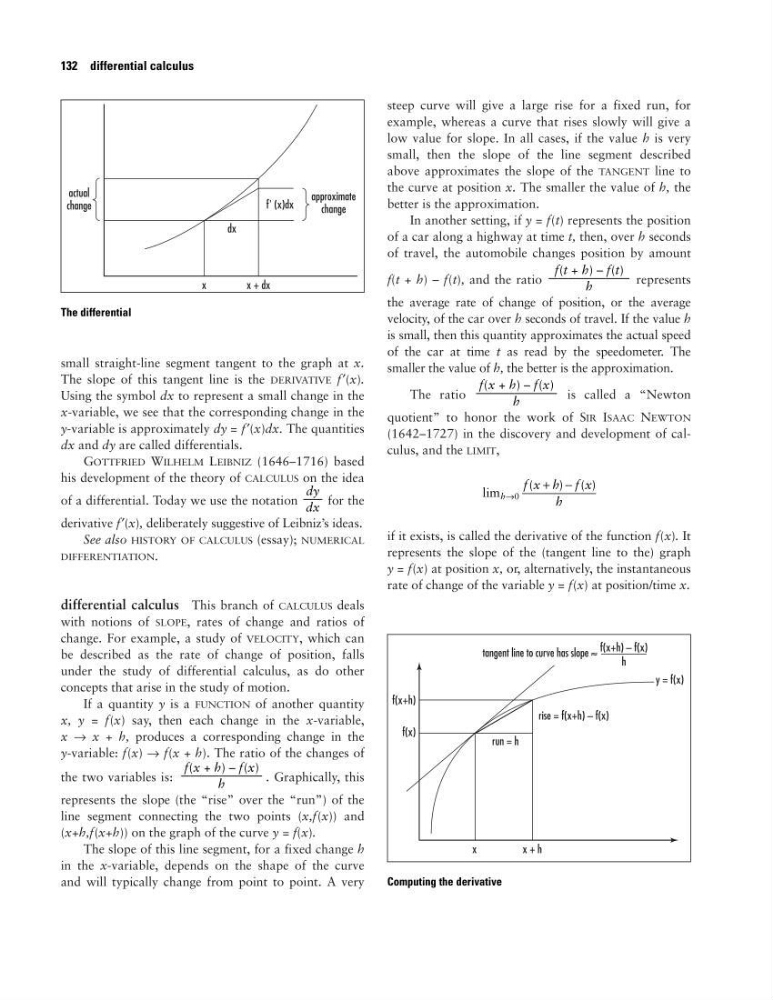
small straight-line segment tangent to the graph at x.
The slope of this tangent line is the DERIVATIVE f′(x).
Using the symbol dx to represent a small change in the
x-variable, we see that the corresponding change in the
y-variable is approximately dy = f′(x)dx. The quantities
dx and dy are called differentials.
GOTTFRIED WILHELM LEIBNIZ (1646–1716) based
his development of the theory of CALCULUS on the idea
of a differential. Today we use the notation
for the
derivative f′(x), deliberately suggestive of Leibniz’s ideas.
See also HISTORY OF CALCULUS (essay); NUMERICAL
DIFFERENTIATION.
differential calculus This branch of CALCULUS deals
with notions of SLOPE, rates of change and ratios of
change. For example, a study of VELOCITY, which can
be described as the rate of change of position, falls
under the study of differential calculus, as do other
concepts that arise in the study of motion.
If a quantity y is a FUNCTION of another quantity
x, y = f(x) say, then each change in the x-variable,
x → x + h, produces a corresponding change in the
y-variable: f(x) → f(x + h). The ratio of the changes of
the two variables is:
. Graphically, this
represents the slope (the “rise” over the “run”) of the
line segment connecting the two points (x,f(x)) and
(x+h,f(x+h)) on the graph of the curve y = f(x).
The slope of this line segment, for a fixed change h
in the x-variable, depends on the shape of the curve
and will typically change from point to point. A very
steep curve will give a large rise for a fixed run, for
example, whereas a curve that rises slowly will give a
low value for slope. In all cases, if the value h is very
small, then the slope of the line segment described
above approximates the slope of the TANGENT line to
the curve at position x. The smaller the value of h, the
better is the approximation.
In another setting, if y = f(t) represents the position
of a car along a highway at time t, then, over h seconds
of travel, the automobile changes position by amount
f(t + h) – f(t), and the ratio
represents
the average rate of change of position, or the average
velocity, of the car over h seconds of travel. If the value h
is small, then this quantity approximates the actual speed
of the car at time t as read by the speedometer. The
smaller the value of h, the better is the approximation.
The ratio
is called a “Newton
quotient” to honor the work of SIR ISAAC NEWTON
(1642–1727) in the discovery and development of calculus, and the LIMIT,
if it exists, is called the derivative of the function f(x). It
represents the slope of the (tangent line to the) graph
y = f(x) at position x, or, alternatively, the instantaneous
rate of change of the variable y = f(x) at position/time x.
lim
(
) ( )
h
f x h f x
h
→
+ −
0
f(x + h) – f(x)
––———
h
f(t + h) – f(t)
––———
h
f(x + h) – f(x)
––———
h
dy
––
dx
132 differential calculus
The differential
Computing the derivative
The slope of this tangent line is the DERIVATIVE f′(x).
Using the symbol dx to represent a small change in the
x-variable, we see that the corresponding change in the
y-variable is approximately dy = f′(x)dx. The quantities
dx and dy are called differentials.
GOTTFRIED WILHELM LEIBNIZ (1646–1716) based
his development of the theory of CALCULUS on the idea
of a differential. Today we use the notation
for the
derivative f′(x), deliberately suggestive of Leibniz’s ideas.
See also HISTORY OF CALCULUS (essay); NUMERICAL
DIFFERENTIATION.
differential calculus This branch of CALCULUS deals
with notions of SLOPE, rates of change and ratios of
change. For example, a study of VELOCITY, which can
be described as the rate of change of position, falls
under the study of differential calculus, as do other
concepts that arise in the study of motion.
If a quantity y is a FUNCTION of another quantity
x, y = f(x) say, then each change in the x-variable,
x → x + h, produces a corresponding change in the
y-variable: f(x) → f(x + h). The ratio of the changes of
the two variables is:
. Graphically, this
represents the slope (the “rise” over the “run”) of the
line segment connecting the two points (x,f(x)) and
(x+h,f(x+h)) on the graph of the curve y = f(x).
The slope of this line segment, for a fixed change h
in the x-variable, depends on the shape of the curve
and will typically change from point to point. A very
steep curve will give a large rise for a fixed run, for
example, whereas a curve that rises slowly will give a
low value for slope. In all cases, if the value h is very
small, then the slope of the line segment described
above approximates the slope of the TANGENT line to
the curve at position x. The smaller the value of h, the
better is the approximation.
In another setting, if y = f(t) represents the position
of a car along a highway at time t, then, over h seconds
of travel, the automobile changes position by amount
f(t + h) – f(t), and the ratio
represents
the average rate of change of position, or the average
velocity, of the car over h seconds of travel. If the value h
is small, then this quantity approximates the actual speed
of the car at time t as read by the speedometer. The
smaller the value of h, the better is the approximation.
The ratio
is called a “Newton
quotient” to honor the work of SIR ISAAC NEWTON
(1642–1727) in the discovery and development of calculus, and the LIMIT,
if it exists, is called the derivative of the function f(x). It
represents the slope of the (tangent line to the) graph
y = f(x) at position x, or, alternatively, the instantaneous
rate of change of the variable y = f(x) at position/time x.
lim
(
) ( )
h
f x h f x
h
→
+ −
0
f(x + h) – f(x)
––———
h
f(t + h) – f(t)
––———
h
f(x + h) – f(x)
––———
h
dy
––
dx
132 differential calculus
The differential
Computing the derivative