

corresponding series with all terms positive does not.
It is possible to multiply convergent series by constants, and to add and subtract two convergent series.
Precisely, if
and
both converge, and k is a
number, then:
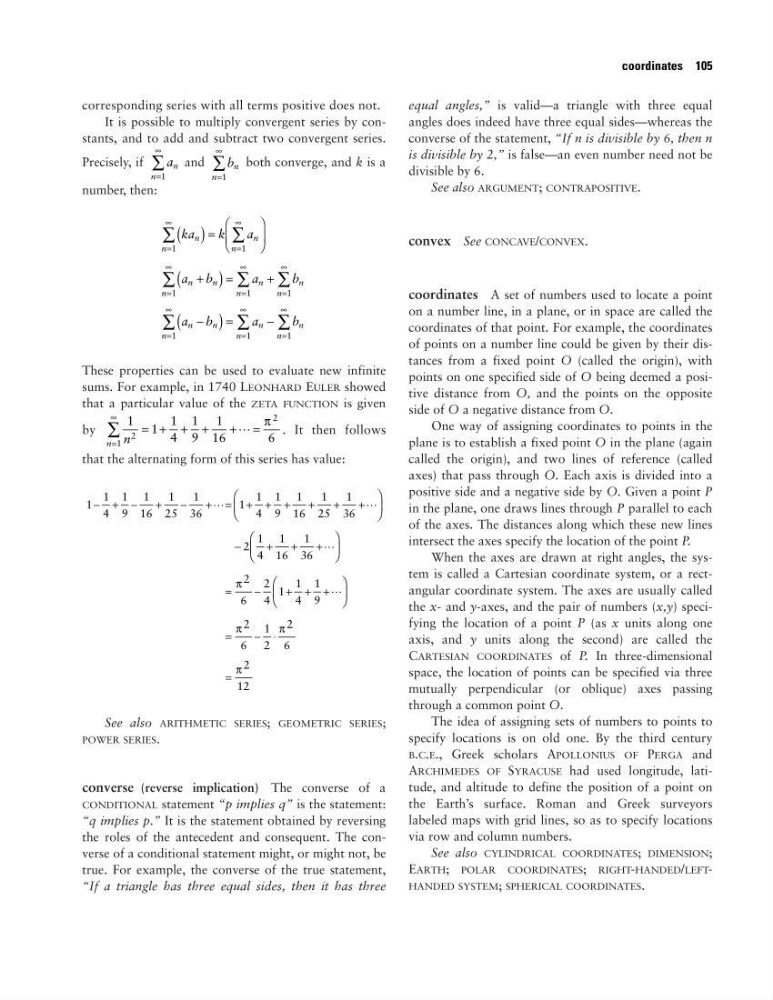
These properties can be used to evaluate new infinite
sums. For example, in 1740 LEONHARD EULER showed
that a particular value of the ZETA FUNCTION is given
by
. It then follows
that the alternating form of this series has value:
See also ARITHMETIC SERIES; GEOMETRIC SERIES;
POWER SERIES.
converse (reverse implication) The converse of a
CONDITIONAL statement “p implies q” is the statement:
“q implies p.” It is the statement obtained by reversing
the roles of the antecedent and consequent. The converse of a conditional statement might, or might not, be
true. For example, the converse of the true statement,
“If a triangle has three equal sides, then it has three
equal angles,” is valid—a triangle with three equal
angles does indeed have three equal sides—whereas the
converse of the statement, “If n is divisible by 6, then n
is divisible by 2,” is false—an even number need not be
divisible by 6.
See also ARGUMENT; CONTRAPOSITIVE.
convex See CONCAVE/CONVEX.
coordinates A set of numbers used to locate a point
on a number line, in a plane, or in space are called the
coordinates of that point. For example, the coordinates
of points on a number line could be given by their distances from a fixed point O (called the origin), with
points on one specified side of O being deemed a positive distance from O, and the points on the opposite
side of O a negative distance from O.
One way of assigning coordinates to points in the
plane is to establish a fixed point O in the plane (again
called the origin), and two lines of reference (called
axes) that pass through O. Each axis is divided into a
positive side and a negative side by O. Given a point P
in the plane, one draws lines through P parallel to each
of the axes. The distances along which these new lines
intersect the axes specify the location of the point P.
When the axes are drawn at right angles, the system is called a Cartesian coordinate system, or a rectangular coordinate system. The axes are usually called
the x- and y-axes, and the pair of numbers (x,y) specifying the location of a point P (as x units along one
axis, and y units along the second) are called the
CARTESIAN COORDINATES of P. In three-dimensional
space, the location of points can be specified via three
mutually perpendicular (or oblique) axes passing
through a common point O.
The idea of assigning sets of numbers to points to
specify locations is on old one. By the third century
B.C.E., Greek scholars APOLLONIUS OF PERGA and
ARCHIMEDES OF SYRACUSE had used longitude, latitude, and altitude to define the position of a point on
the Earth’s surface. Roman and Greek surveyors
labeled maps with grid lines, so as to specify locations
via row and column numbers.
See also CYLINDRICAL COORDINATES; DIMENSION;
EARTH; POLAR COORDINATES; RIGHT-HANDED/LEFTHANDED SYSTEM; SPHERICAL COORDINATES.
1
1
4
1
9
1
16
1
25
1
36
1
1
4
1
9
1
16
1
25
1
36
2
1
4
1
16
1
36
2
6
2
4
1
1
4
1
9
2
6
1
2
2
6
2
12
− + −
+
−
+ = + + +
+
+
+
−
+
+
+
=
−
+ + +
=
− ⋅
=
L
L
L
L
π
π
π
π
1 1
1
4
1
9
1
16
6
2
2
1 n
n
= + + +
+ =
=
∞
∑
L
π
ka
k
a
a b
a
b
a b
a
b
n
n
n
n
n
n
n
n
n
n
n
n
n
n
n
n
n
n
( ) =
+
(
) =
+
−
(
) =
−
=
∞
=
∞
=
∞
=
∞
=
∞
=
∞
=
∞
=
∞
∑
∑
∑
∑
∑
∑
∑
∑
1
1
1
1
1
1
1
1
b n
n=
∞
∑
1
a n
n=
∞
∑
1
coordinates 105
It is possible to multiply convergent series by constants, and to add and subtract two convergent series.
Precisely, if
and
both converge, and k is a
number, then:
These properties can be used to evaluate new infinite
sums. For example, in 1740 LEONHARD EULER showed
that a particular value of the ZETA FUNCTION is given
by
. It then follows
that the alternating form of this series has value:
See also ARITHMETIC SERIES; GEOMETRIC SERIES;
POWER SERIES.
converse (reverse implication) The converse of a
CONDITIONAL statement “p implies q” is the statement:
“q implies p.” It is the statement obtained by reversing
the roles of the antecedent and consequent. The converse of a conditional statement might, or might not, be
true. For example, the converse of the true statement,
“If a triangle has three equal sides, then it has three
equal angles,” is valid—a triangle with three equal
angles does indeed have three equal sides—whereas the
converse of the statement, “If n is divisible by 6, then n
is divisible by 2,” is false—an even number need not be
divisible by 6.
See also ARGUMENT; CONTRAPOSITIVE.
convex See CONCAVE/CONVEX.
coordinates A set of numbers used to locate a point
on a number line, in a plane, or in space are called the
coordinates of that point. For example, the coordinates
of points on a number line could be given by their distances from a fixed point O (called the origin), with
points on one specified side of O being deemed a positive distance from O, and the points on the opposite
side of O a negative distance from O.
One way of assigning coordinates to points in the
plane is to establish a fixed point O in the plane (again
called the origin), and two lines of reference (called
axes) that pass through O. Each axis is divided into a
positive side and a negative side by O. Given a point P
in the plane, one draws lines through P parallel to each
of the axes. The distances along which these new lines
intersect the axes specify the location of the point P.
When the axes are drawn at right angles, the system is called a Cartesian coordinate system, or a rectangular coordinate system. The axes are usually called
the x- and y-axes, and the pair of numbers (x,y) specifying the location of a point P (as x units along one
axis, and y units along the second) are called the
CARTESIAN COORDINATES of P. In three-dimensional
space, the location of points can be specified via three
mutually perpendicular (or oblique) axes passing
through a common point O.
The idea of assigning sets of numbers to points to
specify locations is on old one. By the third century
B.C.E., Greek scholars APOLLONIUS OF PERGA and
ARCHIMEDES OF SYRACUSE had used longitude, latitude, and altitude to define the position of a point on
the Earth’s surface. Roman and Greek surveyors
labeled maps with grid lines, so as to specify locations
via row and column numbers.
See also CYLINDRICAL COORDINATES; DIMENSION;
EARTH; POLAR COORDINATES; RIGHT-HANDED/LEFTHANDED SYSTEM; SPHERICAL COORDINATES.
1
1
4
1
9
1
16
1
25
1
36
1
1
4
1
9
1
16
1
25
1
36
2
1
4
1
16
1
36
2
6
2
4
1
1
4
1
9
2
6
1
2
2
6
2
12
− + −
+
−
+ = + + +
+
+
+
−
+
+
+
=
−
+ + +
=
− ⋅
=
L
L
L
L
π
π
π
π
1 1
1
4
1
9
1
16
6
2
2
1 n
n
= + + +
+ =
=
∞
∑
L
π
ka
k
a
a b
a
b
a b
a
b
n
n
n
n
n
n
n
n
n
n
n
n
n
n
n
n
n
n
( ) =
+
(
) =
+
−
(
) =
−
=
∞
=
∞
=
∞
=
∞
=
∞
=
∞
=
∞
=
∞
∑
∑
∑
∑
∑
∑
∑
∑
1
1
1
1
1
1
1
1
b n
n=
∞
∑
1
a n
n=
∞
∑
1
coordinates 105