

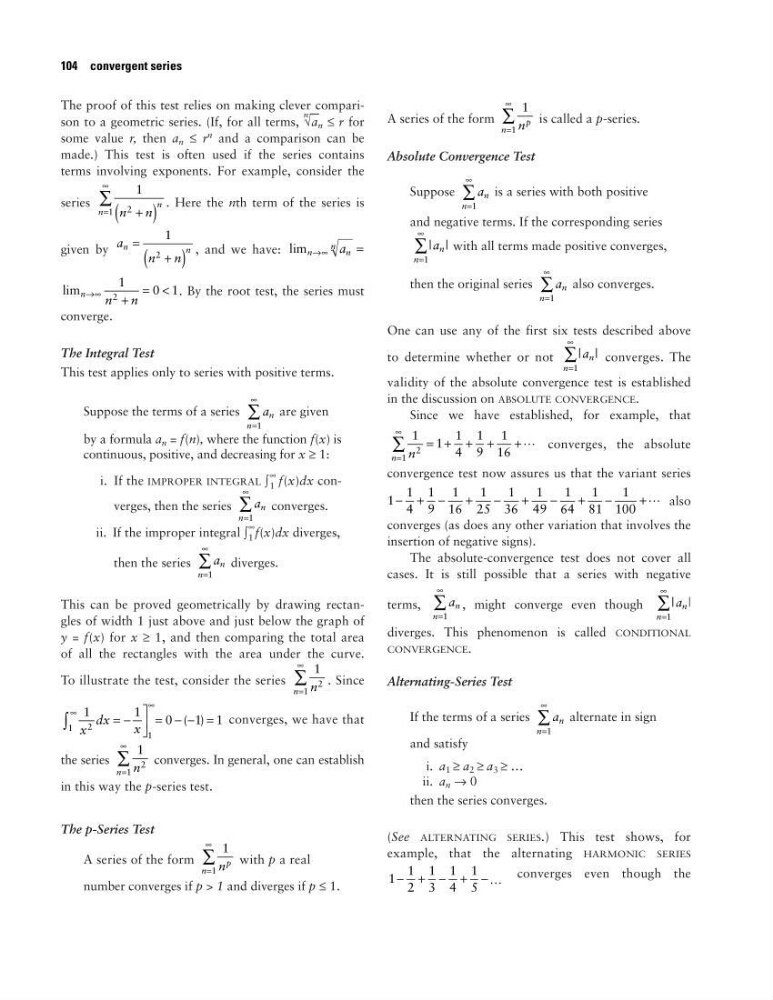
The proof of this test relies on making clever comparison to a geometric series. (If, for all terms,
n
√
–
a n ≤ r for
some value r, then a n ≤ r
n and a comparison can be
made.) This test is often used if the series contains
terms involving exponents. For example, consider the
series
. Here the nth term of the series is
given by
, and we have:
. By the root test, the series must
converge.
The Integral Test
This test applies only to series with positive terms.
Suppose the terms of a series
are given
by a formula a n = f(n), where the function f(x) is
continuous, positive, and decreasing for x ≥ 1:
i. If the IMPROPER INTEGRAL ∫
∞
1 f(x)dx converges, then the series
converges.
ii. If the improper integral ∫
∞
1 f(x)dx diverges,
then the series
diverges.
This can be proved geometrically by drawing rectangles of width 1 just above and just below the graph of
y = f(x) for x ≥ 1, and then comparing the total area
of all the rectangles with the area under the curve.
To illustrate the test, consider the series
. Since
converges, we have that
the series
converges. In general, one can establish
in this way the p-series test.
The p-Series Test
A series of the form
with p a real
number converges if p > 1 and diverges if p ≤ 1.
A series of the form
is called a p-series.
Absolute Convergence Test
Suppose
is a series with both positive
and negative terms. If the corresponding series
with all terms made positive converges,
then the original series
also converges.
One can use any of the first six tests described above
to determine whether or not
converges. The
validity of the absolute convergence test is established
in the discussion on ABSOLUTE CONVERGENCE.
Since we have established, for example, that
converges, the absolute
convergence test now assures us that the variant series
also
converges (as does any other variation that involves the
insertion of negative signs).
The absolute-convergence test does not cover all
cases. It is still possible that a series with negative
terms,
, might converge even though
diverges. This phenomenon is called CONDITIONAL
CONVERGENCE.
Alternating-Series Test
If the terms of a series
alternate in sign
and satisfy
i. a 1 ≥ a 2 ≥ a 3 ≥ …
ii. a n → 0
then the series converges.
(See ALTERNATING SERIES.) This test shows, for
example, that the alternating HARMONIC SERIES
converges even though the
1
1
2
1
3
1
4
1
5
− + − + − L
a n
n=
∞
∑
1
| |
a n
n=
∞
∑
1
a n
n=
∞
∑
1
1
1
4
1
9
1
16
1
25
1
36
1
49
1
64
1
81
1
100
− + −
+
−
+
−
+
−
+L
1 1
1
4
1
9
1
16
2
1 n
n=
∞
∑ = + + + +L
| |
a n
n=
∞
∑
1
a n
n=
∞
∑
1
| |
a n
n=
∞
∑
1
a n
n=
∞
∑
1
1
1 n
p
n=
∞
∑
1
1 n
p
n=
∞
∑
1
2
1 n
n=
∞
∑
1
1
0
1 1
2
1
1
x
dx
x
∞
∞
∫
= −
= − − =
( )
1
2
1 n
n=
∞
∑
a n
n=
∞
∑
1
a n
n=
∞
∑
1
a n
n=
∞
∑
1
lim n
n n
→∞
+
= <
1
0 1
2
lim n
n
n a
→∞
=
a
n n
n
n
=
+
( )
1
2
1
2
1 n n
n
n
+
( )
=
∞
∑
104 convergent series
n
√
–
a n ≤ r for
some value r, then a n ≤ r
n and a comparison can be
made.) This test is often used if the series contains
terms involving exponents. For example, consider the
series
. Here the nth term of the series is
given by
, and we have:
. By the root test, the series must
converge.
The Integral Test
This test applies only to series with positive terms.
Suppose the terms of a series
are given
by a formula a n = f(n), where the function f(x) is
continuous, positive, and decreasing for x ≥ 1:
i. If the IMPROPER INTEGRAL ∫
∞
1 f(x)dx converges, then the series
converges.
ii. If the improper integral ∫
∞
1 f(x)dx diverges,
then the series
diverges.
This can be proved geometrically by drawing rectangles of width 1 just above and just below the graph of
y = f(x) for x ≥ 1, and then comparing the total area
of all the rectangles with the area under the curve.
To illustrate the test, consider the series
. Since
converges, we have that
the series
converges. In general, one can establish
in this way the p-series test.
The p-Series Test
A series of the form
with p a real
number converges if p > 1 and diverges if p ≤ 1.
A series of the form
is called a p-series.
Absolute Convergence Test
Suppose
is a series with both positive
and negative terms. If the corresponding series
with all terms made positive converges,
then the original series
also converges.
One can use any of the first six tests described above
to determine whether or not
converges. The
validity of the absolute convergence test is established
in the discussion on ABSOLUTE CONVERGENCE.
Since we have established, for example, that
converges, the absolute
convergence test now assures us that the variant series
also
converges (as does any other variation that involves the
insertion of negative signs).
The absolute-convergence test does not cover all
cases. It is still possible that a series with negative
terms,
, might converge even though
diverges. This phenomenon is called CONDITIONAL
CONVERGENCE.
Alternating-Series Test
If the terms of a series
alternate in sign
and satisfy
i. a 1 ≥ a 2 ≥ a 3 ≥ …
ii. a n → 0
then the series converges.
(See ALTERNATING SERIES.) This test shows, for
example, that the alternating HARMONIC SERIES
converges even though the
1
1
2
1
3
1
4
1
5
− + − + − L
a n
n=
∞
∑
1
| |
a n
n=
∞
∑
1
a n
n=
∞
∑
1
1
1
4
1
9
1
16
1
25
1
36
1
49
1
64
1
81
1
100
− + −
+
−
+
−
+
−
+L
1 1
1
4
1
9
1
16
2
1 n
n=
∞
∑ = + + + +L
| |
a n
n=
∞
∑
1
a n
n=
∞
∑
1
| |
a n
n=
∞
∑
1
a n
n=
∞
∑
1
1
1 n
p
n=
∞
∑
1
1 n
p
n=
∞
∑
1
2
1 n
n=
∞
∑
1
1
0
1 1
2
1
1
x
dx
x
∞
∞
∫
= −
= − − =
( )
1
2
1 n
n=
∞
∑
a n
n=
∞
∑
1
a n
n=
∞
∑
1
a n
n=
∞
∑
1
lim n
n n
→∞
+
= <
1
0 1
2
lim n
n
n a
→∞
=
a
n n
n
n
=
+
( )
1
2
1
2
1 n n
n
n
+
( )
=
∞
∑
104 convergent series