

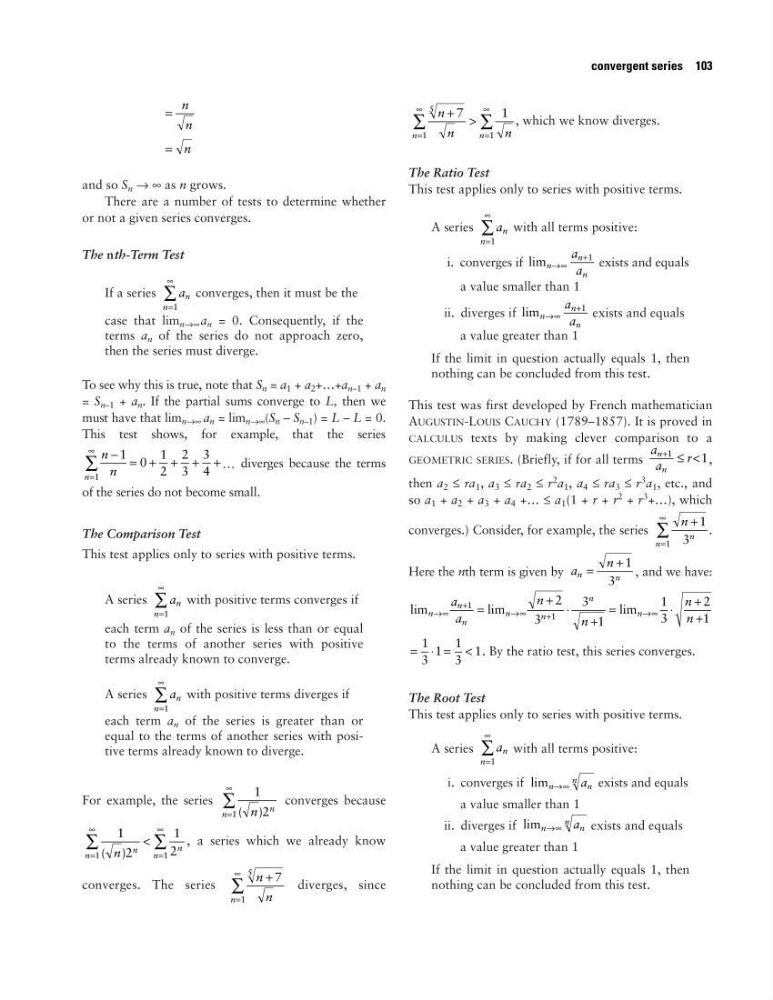
and so S n → ∞ as n grows.
There are a number of tests to determine whether
or not a given series converges.
The nth-Term Test
If a series
converges, then it must be the
case that lim n→∞ a n = 0. Consequently, if the
terms a n of the series do not approach zero,
then the series must diverge.
To see why this is true, note that S n = a 1 + a 2 +…+a n–1 + a n
= S n–1 + a n . If the partial sums converge to L, then we
must have that lim n→∞ a n = lim n→∞ (S n – S n–1 ) = L – L = 0.
This test shows, for example, that the series
diverges because the terms
of the series do not become small.
The Comparison Test
This test applies only to series with positive terms.
A series
with positive terms converges if
each term a n of the series is less than or equal
to the terms of another series with positive
terms already known to converge.
A series
with positive terms diverges if
each term a n of the series is greater than or
equal to the terms of another series with positive terms already known to diverge.
For example, the series
converges because
, a series which we already know
converges. The series
diverges, since
, which we know diverges.
The Ratio Test
This test applies only to series with positive terms.
A series
with all terms positive:
i. converges if
exists and equals
a value smaller than 1
ii. diverges if
exists and equals
a value greater than 1
If the limit in question actually equals 1, then
nothing can be concluded from this test.
This test was first developed by French mathematician
AUGUSTIN-LOUIS CAUCHY (1789–1857). It is proved in
CALCULUS texts by making clever comparison to a
GEOMETRIC SERIES. (Briefly, if for all terms
,
then a 2 ≤ ra 1 , a 3 ≤ ra 2 ≤ r
2
a 1 , a 4 ≤ ra 3 ≤ r
3
a 1 , etc., and
so a 1 + a 2 + a 3 + a 4 +… ≤ a 1 (1 + r + r
2 + r
3
+…), which
converges.) Consider, for example, the series
.
Here the nth term is given by
, and we have:
. By the ratio test, this series converges.
The Root Test
This test applies only to series with positive terms.
A series
with all terms positive:
i. converges if
exists and equals
a value smaller than 1
ii. diverges if
exists and equals
a value greater than 1
If the limit in question actually equals 1, then
nothing can be concluded from this test.
lim n
n
n a
→∞
lim n
n
n a
→∞
a n
n=
∞
∑
1
= ⋅ = <
1
3
1
1
3
1
lim
lim
lim
n
n
n
n
n
n
n
a
a
n
n
n
n
→∞
+
→∞
+
→∞
=
+ ⋅
+
=
⋅
+
+
1
1
2
3
3
1
1
3
2
1
a
n
n
n
=
+ 1
3
n
n
n
+
=
∞
∑
1
3
1
a
a
r
n
n
+
≤ <
1
1
lim n
n
n
a
a
→∞
+1
lim n
n
n
a
a
→∞
+1
a n
n=
∞
∑
1
n
n
n
n
n
+ >
=
∞
=
∞
∑
∑
7
1
5
1
1
n
n
n
+
=
∞
∑
7
5
1
1
2
1
2
1
1
( )
n
n
n
n
n
=
∞
=
∞
∑
∑
<
1
2
1 ( )
n
n
n=
∞
∑
a n
n=
∞
∑
1
a n
n=
∞
∑
1
n
n
n
− = + + + +
=
∞
∑
1 0
1
2
2
3
3
4
1
L
a n
n=
∞
∑
1
n
n
n
=
=
convergent series 103
There are a number of tests to determine whether
or not a given series converges.
The nth-Term Test
If a series
converges, then it must be the
case that lim n→∞ a n = 0. Consequently, if the
terms a n of the series do not approach zero,
then the series must diverge.
To see why this is true, note that S n = a 1 + a 2 +…+a n–1 + a n
= S n–1 + a n . If the partial sums converge to L, then we
must have that lim n→∞ a n = lim n→∞ (S n – S n–1 ) = L – L = 0.
This test shows, for example, that the series
diverges because the terms
of the series do not become small.
The Comparison Test
This test applies only to series with positive terms.
A series
with positive terms converges if
each term a n of the series is less than or equal
to the terms of another series with positive
terms already known to converge.
A series
with positive terms diverges if
each term a n of the series is greater than or
equal to the terms of another series with positive terms already known to diverge.
For example, the series
converges because
, a series which we already know
converges. The series
diverges, since
, which we know diverges.
The Ratio Test
This test applies only to series with positive terms.
A series
with all terms positive:
i. converges if
exists and equals
a value smaller than 1
ii. diverges if
exists and equals
a value greater than 1
If the limit in question actually equals 1, then
nothing can be concluded from this test.
This test was first developed by French mathematician
AUGUSTIN-LOUIS CAUCHY (1789–1857). It is proved in
CALCULUS texts by making clever comparison to a
GEOMETRIC SERIES. (Briefly, if for all terms
,
then a 2 ≤ ra 1 , a 3 ≤ ra 2 ≤ r
2
a 1 , a 4 ≤ ra 3 ≤ r
3
a 1 , etc., and
so a 1 + a 2 + a 3 + a 4 +… ≤ a 1 (1 + r + r
2 + r
3
+…), which
converges.) Consider, for example, the series
.
Here the nth term is given by
, and we have:
. By the ratio test, this series converges.
The Root Test
This test applies only to series with positive terms.
A series
with all terms positive:
i. converges if
exists and equals
a value smaller than 1
ii. diverges if
exists and equals
a value greater than 1
If the limit in question actually equals 1, then
nothing can be concluded from this test.
lim n
n
n a
→∞
lim n
n
n a
→∞
a n
n=
∞
∑
1
= ⋅ = <
1
3
1
1
3
1
lim
lim
lim
n
n
n
n
n
n
n
a
a
n
n
n
n
→∞
+
→∞
+
→∞
=
+ ⋅
+
=
⋅
+
+
1
1
2
3
3
1
1
3
2
1
a
n
n
n
=
+ 1
3
n
n
n
+
=
∞
∑
1
3
1
a
a
r
n
n
+
≤ <
1
1
lim n
n
n
a
a
→∞
+1
lim n
n
n
a
a
→∞
+1
a n
n=
∞
∑
1
n
n
n
n
n
+ >
=
∞
=
∞
∑
∑
7
1
5
1
1
n
n
n
+
=
∞
∑
7
5
1
1
2
1
2
1
1
( )
n
n
n
n
n
=
∞
=
∞
∑
∑
<
1
2
1 ( )
n
n
n=
∞
∑
a n
n=
∞
∑
1
a n
n=
∞
∑
1
n
n
n
− = + + + +
=
∞
∑
1 0
1
2
2
3
3
4
1
L
a n
n=
∞
∑
1
n
n
n
=
=
convergent series 103