

coplanar See PLANE.
coprime Another name for RELATIVELY PRIME.
correlation See CORRELATION COEFFICIENT; SCATTER
DIAGRAM.
correlation coefficient Any numerical value used to
indicate the extent to which two variables in a study are
associated is called a correlation coefficient. For example, a medical study might record the height and shoe
size of adult participants suspecting that there might be
a relationship between these two features. If two variables are such that when one changes, then the other
does so in a related manner (generally the taller an individual, the greater the shoe size on average, say) then
the two variables are said to be correlated. A SCATTER
DIAGRAM is used to detect possible correlations. If the
points of the scatter diagram tend to follow a straight
line, then the two variables are linearly correlated.
KARL PEARSON (1857–1936) developed a measure
to specifically detect linear relationships. If the DATA
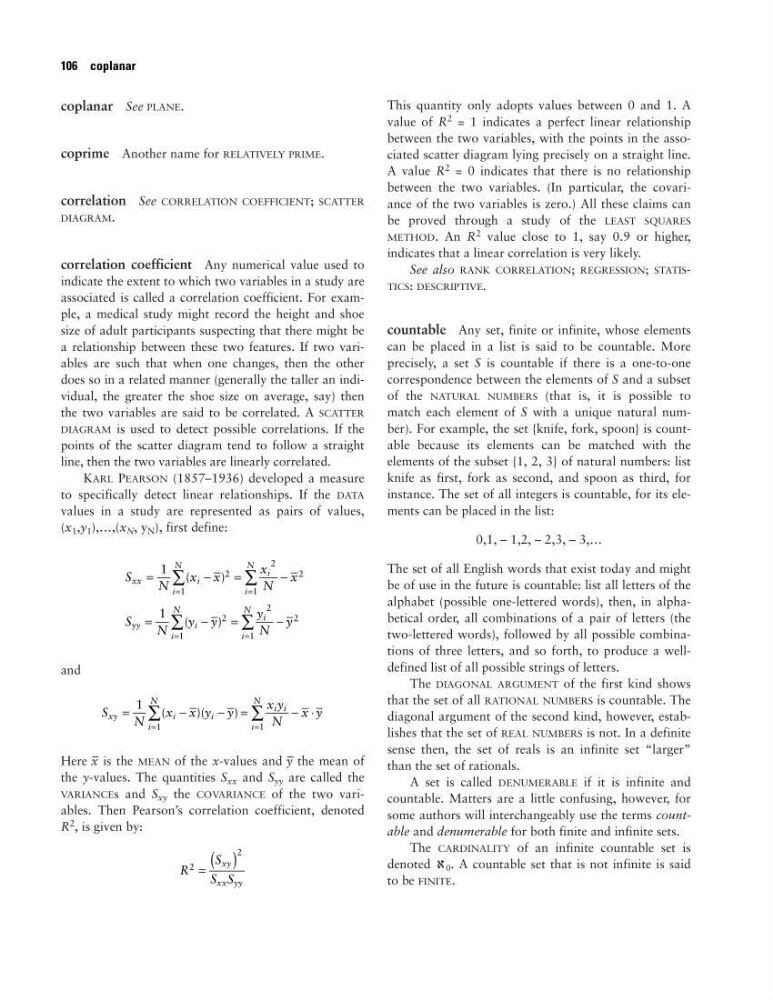
values in a study are represented as pairs of values,
(x 1 ,y 1 ),…,(x N , y N ), first define:
and
Here –
x is the MEAN of the x-values and –
y the mean of
the y-values. The quantities S xx and S yy are called the
VARIANCEs and S xy the COVARIANCE of the two variables. Then Pearson’s correlation coefficient, denoted
R
2
, is given by:
This quantity only adopts values between 0 and 1. A
value of R
2 = 1 indicates a perfect linear relationship
between the two variables, with the points in the associated scatter diagram lying precisely on a straight line.
A value R
2 = 0 indicates that there is no relationship
between the two variables. (In particular, the covariance of the two variables is zero.) All these claims can
be proved through a study of the LEAST SQUARES
METHOD. An R
2 value close to 1, say 0.9 or higher,
indicates that a linear correlation is very likely.
See also RANK CORRELATION; REGRESSION; STATISTICS: DESCRIPTIVE.
countable Any set, finite or infinite, whose elements
can be placed in a list is said to be countable. More
precisely, a set S is countable if there is a one-to-one
correspondence between the elements of S and a subset
of the NATURAL NUMBERS (that is, it is possible to
match each element of S with a unique natural number). For example, the set {knife, fork, spoon} is countable because its elements can be matched with the
elements of the subset {1, 2, 3} of natural numbers: list
knife as first, fork as second, and spoon as third, for
instance. The set of all integers is countable, for its elements can be placed in the list:
0,1, – 1,2, – 2,3, – 3,…
The set of all English words that exist today and might
be of use in the future is countable: list all letters of the
alphabet (possible one-lettered words), then, in alphabetical order, all combinations of a pair of letters (the
two-lettered words), followed by all possible combinations of three letters, and so forth, to produce a welldefined list of all possible strings of letters.
The DIAGONAL ARGUMENT of the first kind shows
that the set of all RATIONAL NUMBERS is countable. The
diagonal argument of the second kind, however, establishes that the set of REAL NUMBERS is not. In a definite
sense then, the set of reals is an infinite set “larger”
than the set of rationals.
A set is called DENUMERABLE if it is infinite and
countable. Matters are a little confusing, however, for
some authors will interchangeably use the terms countable and denumerable for both finite and infinite sets.
The CARDINALITY of an infinite countable set is
denoted ℵ 0 . A countable set that is not infinite is said
to be FINITE.
R
S
S S
xy
xx yy
2
2
=
( )
S
N
x x y y
x y
N
x y
xy
i
i
i
N
i i
i
N
=
−
− =
− ⋅
=
=
∑
∑
1
1
1
(
)(
)
S
N
x x
x
N
x
S
N
y y
y
N
y
xx
i
i
N
i
i
N
yy
i
i
N
i
i
N
=
−
=
−
=
−
=
−
=
=
=
=
∑
∑
∑
∑
1
1
2
1
2
2
1
2
1
2
2
1
(
)
(
)
106 coplanar
coprime Another name for RELATIVELY PRIME.
correlation See CORRELATION COEFFICIENT; SCATTER
DIAGRAM.
correlation coefficient Any numerical value used to
indicate the extent to which two variables in a study are
associated is called a correlation coefficient. For example, a medical study might record the height and shoe
size of adult participants suspecting that there might be
a relationship between these two features. If two variables are such that when one changes, then the other
does so in a related manner (generally the taller an individual, the greater the shoe size on average, say) then
the two variables are said to be correlated. A SCATTER
DIAGRAM is used to detect possible correlations. If the
points of the scatter diagram tend to follow a straight
line, then the two variables are linearly correlated.
KARL PEARSON (1857–1936) developed a measure
to specifically detect linear relationships. If the DATA
values in a study are represented as pairs of values,
(x 1 ,y 1 ),…,(x N , y N ), first define:
and
Here –
x is the MEAN of the x-values and –
y the mean of
the y-values. The quantities S xx and S yy are called the
VARIANCEs and S xy the COVARIANCE of the two variables. Then Pearson’s correlation coefficient, denoted
R
2
, is given by:
This quantity only adopts values between 0 and 1. A
value of R
2 = 1 indicates a perfect linear relationship
between the two variables, with the points in the associated scatter diagram lying precisely on a straight line.
A value R
2 = 0 indicates that there is no relationship
between the two variables. (In particular, the covariance of the two variables is zero.) All these claims can
be proved through a study of the LEAST SQUARES
METHOD. An R
2 value close to 1, say 0.9 or higher,
indicates that a linear correlation is very likely.
See also RANK CORRELATION; REGRESSION; STATISTICS: DESCRIPTIVE.
countable Any set, finite or infinite, whose elements
can be placed in a list is said to be countable. More
precisely, a set S is countable if there is a one-to-one
correspondence between the elements of S and a subset
of the NATURAL NUMBERS (that is, it is possible to
match each element of S with a unique natural number). For example, the set {knife, fork, spoon} is countable because its elements can be matched with the
elements of the subset {1, 2, 3} of natural numbers: list
knife as first, fork as second, and spoon as third, for
instance. The set of all integers is countable, for its elements can be placed in the list:
0,1, – 1,2, – 2,3, – 3,…
The set of all English words that exist today and might
be of use in the future is countable: list all letters of the
alphabet (possible one-lettered words), then, in alphabetical order, all combinations of a pair of letters (the
two-lettered words), followed by all possible combinations of three letters, and so forth, to produce a welldefined list of all possible strings of letters.
The DIAGONAL ARGUMENT of the first kind shows
that the set of all RATIONAL NUMBERS is countable. The
diagonal argument of the second kind, however, establishes that the set of REAL NUMBERS is not. In a definite
sense then, the set of reals is an infinite set “larger”
than the set of rationals.
A set is called DENUMERABLE if it is infinite and
countable. Matters are a little confusing, however, for
some authors will interchangeably use the terms countable and denumerable for both finite and infinite sets.
The CARDINALITY of an infinite countable set is
denoted ℵ 0 . A countable set that is not infinite is said
to be FINITE.
R
S
S S
xy
xx yy
2
2
=
( )
S
N
x x y y
x y
N
x y
xy
i
i
i
N
i i
i
N
=
−
− =
− ⋅
=
=
∑
∑
1
1
1
(
)(
)
S
N
x x
x
N
x
S
N
y y
y
N
y
xx
i
i
N
i
i
N
yy
i
i
N
i
i
N
=
−
=
−
=
−
=
−
=
=
=
=
∑
∑
∑
∑
1
1
2
1
2
2
1
2
1
2
2
1
(
)
(
)
106 coplanar