

Unraveling the continued-fraction expansions of other
irrational numbers can yield analogous discoveries.
continuous function Informally, a function is said to
be continuous if one can draw its graph without ever
lifting the pencil from the page. This means that the
graph of the function consists of a single curved line
with no gaps, jumps, or holes.
More precisely, a function is continuous at a point
x = a, if the function is defined at the point a, and the
LIMIT of f(x) as x approaches a equals the value of the
function at a:
lim x→a f(x) = f(a)
(If, for example, a function has values f(0.9) = 1.9,
f(0.99) = 1.99, f(0.999) = 1.999, and so on, then one
would be very surprised to learn that f(1) equals 18.
The function would not be deemed continuous at x =
1.) A function that is not continuous at a point is said
to be discontinuous, or to have a discontinuity, at that
point. A function that is continuous at every point in
its domain is called continuous.
Mathematicians have proved that:
i. The sum of two continuous functions is continuous.
ii. The product of two continuous functions is
continuous.
iii. The quotient of two continuous functions is continuous at each point where the denominator is
not zero.
iv. The COMPOSITION of two continuous functions is
continuous.
Since the straight-line graph f(x) = x is continuous, it follows from properties i and ii that any POLYNOMIAL function p(x) = a n x
n
+…+a 1 x + a 0 is continuous. By property
iii, any RATIONAL FUNCTION is continuous at all points
where the denominator is not zero. The functions sin x
and cos x from TRIGONOMETRY are both continuous.
The tangent function, tan x =
, is continuous
at every point other than
, the
locations where cosine is zero.
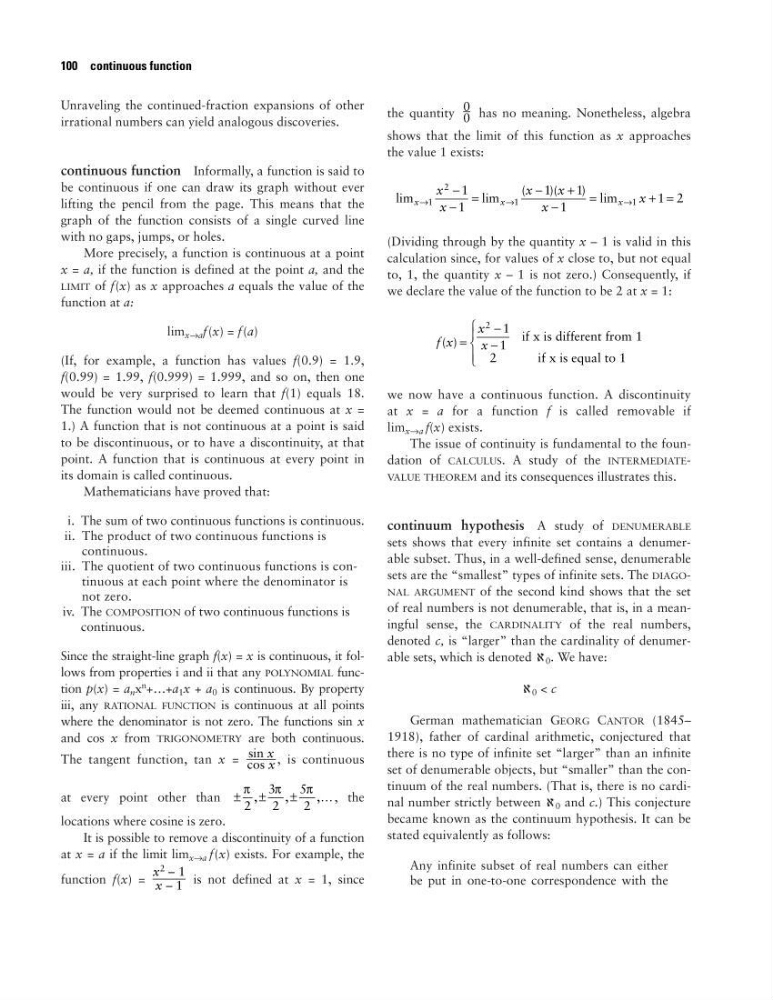
It is possible to remove a discontinuity of a function
at x = a if the limit lim x→a f(x) exists. For example, the
function f(x) =
is not defined at x = 1, since
the quantity
has no meaning. Nonetheless, algebra
shows that the limit of this function as x approaches
the value 1 exists:
(Dividing through by the quantity x – 1 is valid in this
calculation since, for values of x close to, but not equal
to, 1, the quantity x – 1 is not zero.) Consequently, if
we declare the value of the function to be 2 at x = 1:
we now have a continuous function. A discontinuity
at x = a for a function f is called removable if
lim x→a f(x) exists.
The issue of continuity is fundamental to the foundation of CALCULUS. A study of the INTERMEDIATEVALUE THEOREM and its consequences illustrates this.
continuum hypothesis A study of DENUMERABLE
sets shows that every infinite set contains a denumerable subset. Thus, in a well-defined sense, denumerable
sets are the “smallest” types of infinite sets. The DIAGONAL ARGUMENT of the second kind shows that the set
of real numbers is not denumerable, that is, in a meaningful sense, the CARDINALITY of the real numbers,
denoted c, is “larger” than the cardinality of denumerable sets, which is denoted ℵ 0 . We have:
ℵ 0 < c
German mathematician GEORG CANTOR (1845–
1918), father of cardinal arithmetic, conjectured that
there is no type of infinite set “larger” than an infinite
set of denumerable objects, but “smaller” than the continuum of the real numbers. (That is, there is no cardinal number strictly between ℵ 0 and c.) This conjecture
became known as the continuum hypothesis. It can be
stated equivalently as follows:
Any infinite subset of real numbers can either
be put in one-to-one correspondence with the
f x
x
x
( ) =
−
−
2 1
1
2
if x is different from 1
if x is equal to 1
lim
lim
(
)(
) lim
x
x
x
x
x
x
x
x
x
→
→
→
−
−
=
−
+
−
=
+ =
1
2
1
1
1
1
1
1
1
1 2
0
0
x
2 – 1
x – 1
± ±
±
π
π
π
2
3
2
5
2
,
,
,K
sin x
cos x
100 continuous function
irrational numbers can yield analogous discoveries.
continuous function Informally, a function is said to
be continuous if one can draw its graph without ever
lifting the pencil from the page. This means that the
graph of the function consists of a single curved line
with no gaps, jumps, or holes.
More precisely, a function is continuous at a point
x = a, if the function is defined at the point a, and the
LIMIT of f(x) as x approaches a equals the value of the
function at a:
lim x→a f(x) = f(a)
(If, for example, a function has values f(0.9) = 1.9,
f(0.99) = 1.99, f(0.999) = 1.999, and so on, then one
would be very surprised to learn that f(1) equals 18.
The function would not be deemed continuous at x =
1.) A function that is not continuous at a point is said
to be discontinuous, or to have a discontinuity, at that
point. A function that is continuous at every point in
its domain is called continuous.
Mathematicians have proved that:
i. The sum of two continuous functions is continuous.
ii. The product of two continuous functions is
continuous.
iii. The quotient of two continuous functions is continuous at each point where the denominator is
not zero.
iv. The COMPOSITION of two continuous functions is
continuous.
Since the straight-line graph f(x) = x is continuous, it follows from properties i and ii that any POLYNOMIAL function p(x) = a n x
n
+…+a 1 x + a 0 is continuous. By property
iii, any RATIONAL FUNCTION is continuous at all points
where the denominator is not zero. The functions sin x
and cos x from TRIGONOMETRY are both continuous.
The tangent function, tan x =
, is continuous
at every point other than
, the
locations where cosine is zero.
It is possible to remove a discontinuity of a function
at x = a if the limit lim x→a f(x) exists. For example, the
function f(x) =
is not defined at x = 1, since
the quantity
has no meaning. Nonetheless, algebra
shows that the limit of this function as x approaches
the value 1 exists:
(Dividing through by the quantity x – 1 is valid in this
calculation since, for values of x close to, but not equal
to, 1, the quantity x – 1 is not zero.) Consequently, if
we declare the value of the function to be 2 at x = 1:
we now have a continuous function. A discontinuity
at x = a for a function f is called removable if
lim x→a f(x) exists.
The issue of continuity is fundamental to the foundation of CALCULUS. A study of the INTERMEDIATEVALUE THEOREM and its consequences illustrates this.
continuum hypothesis A study of DENUMERABLE
sets shows that every infinite set contains a denumerable subset. Thus, in a well-defined sense, denumerable
sets are the “smallest” types of infinite sets. The DIAGONAL ARGUMENT of the second kind shows that the set
of real numbers is not denumerable, that is, in a meaningful sense, the CARDINALITY of the real numbers,
denoted c, is “larger” than the cardinality of denumerable sets, which is denoted ℵ 0 . We have:
ℵ 0 < c
German mathematician GEORG CANTOR (1845–
1918), father of cardinal arithmetic, conjectured that
there is no type of infinite set “larger” than an infinite
set of denumerable objects, but “smaller” than the continuum of the real numbers. (That is, there is no cardinal number strictly between ℵ 0 and c.) This conjecture
became known as the continuum hypothesis. It can be
stated equivalently as follows:
Any infinite subset of real numbers can either
be put in one-to-one correspondence with the
f x
x
x
( ) =
−
−
2 1
1
2
if x is different from 1
if x is equal to 1
lim
lim
(
)(
) lim
x
x
x
x
x
x
x
x
x
→
→
→
−
−
=
−
+
−
=
+ =
1
2
1
1
1
1
1
1
1
1 2
0
0
x
2 – 1
x – 1
± ±
±
π
π
π
2
3
2
5
2
,
,
,K
sin x
cos x
100 continuous function