

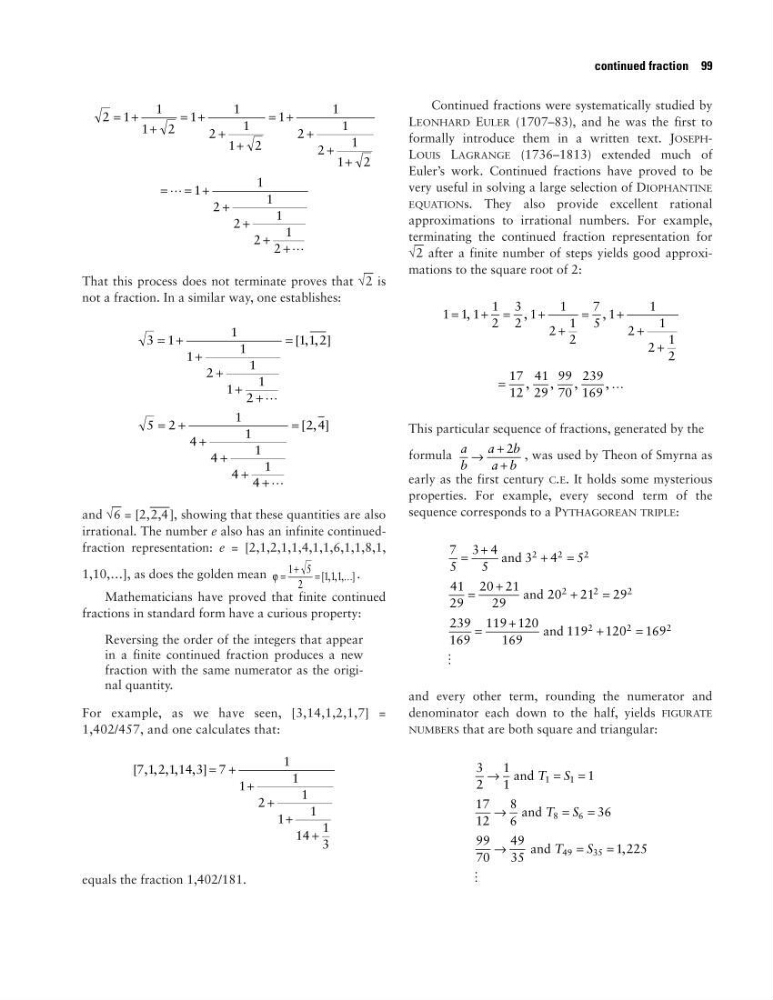
That this process does not terminate proves that √
–
2 is
not a fraction. In a similar way, one establishes:
and √
–
6 = [2,
—
2,4], showing that these quantities are also
irrational. The number e also has an infinite continuedfraction representation: e = [2,1,2,1,1,4,1,1,6,1,1,8,1,
1,10,…], as does the golden mean
.
Mathematicians have proved that finite continued
fractions in standard form have a curious property:
Reversing the order of the integers that appear
in a finite continued fraction produces a new
fraction with the same numerator as the original quantity.
For example, as we have seen, [3,14,1,2,1,7] =
1,402/457, and one calculates that:
equals the fraction 1,402/181.
Continued fractions were systematically studied by
LEONHARD EULER (1707–83), and he was the first to
formally introduce them in a written text. JOSEPHLOUIS LAGRANGE (1736–1813) extended much of
Euler’s work. Continued fractions have proved to be
very useful in solving a large selection of DIOPHANTINE
EQUATIONs. They also provide excellent rational
approximations to irrational numbers. For example,
terminating the continued fraction representation for
√
–
2 after a finite number of steps yields good approximations to the square root of 2:
This particular sequence of fractions, generated by the
formula
, was used by Theon of Smyrna as
early as the first century C.E. It holds some mysterious
properties. For example, every second term of the
sequence corresponds to a PYTHAGOREAN TRIPLE:
and every other term, rounding the numerator and
denominator each down to the half, yields FIGURATE
NUMBERS that are both square and triangular:
3
2
1
1
1
17
12
8
6
36
99
70
49
35
1 225
1
1
8
6
49
35
→
= =
→
= =
→
=
=
and
and
and
T S
T S
T
S
,
M
7
5
3 4
5
3 4
5
41
29
20 21
29
20 21 29
239
169
119 120
169
119 120 169
2
2
2
2
2
2
2
2
2
=
+
+
=
=
+
+
=
=
+
+
=
and
and
and
M
a
b
a b
a b
→
+
+
2
17
12
41
29
99
70
239
169
=
,
,
,
,K
1 1 1
1
2
3
2
1
1
2
1
2
7
5
1
1
2
1
2
1
2
=
+ =
+
+
=
+
+
+
,
,
,
[ , , , , , ]
7 1 2 1 14 3 7
1
1
1
2
1
1
1
14
1
3
= +
+
+
+
+
ϕ =
+ =
1 5
2
1 1 1
[ , , , ]
K
3 1
1
1
1
2
1
1
1
2
1 1 2
5 2
1
4
1
4
1
4
1
4
2 4
= +
+
+
+ +
=
= +
+
+
+ +
=
L
L
[ , , ]
[ , ]
1
1
2
1
2
1
2
1
2
= = +
+
+
+ +
L
L
2 1
1
1
2
1
1
2
1
1
2
1
1
2
1
2
1
1
2
= + +
= +
+ +
= +
+
+ +
continued fraction 99
–
2 is
not a fraction. In a similar way, one establishes:
and √
–
6 = [2,
—
2,4], showing that these quantities are also
irrational. The number e also has an infinite continuedfraction representation: e = [2,1,2,1,1,4,1,1,6,1,1,8,1,
1,10,…], as does the golden mean
.
Mathematicians have proved that finite continued
fractions in standard form have a curious property:
Reversing the order of the integers that appear
in a finite continued fraction produces a new
fraction with the same numerator as the original quantity.
For example, as we have seen, [3,14,1,2,1,7] =
1,402/457, and one calculates that:
equals the fraction 1,402/181.
Continued fractions were systematically studied by
LEONHARD EULER (1707–83), and he was the first to
formally introduce them in a written text. JOSEPHLOUIS LAGRANGE (1736–1813) extended much of
Euler’s work. Continued fractions have proved to be
very useful in solving a large selection of DIOPHANTINE
EQUATIONs. They also provide excellent rational
approximations to irrational numbers. For example,
terminating the continued fraction representation for
√
–
2 after a finite number of steps yields good approximations to the square root of 2:
This particular sequence of fractions, generated by the
formula
, was used by Theon of Smyrna as
early as the first century C.E. It holds some mysterious
properties. For example, every second term of the
sequence corresponds to a PYTHAGOREAN TRIPLE:
and every other term, rounding the numerator and
denominator each down to the half, yields FIGURATE
NUMBERS that are both square and triangular:
3
2
1
1
1
17
12
8
6
36
99
70
49
35
1 225
1
1
8
6
49
35
→
= =
→
= =
→
=
=
and
and
and
T S
T S
T
S
,
M
7
5
3 4
5
3 4
5
41
29
20 21
29
20 21 29
239
169
119 120
169
119 120 169
2
2
2
2
2
2
2
2
2
=
+
+
=
=
+
+
=
=
+
+
=
and
and
and
M
a
b
a b
a b
→
+
+
2
17
12
41
29
99
70
239
169
=
,
,
,
,K
1 1 1
1
2
3
2
1
1
2
1
2
7
5
1
1
2
1
2
1
2
=
+ =
+
+
=
+
+
+
,
,
,
[ , , , , , ]
7 1 2 1 14 3 7
1
1
1
2
1
1
1
14
1
3
= +
+
+
+
+
ϕ =
+ =
1 5
2
1 1 1
[ , , , ]
K
3 1
1
1
1
2
1
1
1
2
1 1 2
5 2
1
4
1
4
1
4
1
4
2 4
= +
+
+
+ +
=
= +
+
+
+ +
=
L
L
[ , , ]
[ , ]
1
1
2
1
2
1
2
1
2
= = +
+
+
+ +
L
L
2 1
1
1
2
1
1
2
1
1
2
1
1
2
1
2
1
1
2
= + +
= +
+ +
= +
+
+ +
continued fraction 99