

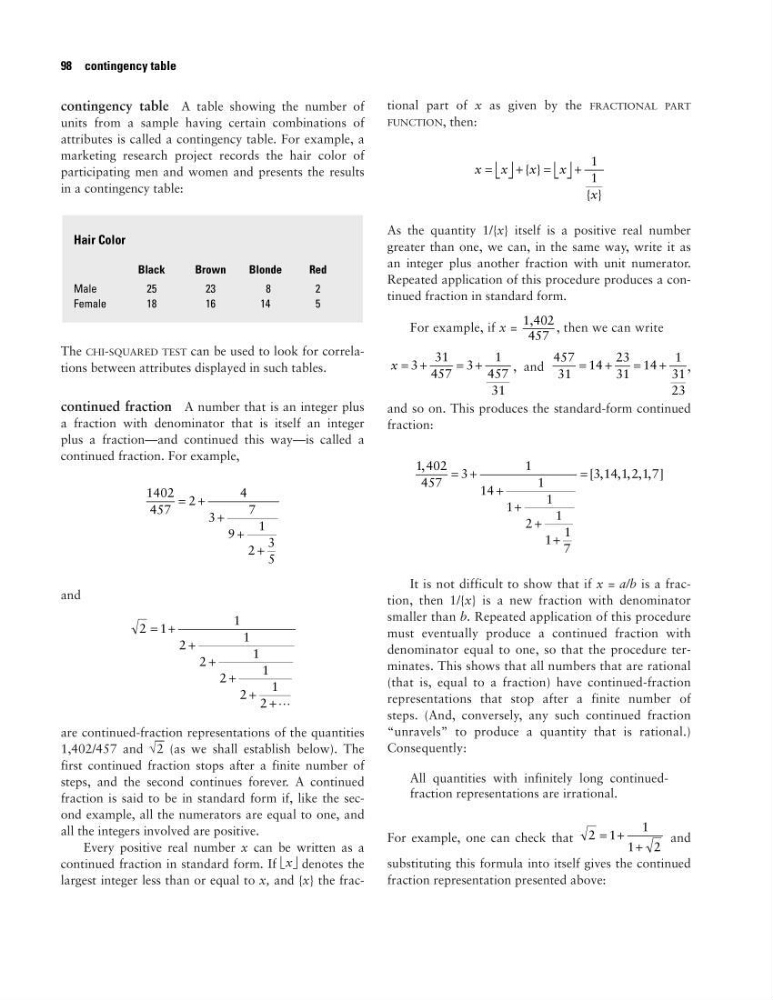
contingency table A table showing the number of
units from a sample having certain combinations of
attributes is called a contingency table. For example, a
marketing research project records the hair color of
participating men and women and presents the results
in a contingency table:
The CHI-SQUARED TEST can be used to look for correlations between attributes displayed in such tables.
continued fraction A number that is an integer plus
a fraction with denominator that is itself an integer
plus a fraction—and continued this way—is called a
continued fraction. For example,
and
are continued-fraction representations of the quantities
1,402/457 and √
–
2 (as we shall establish below). The
first continued fraction stops after a finite number of
steps, and the second continues forever. A continued
fraction is said to be in standard form if, like the second example, all the numerators are equal to one, and
all the integers involved are positive.
Every positive real number x can be written as a
continued fraction in standard form. If x denotes the
largest integer less than or equal to x, and {x} the fractional part of x as given by the FRACTIONAL PART
FUNCTION, then:
As the quantity 1/{x} itself is a positive real number
greater than one, we can, in the same way, write it as
an integer plus another fraction with unit numerator.
Repeated application of this procedure produces a continued fraction in standard form.
For example, if x =
, then we can write
, and
,
and so on. This produces the standard-form continued
fraction:
It is not difficult to show that if x = a/b is a fraction, then 1/{x} is a new fraction with denominator
smaller than b. Repeated application of this procedure
must eventually produce a continued fraction with
denominator equal to one, so that the procedure terminates. This shows that all numbers that are rational
(that is, equal to a fraction) have continued-fraction
representations that stop after a finite number of
steps. (And, conversely, any such continued fraction
“unravels” to produce a quantity that is rational.)
Consequently:
All quantities with infinitely long continuedfraction representations are irrational.
For example, one can check that
and
substituting this formula into itself gives the continued
fraction representation presented above:
2 1
1
1
2
= + +
1 402
457
3
1
14
1
1
1
2
1
1
1
7
3 14 1 2 1 7
,
[ , , , , , ]
= +
+
+
+
+
=
457
31
14
23
31
14
1
31
23
= +
= +
x = +
= +
3
31
457
3
1
457
31
1,402
457
x
x
x
x
x
= + = +
{ }
{ }
1
1
2 1
1
2
1
2
1
2
1
2
1
2
= +
+
+
+
+ + L
1402
457
2
4
3
7
9
1
2
3
5
= +
+
+
+
Hair Color
Black
Brown
Blonde
Red
Male
25
23
8
2
Female
18
16
14
5
98 contingency table
units from a sample having certain combinations of
attributes is called a contingency table. For example, a
marketing research project records the hair color of
participating men and women and presents the results
in a contingency table:
The CHI-SQUARED TEST can be used to look for correlations between attributes displayed in such tables.
continued fraction A number that is an integer plus
a fraction with denominator that is itself an integer
plus a fraction—and continued this way—is called a
continued fraction. For example,
and
are continued-fraction representations of the quantities
1,402/457 and √
–
2 (as we shall establish below). The
first continued fraction stops after a finite number of
steps, and the second continues forever. A continued
fraction is said to be in standard form if, like the second example, all the numerators are equal to one, and
all the integers involved are positive.
Every positive real number x can be written as a
continued fraction in standard form. If x denotes the
largest integer less than or equal to x, and {x} the fractional part of x as given by the FRACTIONAL PART
FUNCTION, then:
As the quantity 1/{x} itself is a positive real number
greater than one, we can, in the same way, write it as
an integer plus another fraction with unit numerator.
Repeated application of this procedure produces a continued fraction in standard form.
For example, if x =
, then we can write
, and
,
and so on. This produces the standard-form continued
fraction:
It is not difficult to show that if x = a/b is a fraction, then 1/{x} is a new fraction with denominator
smaller than b. Repeated application of this procedure
must eventually produce a continued fraction with
denominator equal to one, so that the procedure terminates. This shows that all numbers that are rational
(that is, equal to a fraction) have continued-fraction
representations that stop after a finite number of
steps. (And, conversely, any such continued fraction
“unravels” to produce a quantity that is rational.)
Consequently:
All quantities with infinitely long continuedfraction representations are irrational.
For example, one can check that
and
substituting this formula into itself gives the continued
fraction representation presented above:
2 1
1
1
2
= + +
1 402
457
3
1
14
1
1
1
2
1
1
1
7
3 14 1 2 1 7
,
[ , , , , , ]
= +
+
+
+
+
=
457
31
14
23
31
14
1
31
23
= +
= +
x = +
= +
3
31
457
3
1
457
31
1,402
457
x
x
x
x
x
= + = +
{ }
{ }
1
1
2 1
1
2
1
2
1
2
1
2
1
2
= +
+
+
+
+ + L
1402
457
2
4
3
7
9
1
2
3
5
= +
+
+
+
Hair Color
Black
Brown
Blonde
Red
Male
25
23
8
2
Female
18
16
14
5
98 contingency table