

regular hexagon with these primitive tools, the construction of a regular heptagon (a seven-sided polygon)
is impossible. CARL FRIEDRICH GAUSS (1777–1855)
proved that a regular n-gon is constructible if, and only
if, n is a number of the form 2
k p 1 p 2 …p n , with each p i
a distinct PRIME of the form 2
2 s + 1 (such as 3, 5, 17,
257, and 65,537.) Although one can bisect an angle
with straightedge and compass, the problem of TRISECTING AN ANGLE is unsolvable. The two classical
problems of SQUARING THE CIRCLE and DUPLICATING
THE CUBE also cannot be solved.
Constructible Numbers
A real number r is said to be constructible if, given a
line segment on a page deemed to be of unit length, it
is possible to construct from it a line segment of
length r using only the tools of a straightedge and a
compass. For instance, the number 2 is constructible.
(Given a line segment AB of length one, use the
straightedge to extend the length of the line. Draw a
circle of radius equal to the length of AB, centered
about B, to intersect the line at a new point C. Then
the length of AC is 2.) Any positive whole number is
constructible.
Suppose a and b are two constructible numbers
with b > a. (That is, given a line segment of length 1,
we can also produce line segments of lengths a and b.)
Then the following is true:
The numbers a + b, b – a, a × b, , and √
–
a are
constructible.
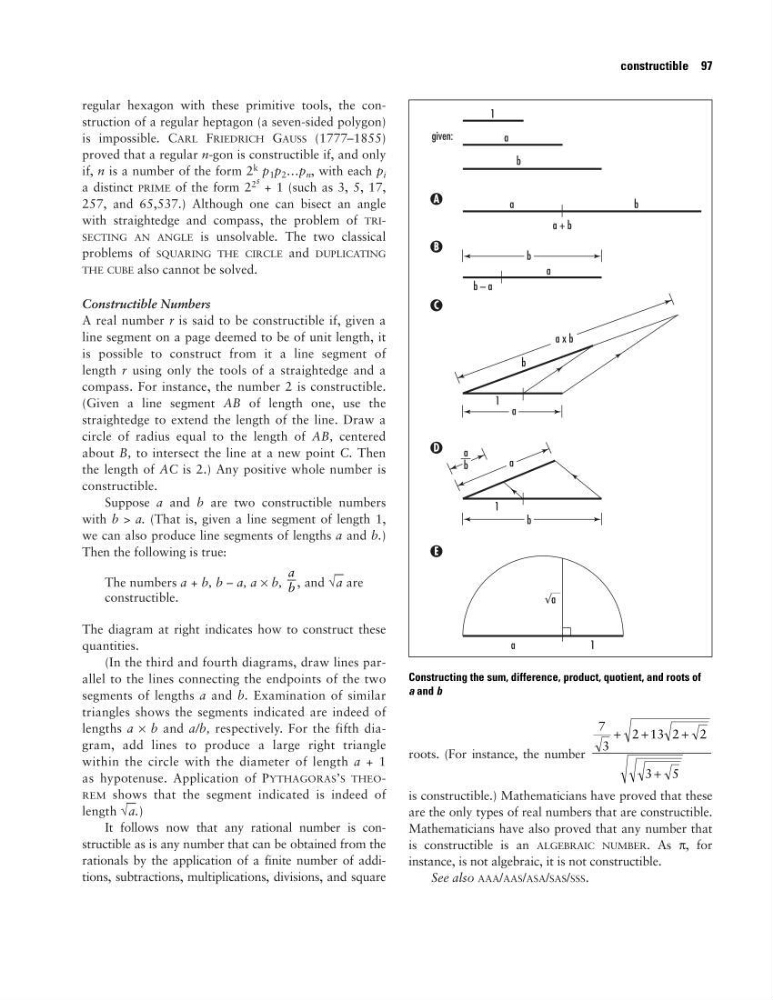
The diagram at right indicates how to construct these
quantities.
(In the third and fourth diagrams, draw lines parallel to the lines connecting the endpoints of the two
segments of lengths a and b. Examination of similar
triangles shows the segments indicated are indeed of
lengths a × b and a/b, respectively. For the fifth diagram, add lines to produce a large right triangle
within the circle with the diameter of length a + 1
as hypotenuse. Application of PYTHAGORAS’S THEOREM shows that the segment indicated is indeed of
length √
–
a.)
It follows now that any rational number is constructible as is any number that can be obtained from the
rationals by the application of a finite number of additions, subtractions, multiplications, divisions, and square
roots. (For instance, the number
is constructible.) Mathematicians have proved that these
are the only types of real numbers that are constructible.
Mathematicians have also proved that any number that
is constructible is an ALGEBRAIC NUMBER. As π, for
instance, is not algebraic, it is not constructible.
See also AAA/AAS/ASA/SAS/SSS.
7
3
2 13 2
2
3
5
+
+
+
+
a
b
constructible 97
Constructing the sum, difference, product, quotient, and roots of
a and b
is impossible. CARL FRIEDRICH GAUSS (1777–1855)
proved that a regular n-gon is constructible if, and only
if, n is a number of the form 2
k p 1 p 2 …p n , with each p i
a distinct PRIME of the form 2
2 s + 1 (such as 3, 5, 17,
257, and 65,537.) Although one can bisect an angle
with straightedge and compass, the problem of TRISECTING AN ANGLE is unsolvable. The two classical
problems of SQUARING THE CIRCLE and DUPLICATING
THE CUBE also cannot be solved.
Constructible Numbers
A real number r is said to be constructible if, given a
line segment on a page deemed to be of unit length, it
is possible to construct from it a line segment of
length r using only the tools of a straightedge and a
compass. For instance, the number 2 is constructible.
(Given a line segment AB of length one, use the
straightedge to extend the length of the line. Draw a
circle of radius equal to the length of AB, centered
about B, to intersect the line at a new point C. Then
the length of AC is 2.) Any positive whole number is
constructible.
Suppose a and b are two constructible numbers
with b > a. (That is, given a line segment of length 1,
we can also produce line segments of lengths a and b.)
Then the following is true:
The numbers a + b, b – a, a × b, , and √
–
a are
constructible.
The diagram at right indicates how to construct these
quantities.
(In the third and fourth diagrams, draw lines parallel to the lines connecting the endpoints of the two
segments of lengths a and b. Examination of similar
triangles shows the segments indicated are indeed of
lengths a × b and a/b, respectively. For the fifth diagram, add lines to produce a large right triangle
within the circle with the diameter of length a + 1
as hypotenuse. Application of PYTHAGORAS’S THEOREM shows that the segment indicated is indeed of
length √
–
a.)
It follows now that any rational number is constructible as is any number that can be obtained from the
rationals by the application of a finite number of additions, subtractions, multiplications, divisions, and square
roots. (For instance, the number
is constructible.) Mathematicians have proved that these
are the only types of real numbers that are constructible.
Mathematicians have also proved that any number that
is constructible is an ALGEBRAIC NUMBER. As π, for
instance, is not algebraic, it is not constructible.
See also AAA/AAS/ASA/SAS/SSS.
7
3
2 13 2
2
3
5
+
+
+
+
a
b
constructible 97
Constructing the sum, difference, product, quotient, and roots of
a and b