

set of natural numbers, or can be put in oneto-one correspondence with the entire set of
real numbers.
Despite his efforts, Cantor was unable to establish
whether or not his continuum hypothesis was true. In
1940 Austrian mathematician KURT GÖDEL proved
that the continuum hypothesis cannot be proved false.
Unfortunately, as GÖDEL’S INCOMPLETENESS THEOREMS
show, this does not mean that the continuum hypothesis is true: there exist statements in mathematics that
are undecidable, that is, ones that cannot be proved
true and cannot be proved false. It was suspected that
the continuum hypothesis might be such an undecidable statement. Twenty-three years later in 1963,
American logician Paul Cohen managed to prove that
this is indeed the case. Consequently one can either
deem the continuum hypothesis as true or as false, an
arbitrary choice, and be certain never to run into a
mathematical contradiction as a result.
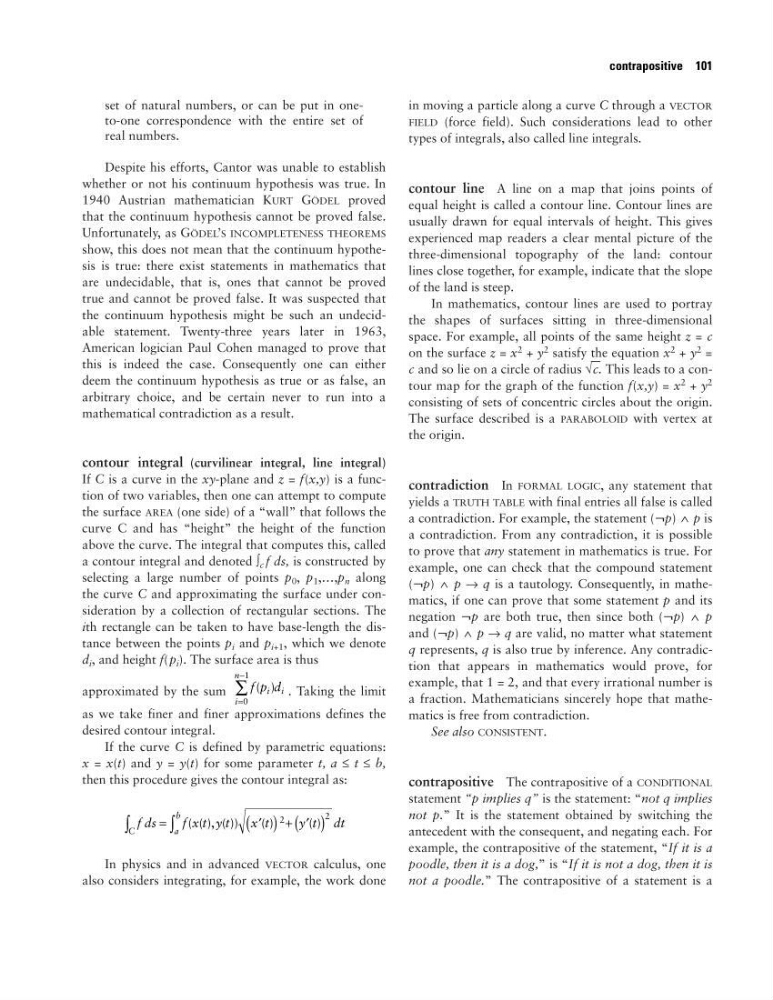
contour integral (curvilinear integral, line integral)
If C is a curve in the xy-plane and z = f(x,y) is a function of two variables, then one can attempt to compute
the surface AREA (one side) of a “wall” that follows the
curve C and has “height” the height of the function
above the curve. The integral that computes this, called
a contour integral and denoted ∫ c f ds, is constructed by
selecting a large number of points p 0 , p 1 ,…,p n along
the curve C and approximating the surface under consideration by a collection of rectangular sections. The
ith rectangle can be taken to have base-length the distance between the points p i and p i+1 , which we denote
d i , and height f(p i ). The surface area is thus
approximated by the sum
. Taking the limit
as we take finer and finer approximations defines the
desired contour integral.
If the curve C is defined by parametric equations:
x = x(t) and y = y(t) for some parameter t, a ≤ t ≤ b,
then this procedure gives the contour integral as:
In physics and in advanced VECTOR calculus, one
also considers integrating, for example, the work done
in moving a particle along a curve C through a VECTOR
FIELD (force field). Such considerations lead to other
types of integrals, also called line integrals.
contour line A line on a map that joins points of
equal height is called a contour line. Contour lines are
usually drawn for equal intervals of height. This gives
experienced map readers a clear mental picture of the
three-dimensional topography of the land: contour
lines close together, for example, indicate that the slope
of the land is steep.
In mathematics, contour lines are used to portray
the shapes of surfaces sitting in three-dimensional
space. For example, all points of the same height z = c
on the surface z = x
2 + y 2 satisfy the equation x 2 + y 2 =
c and so lie on a circle of radius √
–
c. This leads to a contour map for the graph of the function f(x,y) = x
2 + y
2
consisting of sets of concentric circles about the origin.
The surface described is a PARABOLOID with vertex at
the origin.
contradiction In FORMAL LOGIC, any statement that
yields a TRUTH TABLE with final entries all false is called
a contradiction. For example, the statement (¬p) p is
a contradiction. From any contradiction, it is possible
to prove that any statement in mathematics is true. For
example, one can check that the compound statement
(¬p)
p → q is a tautology. Consequently, in mathematics, if one can prove that some statement p and its
negation ¬p are both true, then since both (¬p)
p
and (¬p) p → q are valid, no matter what statement
q represents, q is also true by inference. Any contradiction that appears in mathematics would prove, for
example, that 1 = 2, and that every irrational number is
a fraction. Mathematicians sincerely hope that mathematics is free from contradiction.
See also CONSISTENT.
contrapositive The contrapositive of a CONDITIONAL
statement “p implies q” is the statement: “not q implies
not p.” It is the statement obtained by switching the
antecedent with the consequent, and negating each. For
example, the contrapositive of the statement, “If it is a
poodle, then it is a dog,” is “If it is not a dog, then it is
not a poodle.” The contrapositive of a statement is a
∨
∨
∨
∨
f ds
f x t y t
x t
y t dt
C
a
b
∫
∫
=
′
( ) + ′
( )
( ( ), ( ))
( )
( )
2
2
f p d
i i
i
n
( )
=
−
∑
0
1
contrapositive 101
real numbers.
Despite his efforts, Cantor was unable to establish
whether or not his continuum hypothesis was true. In
1940 Austrian mathematician KURT GÖDEL proved
that the continuum hypothesis cannot be proved false.
Unfortunately, as GÖDEL’S INCOMPLETENESS THEOREMS
show, this does not mean that the continuum hypothesis is true: there exist statements in mathematics that
are undecidable, that is, ones that cannot be proved
true and cannot be proved false. It was suspected that
the continuum hypothesis might be such an undecidable statement. Twenty-three years later in 1963,
American logician Paul Cohen managed to prove that
this is indeed the case. Consequently one can either
deem the continuum hypothesis as true or as false, an
arbitrary choice, and be certain never to run into a
mathematical contradiction as a result.
contour integral (curvilinear integral, line integral)
If C is a curve in the xy-plane and z = f(x,y) is a function of two variables, then one can attempt to compute
the surface AREA (one side) of a “wall” that follows the
curve C and has “height” the height of the function
above the curve. The integral that computes this, called
a contour integral and denoted ∫ c f ds, is constructed by
selecting a large number of points p 0 , p 1 ,…,p n along
the curve C and approximating the surface under consideration by a collection of rectangular sections. The
ith rectangle can be taken to have base-length the distance between the points p i and p i+1 , which we denote
d i , and height f(p i ). The surface area is thus
approximated by the sum
. Taking the limit
as we take finer and finer approximations defines the
desired contour integral.
If the curve C is defined by parametric equations:
x = x(t) and y = y(t) for some parameter t, a ≤ t ≤ b,
then this procedure gives the contour integral as:
In physics and in advanced VECTOR calculus, one
also considers integrating, for example, the work done
in moving a particle along a curve C through a VECTOR
FIELD (force field). Such considerations lead to other
types of integrals, also called line integrals.
contour line A line on a map that joins points of
equal height is called a contour line. Contour lines are
usually drawn for equal intervals of height. This gives
experienced map readers a clear mental picture of the
three-dimensional topography of the land: contour
lines close together, for example, indicate that the slope
of the land is steep.
In mathematics, contour lines are used to portray
the shapes of surfaces sitting in three-dimensional
space. For example, all points of the same height z = c
on the surface z = x
2 + y 2 satisfy the equation x 2 + y 2 =
c and so lie on a circle of radius √
–
c. This leads to a contour map for the graph of the function f(x,y) = x
2 + y
2
consisting of sets of concentric circles about the origin.
The surface described is a PARABOLOID with vertex at
the origin.
contradiction In FORMAL LOGIC, any statement that
yields a TRUTH TABLE with final entries all false is called
a contradiction. For example, the statement (¬p) p is
a contradiction. From any contradiction, it is possible
to prove that any statement in mathematics is true. For
example, one can check that the compound statement
(¬p)
p → q is a tautology. Consequently, in mathematics, if one can prove that some statement p and its
negation ¬p are both true, then since both (¬p)
p
and (¬p) p → q are valid, no matter what statement
q represents, q is also true by inference. Any contradiction that appears in mathematics would prove, for
example, that 1 = 2, and that every irrational number is
a fraction. Mathematicians sincerely hope that mathematics is free from contradiction.
See also CONSISTENT.
contrapositive The contrapositive of a CONDITIONAL
statement “p implies q” is the statement: “not q implies
not p.” It is the statement obtained by switching the
antecedent with the consequent, and negating each. For
example, the contrapositive of the statement, “If it is a
poodle, then it is a dog,” is “If it is not a dog, then it is
not a poodle.” The contrapositive of a statement is a
∨
∨
∨
∨
f ds
f x t y t
x t
y t dt
C
a
b
∫
∫
=
′
( ) + ′
( )
( ( ), ( ))
( )
( )
2
2
f p d
i i
i
n
( )
=
−
∑
0
1
contrapositive 101