

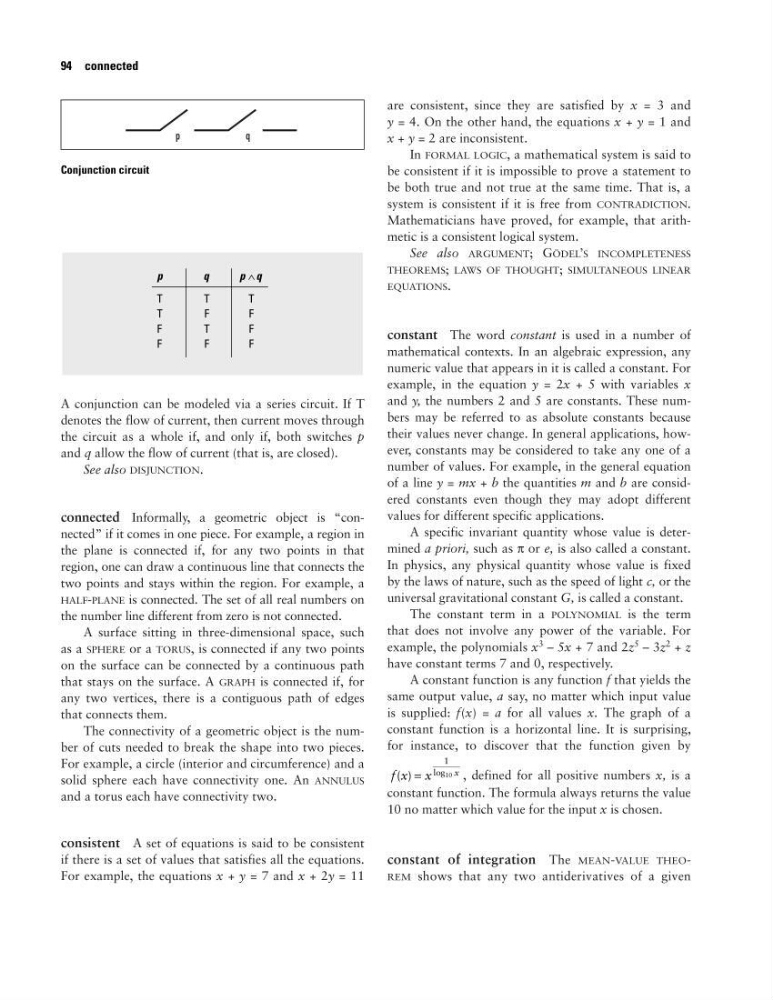
A conjunction can be modeled via a series circuit. If T
denotes the flow of current, then current moves through
the circuit as a whole if, and only if, both switches p
and q allow the flow of current (that is, are closed).
See also DISJUNCTION.
connected Informally, a geometric object is “connected” if it comes in one piece. For example, a region in
the plane is connected if, for any two points in that
region, one can draw a continuous line that connects the
two points and stays within the region. For example, a
HALF-PLANE is connected. The set of all real numbers on
the number line different from zero is not connected.
A surface sitting in three-dimensional space, such
as a SPHERE or a TORUS, is connected if any two points
on the surface can be connected by a continuous path
that stays on the surface. A GRAPH is connected if, for
any two vertices, there is a contiguous path of edges
that connects them.
The connectivity of a geometric object is the number of cuts needed to break the shape into two pieces.
For example, a circle (interior and circumference) and a
solid sphere each have connectivity one. An ANNULUS
and a torus each have connectivity two.
consistent A set of equations is said to be consistent
if there is a set of values that satisfies all the equations.
For example, the equations x + y = 7 and x + 2y = 11
are consistent, since they are satisfied by x = 3 and
y = 4. On the other hand, the equations x + y = 1 and
x + y = 2 are inconsistent.
In FORMAL LOGIC, a mathematical system is said to
be consistent if it is impossible to prove a statement to
be both true and not true at the same time. That is, a
system is consistent if it is free from CONTRADICTION.
Mathematicians have proved, for example, that arithmetic is a consistent logical system.
See also ARGUMENT; GÖDEL’S INCOMPLETENESS
THEOREMS; LAWS OF THOUGHT; SIMULTANEOUS LINEAR
EQUATIONS.
constant The word constant is used in a number of
mathematical contexts. In an algebraic expression, any
numeric value that appears in it is called a constant. For
example, in the equation y = 2x + 5 with variables x
and y, the numbers 2 and 5 are constants. These numbers may be referred to as absolute constants because
their values never change. In general applications, however, constants may be considered to take any one of a
number of values. For example, in the general equation
of a line y = mx + b the quantities m and b are considered constants even though they may adopt different
values for different specific applications.
A specific invariant quantity whose value is determined a priori, such as π or e, is also called a constant.
In physics, any physical quantity whose value is fixed
by the laws of nature, such as the speed of light c, or the
universal gravitational constant G, is called a constant.
The constant term in a POLYNOMIAL is the term
that does not involve any power of the variable. For
example, the polynomials x
3 – 5x + 7 and 2z
5 – 3z
2 + z
have constant terms 7 and 0, respectively.
A constant function is any function f that yields the
same output value, a say, no matter which input value
is supplied: f(x) = a for all values x. The graph of a
constant function is a horizontal line. It is surprising,
for instance, to discover that the function given by
, defined for all positive numbers x, is a
constant function. The formula always returns the value
10 no matter which value for the input x is chosen.
constant of integration The MEAN-VALUE THEOREM shows that any two antiderivatives of a given
f x x
x
( )
log
=
1
10
p
q
p∧ q
T
T
T
T
F
F
F
T
F
F
F
F
94 connected
Conjunction circuit
denotes the flow of current, then current moves through
the circuit as a whole if, and only if, both switches p
and q allow the flow of current (that is, are closed).
See also DISJUNCTION.
connected Informally, a geometric object is “connected” if it comes in one piece. For example, a region in
the plane is connected if, for any two points in that
region, one can draw a continuous line that connects the
two points and stays within the region. For example, a
HALF-PLANE is connected. The set of all real numbers on
the number line different from zero is not connected.
A surface sitting in three-dimensional space, such
as a SPHERE or a TORUS, is connected if any two points
on the surface can be connected by a continuous path
that stays on the surface. A GRAPH is connected if, for
any two vertices, there is a contiguous path of edges
that connects them.
The connectivity of a geometric object is the number of cuts needed to break the shape into two pieces.
For example, a circle (interior and circumference) and a
solid sphere each have connectivity one. An ANNULUS
and a torus each have connectivity two.
consistent A set of equations is said to be consistent
if there is a set of values that satisfies all the equations.
For example, the equations x + y = 7 and x + 2y = 11
are consistent, since they are satisfied by x = 3 and
y = 4. On the other hand, the equations x + y = 1 and
x + y = 2 are inconsistent.
In FORMAL LOGIC, a mathematical system is said to
be consistent if it is impossible to prove a statement to
be both true and not true at the same time. That is, a
system is consistent if it is free from CONTRADICTION.
Mathematicians have proved, for example, that arithmetic is a consistent logical system.
See also ARGUMENT; GÖDEL’S INCOMPLETENESS
THEOREMS; LAWS OF THOUGHT; SIMULTANEOUS LINEAR
EQUATIONS.
constant The word constant is used in a number of
mathematical contexts. In an algebraic expression, any
numeric value that appears in it is called a constant. For
example, in the equation y = 2x + 5 with variables x
and y, the numbers 2 and 5 are constants. These numbers may be referred to as absolute constants because
their values never change. In general applications, however, constants may be considered to take any one of a
number of values. For example, in the general equation
of a line y = mx + b the quantities m and b are considered constants even though they may adopt different
values for different specific applications.
A specific invariant quantity whose value is determined a priori, such as π or e, is also called a constant.
In physics, any physical quantity whose value is fixed
by the laws of nature, such as the speed of light c, or the
universal gravitational constant G, is called a constant.
The constant term in a POLYNOMIAL is the term
that does not involve any power of the variable. For
example, the polynomials x
3 – 5x + 7 and 2z
5 – 3z
2 + z
have constant terms 7 and 0, respectively.
A constant function is any function f that yields the
same output value, a say, no matter which input value
is supplied: f(x) = a for all values x. The graph of a
constant function is a horizontal line. It is surprising,
for instance, to discover that the function given by
, defined for all positive numbers x, is a
constant function. The formula always returns the value
10 no matter which value for the input x is chosen.
constant of integration The MEAN-VALUE THEOREM shows that any two antiderivatives of a given
f x x
x
( )
log
=
1
10
p
q
p∧ q
T
T
T
T
F
F
F
T
F
F
F
F
94 connected
Conjunction circuit