

The Greek scholars of antiquity were the first to
study conic sections. With no practical applications in
mind, mathematicians pursued the topic solely for its
beauty and its intellectual rewards. Around 225 B.C.E.
APOLLONIUS OF PERGA wrote a series of eight books,
titled The Conics, in which he thoroughly investigated
these curves. He introduced the names parabola,
ellipse, and hyperbola. ARCHIMEDES OF SYRACUSE (ca.
287–212 B.C.E.) also wrote about these curves. Almost
2,000 years later, scientists began finding applications
of conic sections to problems in the real world. In 1604
GALILEO GALILEI discovered that objects thrown in the
air follow parabolic paths (if air resistance can be
neglected), and in 1609 astronomer JOHANNES KEPLER
discovered that the orbit of Mars is an ellipse. He conjectured that all planetary bodies have elliptical orbits,
which, 60 years later, ISAAC NEWTON was able to prove
using his newly developed law of gravitation. This century, scientists have discovered that the path of an
alpha particle in the electrical field of an atomic
nucleus is a hyperbola.
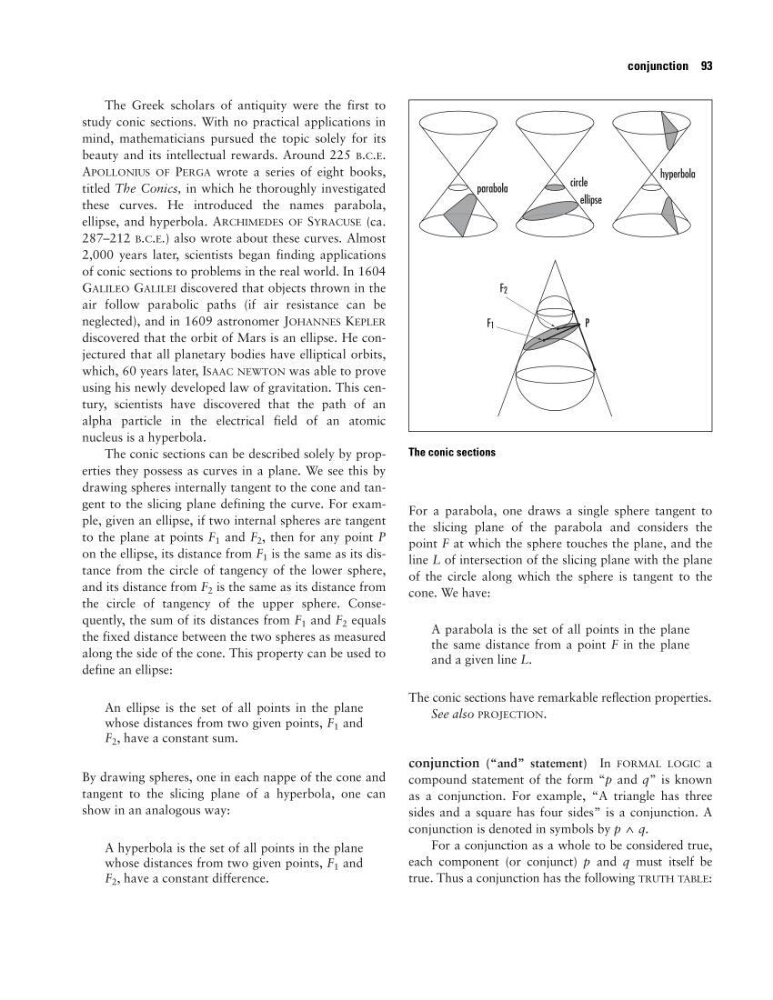
The conic sections can be described solely by properties they possess as curves in a plane. We see this by
drawing spheres internally tangent to the cone and tangent to the slicing plane defining the curve. For example, given an ellipse, if two internal spheres are tangent
to the plane at points F 1 and F 2 , then for any point P
on the ellipse, its distance from F 1 is the same as its distance from the circle of tangency of the lower sphere,
and its distance from F 2 is the same as its distance from
the circle of tangency of the upper sphere. Consequently, the sum of its distances from F 1 and F 2 equals
the fixed distance between the two spheres as measured
along the side of the cone. This property can be used to
define an ellipse:
An ellipse is the set of all points in the plane
whose distances from two given points, F 1 and
F 2 , have a constant sum.
By drawing spheres, one in each nappe of the cone and
tangent to the slicing plane of a hyperbola, one can
show in an analogous way:
A hyperbola is the set of all points in the plane
whose distances from two given points, F 1 and
F 2 , have a constant difference.
For a parabola, one draws a single sphere tangent to
the slicing plane of the parabola and considers the
point F at which the sphere touches the plane, and the
line L of intersection of the slicing plane with the plane
of the circle along which the sphere is tangent to the
cone. We have:
A parabola is the set of all points in the plane
the same distance from a point F in the plane
and a given line L.
The conic sections have remarkable reflection properties.
See also PROJECTION.
conjunction (“and” statement) In FORMAL LOGIC a
compound statement of the form “p and q” is known
as a conjunction. For example, “A triangle has three
sides and a square has four sides” is a conjunction. A
conjunction is denoted in symbols by p q.
For a conjunction as a whole to be considered true,
each component (or conjunct) p and q must itself be
true. Thus a conjunction has the following TRUTH TABLE:
∨
conjunction 93
The conic sections
study conic sections. With no practical applications in
mind, mathematicians pursued the topic solely for its
beauty and its intellectual rewards. Around 225 B.C.E.
APOLLONIUS OF PERGA wrote a series of eight books,
titled The Conics, in which he thoroughly investigated
these curves. He introduced the names parabola,
ellipse, and hyperbola. ARCHIMEDES OF SYRACUSE (ca.
287–212 B.C.E.) also wrote about these curves. Almost
2,000 years later, scientists began finding applications
of conic sections to problems in the real world. In 1604
GALILEO GALILEI discovered that objects thrown in the
air follow parabolic paths (if air resistance can be
neglected), and in 1609 astronomer JOHANNES KEPLER
discovered that the orbit of Mars is an ellipse. He conjectured that all planetary bodies have elliptical orbits,
which, 60 years later, ISAAC NEWTON was able to prove
using his newly developed law of gravitation. This century, scientists have discovered that the path of an
alpha particle in the electrical field of an atomic
nucleus is a hyperbola.
The conic sections can be described solely by properties they possess as curves in a plane. We see this by
drawing spheres internally tangent to the cone and tangent to the slicing plane defining the curve. For example, given an ellipse, if two internal spheres are tangent
to the plane at points F 1 and F 2 , then for any point P
on the ellipse, its distance from F 1 is the same as its distance from the circle of tangency of the lower sphere,
and its distance from F 2 is the same as its distance from
the circle of tangency of the upper sphere. Consequently, the sum of its distances from F 1 and F 2 equals
the fixed distance between the two spheres as measured
along the side of the cone. This property can be used to
define an ellipse:
An ellipse is the set of all points in the plane
whose distances from two given points, F 1 and
F 2 , have a constant sum.
By drawing spheres, one in each nappe of the cone and
tangent to the slicing plane of a hyperbola, one can
show in an analogous way:
A hyperbola is the set of all points in the plane
whose distances from two given points, F 1 and
F 2 , have a constant difference.
For a parabola, one draws a single sphere tangent to
the slicing plane of the parabola and considers the
point F at which the sphere touches the plane, and the
line L of intersection of the slicing plane with the plane
of the circle along which the sphere is tangent to the
cone. We have:
A parabola is the set of all points in the plane
the same distance from a point F in the plane
and a given line L.
The conic sections have remarkable reflection properties.
See also PROJECTION.
conjunction (“and” statement) In FORMAL LOGIC a
compound statement of the form “p and q” is known
as a conjunction. For example, “A triangle has three
sides and a square has four sides” is a conjunction. A
conjunction is denoted in symbols by p q.
For a conjunction as a whole to be considered true,
each component (or conjunct) p and q must itself be
true. Thus a conjunction has the following TRUTH TABLE:
∨
conjunction 93
The conic sections