

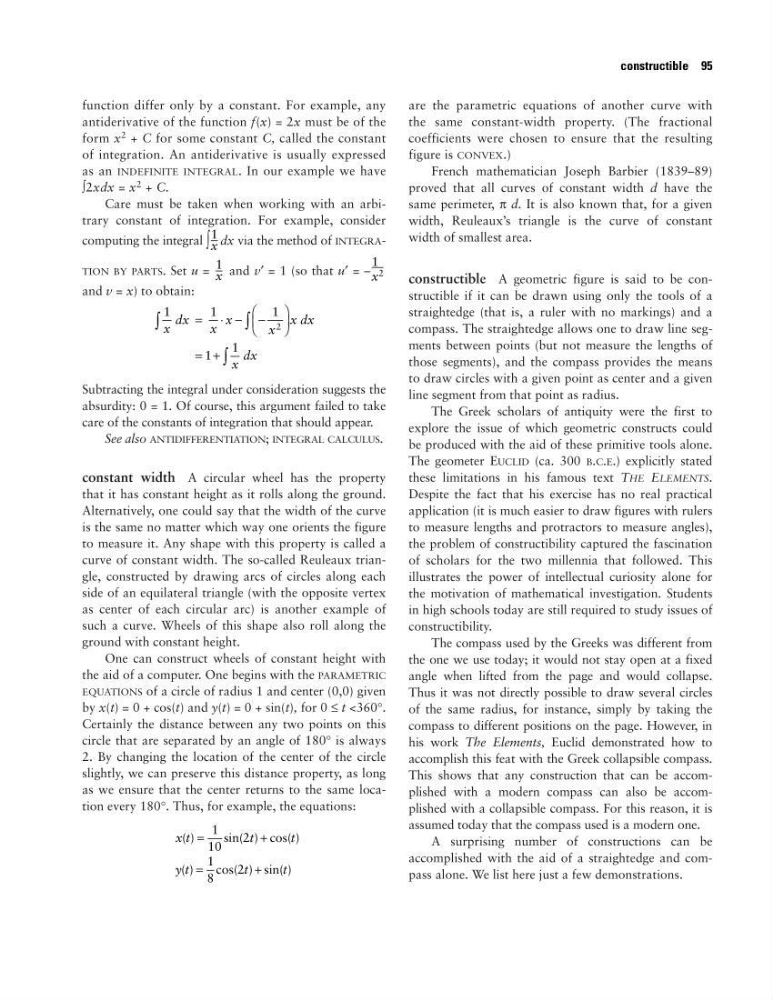
function differ only by a constant. For example, any
antiderivative of the function f(x) = 2x must be of the
form x
2 + C for some constant C, called the constant
of integration. An antiderivative is usually expressed
as an INDEFINITE INTEGRAL. In our example we have
∫2xdx = x
2 + C.
Care must be taken when working with an arbitrary constant of integration. For example, consider
computing the integral ∫ dx via the method of INTEGRATION BY PARTS. Set u =
and v′ = 1 (so that u′ = –
and v = x) to obtain:
Subtracting the integral under consideration suggests the
absurdity: 0 = 1. Of course, this argument failed to take
care of the constants of integration that should appear.
See also ANTIDIFFERENTIATION; INTEGRAL CALCULUS.
constant width A circular wheel has the property
that it has constant height as it rolls along the ground.
Alternatively, one could say that the width of the curve
is the same no matter which way one orients the figure
to measure it. Any shape with this property is called a
curve of constant width. The so-called Reuleaux triangle, constructed by drawing arcs of circles along each
side of an equilateral triangle (with the opposite vertex
as center of each circular arc) is another example of
such a curve. Wheels of this shape also roll along the
ground with constant height.
One can construct wheels of constant height with
the aid of a computer. One begins with the PARAMETRIC
EQUATIONS of a circle of radius 1 and center (0,0) given
by x(t) = 0 + cos(t) and y(t) = 0 + sin(t), for 0 ≤ t <360°.
Certainly the distance between any two points on this
circle that are separated by an angle of 180° is always
2. By changing the location of the center of the circle
slightly, we can preserve this distance property, as long
as we ensure that the center returns to the same location every 180°. Thus, for example, the equations:
are the parametric equations of another curve with
the same constant-width property. (The fractional
coefficients were chosen to ensure that the resulting
figure is CONVEX.)
French mathematician Joseph Barbier (1839–89)
proved that all curves of constant width d have the
same perimeter, π d. It is also known that, for a given
width, Reuleaux’s triangle is the curve of constant
width of smallest area.
constructible A geometric figure is said to be constructible if it can be drawn using only the tools of a
straightedge (that is, a ruler with no markings) and a
compass. The straightedge allows one to draw line segments between points (but not measure the lengths of
those segments), and the compass provides the means
to draw circles with a given point as center and a given
line segment from that point as radius.
The Greek scholars of antiquity were the first to
explore the issue of which geometric constructs could
be produced with the aid of these primitive tools alone.
The geometer EUCLID (ca. 300 B.C.E.) explicitly stated
these limitations in his famous text THE ELEMENTS.
Despite the fact that his exercise has no real practical
application (it is much easier to draw figures with rulers
to measure lengths and protractors to measure angles),
the problem of constructibility captured the fascination
of scholars for the two millennia that followed. This
illustrates the power of intellectual curiosity alone for
the motivation of mathematical investigation. Students
in high schools today are still required to study issues of
constructibility.
The compass used by the Greeks was different from
the one we use today; it would not stay open at a fixed
angle when lifted from the page and would collapse.
Thus it was not directly possible to draw several circles
of the same radius, for instance, simply by taking the
compass to different positions on the page. However, in
his work The Elements, Euclid demonstrated how to
accomplish this feat with the Greek collapsible compass.
This shows that any construction that can be accomplished with a modern compass can also be accomplished with a collapsible compass. For this reason, it is
assumed today that the compass used is a modern one.
A surprising number of constructions can be
accomplished with the aid of a straightedge and compass alone. We list here just a few demonstrations.
x t
t
t
y t
t
t
( )
sin( ) cos( )
( )
cos( ) sin( )
=
+
=
+
1
10
2
1
8
2
1
1
1
1
1
2
x
dx
x
x
x
x dx
x
dx
∫
∫
∫
= ⋅ − −
= +
1
x
2
1
x
1
x
constructible 95
antiderivative of the function f(x) = 2x must be of the
form x
2 + C for some constant C, called the constant
of integration. An antiderivative is usually expressed
as an INDEFINITE INTEGRAL. In our example we have
∫2xdx = x
2 + C.
Care must be taken when working with an arbitrary constant of integration. For example, consider
computing the integral ∫ dx via the method of INTEGRATION BY PARTS. Set u =
and v′ = 1 (so that u′ = –
and v = x) to obtain:
Subtracting the integral under consideration suggests the
absurdity: 0 = 1. Of course, this argument failed to take
care of the constants of integration that should appear.
See also ANTIDIFFERENTIATION; INTEGRAL CALCULUS.
constant width A circular wheel has the property
that it has constant height as it rolls along the ground.
Alternatively, one could say that the width of the curve
is the same no matter which way one orients the figure
to measure it. Any shape with this property is called a
curve of constant width. The so-called Reuleaux triangle, constructed by drawing arcs of circles along each
side of an equilateral triangle (with the opposite vertex
as center of each circular arc) is another example of
such a curve. Wheels of this shape also roll along the
ground with constant height.
One can construct wheels of constant height with
the aid of a computer. One begins with the PARAMETRIC
EQUATIONS of a circle of radius 1 and center (0,0) given
by x(t) = 0 + cos(t) and y(t) = 0 + sin(t), for 0 ≤ t <360°.
Certainly the distance between any two points on this
circle that are separated by an angle of 180° is always
2. By changing the location of the center of the circle
slightly, we can preserve this distance property, as long
as we ensure that the center returns to the same location every 180°. Thus, for example, the equations:
are the parametric equations of another curve with
the same constant-width property. (The fractional
coefficients were chosen to ensure that the resulting
figure is CONVEX.)
French mathematician Joseph Barbier (1839–89)
proved that all curves of constant width d have the
same perimeter, π d. It is also known that, for a given
width, Reuleaux’s triangle is the curve of constant
width of smallest area.
constructible A geometric figure is said to be constructible if it can be drawn using only the tools of a
straightedge (that is, a ruler with no markings) and a
compass. The straightedge allows one to draw line segments between points (but not measure the lengths of
those segments), and the compass provides the means
to draw circles with a given point as center and a given
line segment from that point as radius.
The Greek scholars of antiquity were the first to
explore the issue of which geometric constructs could
be produced with the aid of these primitive tools alone.
The geometer EUCLID (ca. 300 B.C.E.) explicitly stated
these limitations in his famous text THE ELEMENTS.
Despite the fact that his exercise has no real practical
application (it is much easier to draw figures with rulers
to measure lengths and protractors to measure angles),
the problem of constructibility captured the fascination
of scholars for the two millennia that followed. This
illustrates the power of intellectual curiosity alone for
the motivation of mathematical investigation. Students
in high schools today are still required to study issues of
constructibility.
The compass used by the Greeks was different from
the one we use today; it would not stay open at a fixed
angle when lifted from the page and would collapse.
Thus it was not directly possible to draw several circles
of the same radius, for instance, simply by taking the
compass to different positions on the page. However, in
his work The Elements, Euclid demonstrated how to
accomplish this feat with the Greek collapsible compass.
This shows that any construction that can be accomplished with a modern compass can also be accomplished with a collapsible compass. For this reason, it is
assumed today that the compass used is a modern one.
A surprising number of constructions can be
accomplished with the aid of a straightedge and compass alone. We list here just a few demonstrations.
x t
t
t
y t
t
t
( )
sin( ) cos( )
( )
cos( ) sin( )
=
+
=
+
1
10
2
1
8
2
1
1
1
1
1
2
x
dx
x
x
x
x dx
x
dx
∫
∫
∫
= ⋅ − −
= +
1
x
2
1
x
1
x
constructible 95