

"'O
0
c
:J
0
(V)
..--t
0
N
@
.......
..c
O'l
·;::::
>0..
0
u
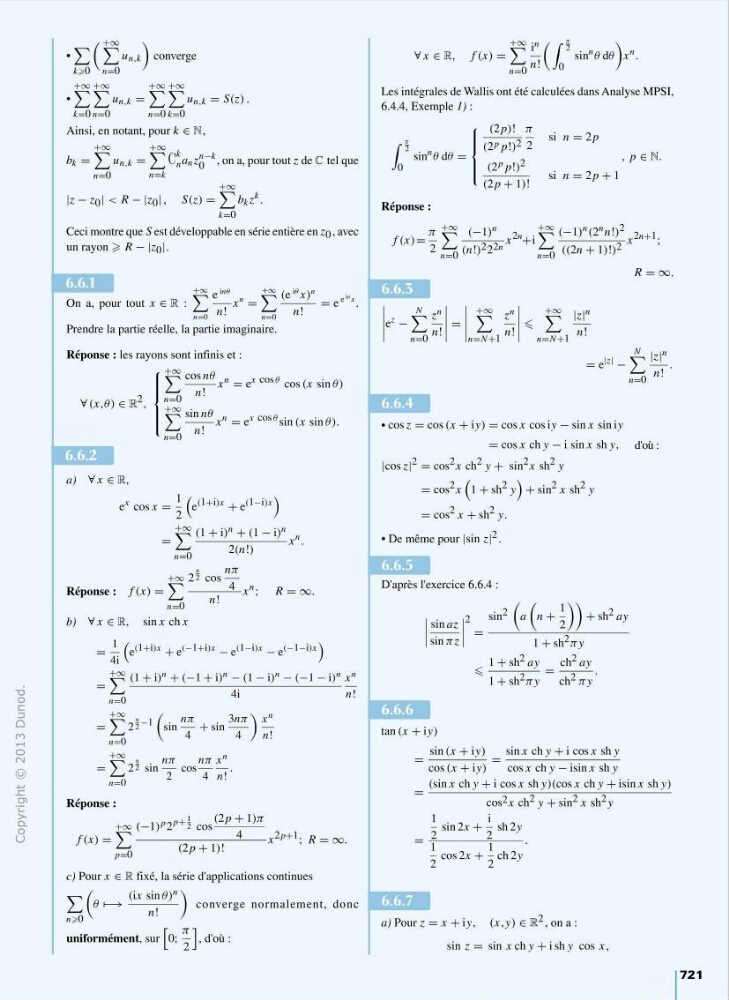
• L ( ~ Un,k) converge
k;;,O n=O
+oo +oo
+oo +oo
• L Lun, k = L Lun,k = S (z ).
k=Ün=O
n=Ük=O
Ainsi, en notant, pour k E N,
+oo
+oo
bk = L un ,k = L C~a 11 z 0 -k, on a, pour tout z de C tel que
n=O
n=k
+oo
lz - zo l < R - lzo l. S (z) = Lbki.
k=O
Ceci montre que S est développable en série entière en zo, avec
un rayon ~ R - lzo l.
+oo e inll
+oo (e ill x )"
;e
On a, pour tout x E lR : L -;;1 x" = L:-n1
-
= e e x .
n=O
·
n=O
·
Prendre la partie réelle, la partie imaginaire.
Réponse : les rayons sont infinis et :
- -xn =ex cos cos (x sin &)
l
+ Loo cos ne
·e
n!
' V (x B) E JR.2
n= Ü
'
,
+oo .
smnB
. .
L -1
- x" = e" cos esin (x sin &) .
0
n.
n=
a) ' V X E JR,
ex cosx = ~ (e(l +i)x + eCl-i)x)
_ ~ (1 + i)" + (1 - i)n x "
- ~
2 (n !)
·
n=O
11
nn
+oo 2 2 cos -
Réponse: f(x) = L
1
4 x ";
R = oo.
n=O
n.
b) ' V xE JR, sin xch x
= ~ ( e(l+i)x +e<-l +i)x - e( l-i)x - e<- 1- i)x )
= ~ (1 + i)" + (- 1 + i)" - (1 - i)" - (- 1 - i)" x "
~
4·
1
n=O
1
n.
+oo " (
nrr
3nrr ) x"
= z= 22 - l sin - +sin - - -
n=O
4
4
n'
+oo "
nrr
nrr x"
= ~2 2 sin - cos- - .
~
2
4 n!
n=O
Réponse:
+oo (-1 )P2P+ ~ cos ( 2 p + l)rr
f (x )=L
4
x 2p+ l.R= oo.
p=O
(2p+l)!
'
c) Pour x E lR fi xé, la série d'applications continues
L ( e ~ (ix s~~ B)n) conve rge norm ale me nt , donc
n;;,O
uniformément, sur [ O; ~ J, d'où :
'V x E JR, f(x ) = ~ i", ( f ~ sin" Bde)x" .
n=O n. Jo
Les intégrales de Wallis ont été calcul ées dans Analyse MPSI,
6.4.4, Exemple 1) :
(2p) ! rr
si n =2p
t , ;n'O d9 ~ l
(2P p! )2 2
(2 P p!)2
, p E N.
(2p + l )!
si n = 2p + l
Réponse:
rr +oo ( - 1 )"
+oo ( - 1)" (2" n ' ) 2
f (x ) - - "\"'
x 2 "+ i "\"'
· x 2 n+I.
- 2 ~ (n! )222n
,f=Q ( (2n + 1) !)2
'
R =OO .
= elz l _ t 11' ...
n=O n!
• cosz =cos (x + iy) = cosx cos iy - sin x sin iy
= cosx ch y - i sin x sh y, d'où :
lcos z l 2 = cos 2 x ch 2 y+ sin 2 x sh 2 y
= cos 2 x ( 1 + sh 2 y) + sin 2 x sh 2 y
= cos 2 x + sh 2 y .
•De même pour lsin z l 2 .
D'après l'exercice 6.6.4 :
1
s~n az
1
2
sin
2
(a ( n + ~)) + sh
2
ay
s in rr z
1 + sh 2 rr y
tan (x + iy)
l + sh 2 ay
:::; - - - -
1 +sh2 rr y
ch 2 a y
ch 2 rry.
sin (x + iy)
sinx ch y + i cosx sh y
cos (x + iy)
cosxch y- isin x sh y
(sin x ch y+ i cos x sh y) (cosx ch y+ isin x sh y)
cos 2 x ch 2 y + sin 2 x sh 2 y
1
i
- sin2x + - sh2y
2
2
l
1
2
cos 2x + 2
ch 2 y
a) Pour z = x+ i y , (x ,y) EJR. 2 , on a:
sin z = sin x ch y + i sh y cos x,
1 721
0
c
:J
0
(V)
..--t
0
N
@
.......
..c
O'l
·;::::
>0..
0
u
• L ( ~ Un,k) converge
k;;,O n=O
+oo +oo
+oo +oo
• L Lun, k = L Lun,k = S (z ).
k=Ün=O
n=Ük=O
Ainsi, en notant, pour k E N,
+oo
+oo
bk = L un ,k = L C~a 11 z 0 -k, on a, pour tout z de C tel que
n=O
n=k
+oo
lz - zo l < R - lzo l. S (z) = Lbki.
k=O
Ceci montre que S est développable en série entière en zo, avec
un rayon ~ R - lzo l.
+oo e inll
+oo (e ill x )"
;e
On a, pour tout x E lR : L -;;1 x" = L:-n1
-
= e e x .
n=O
·
n=O
·
Prendre la partie réelle, la partie imaginaire.
Réponse : les rayons sont infinis et :
- -xn =ex cos cos (x sin &)
l
+ Loo cos ne
·e
n!
' V (x B) E JR.2
n= Ü
'
,
+oo .
smnB
. .
L -1
- x" = e" cos esin (x sin &) .
0
n.
n=
a) ' V X E JR,
ex cosx = ~ (e(l +i)x + eCl-i)x)
_ ~ (1 + i)" + (1 - i)n x "
- ~
2 (n !)
·
n=O
11
nn
+oo 2 2 cos -
Réponse: f(x) = L
1
4 x ";
R = oo.
n=O
n.
b) ' V xE JR, sin xch x
= ~ ( e(l+i)x +e<-l +i)x - e( l-i)x - e<- 1- i)x )
= ~ (1 + i)" + (- 1 + i)" - (1 - i)" - (- 1 - i)" x "
~
4·
1
n=O
1
n.
+oo " (
nrr
3nrr ) x"
= z= 22 - l sin - +sin - - -
n=O
4
4
n'
+oo "
nrr
nrr x"
= ~2 2 sin - cos- - .
~
2
4 n!
n=O
Réponse:
+oo (-1 )P2P+ ~ cos ( 2 p + l)rr
f (x )=L
4
x 2p+ l.R= oo.
p=O
(2p+l)!
'
c) Pour x E lR fi xé, la série d'applications continues
L ( e ~ (ix s~~ B)n) conve rge norm ale me nt , donc
n;;,O
uniformément, sur [ O; ~ J, d'où :
'V x E JR, f(x ) = ~ i", ( f ~ sin" Bde)x" .
n=O n. Jo
Les intégrales de Wallis ont été calcul ées dans Analyse MPSI,
6.4.4, Exemple 1) :
(2p) ! rr
si n =2p
t , ;n'O d9 ~ l
(2P p! )2 2
(2 P p!)2
, p E N.
(2p + l )!
si n = 2p + l
Réponse:
rr +oo ( - 1 )"
+oo ( - 1)" (2" n ' ) 2
f (x ) - - "\"'
x 2 "+ i "\"'
· x 2 n+I.
- 2 ~ (n! )222n
,f=Q ( (2n + 1) !)2
'
R =OO .
= elz l _ t 11' ...
n=O n!
• cosz =cos (x + iy) = cosx cos iy - sin x sin iy
= cosx ch y - i sin x sh y, d'où :
lcos z l 2 = cos 2 x ch 2 y+ sin 2 x sh 2 y
= cos 2 x ( 1 + sh 2 y) + sin 2 x sh 2 y
= cos 2 x + sh 2 y .
•De même pour lsin z l 2 .
D'après l'exercice 6.6.4 :
1
s~n az
1
2
sin
2
(a ( n + ~)) + sh
2
ay
s in rr z
1 + sh 2 rr y
tan (x + iy)
l + sh 2 ay
:::; - - - -
1 +sh2 rr y
ch 2 a y
ch 2 rry.
sin (x + iy)
sinx ch y + i cosx sh y
cos (x + iy)
cosxch y- isin x sh y
(sin x ch y+ i cos x sh y) (cosx ch y+ isin x sh y)
cos 2 x ch 2 y + sin 2 x sh 2 y
1
i
- sin2x + - sh2y
2
2
l
1
2
cos 2x + 2
ch 2 y
a) Pour z = x+ i y , (x ,y) EJR. 2 , on a:
sin z = sin x ch y + i sh y cos x,
1 721