

96
Chapitre 4 • Fondements du calcul matriciel
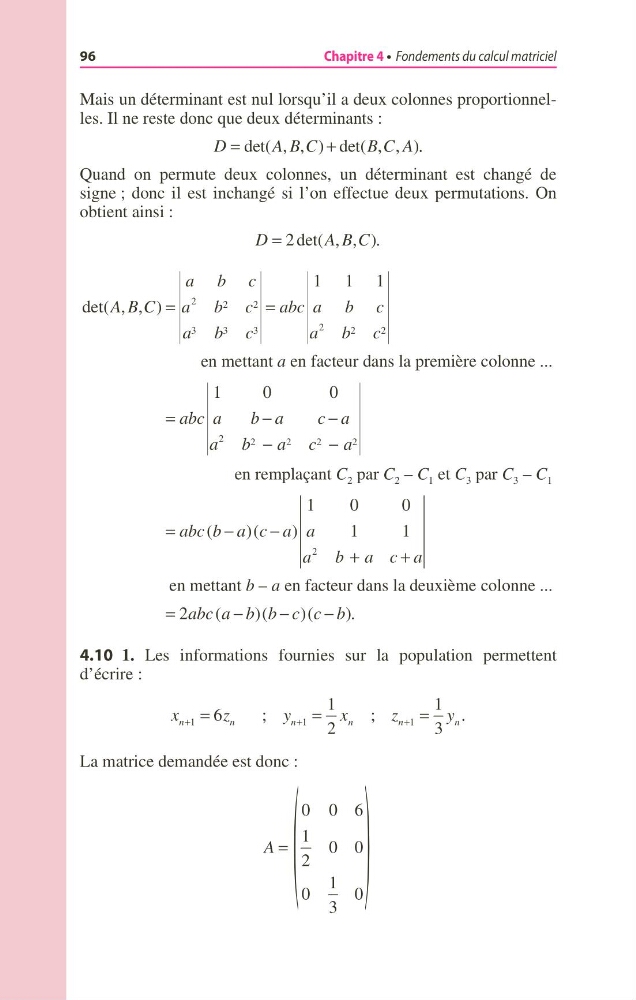
Mais un déterminant est nul lorsqu’il a deux colonnes proportionnelles. Il ne reste donc que deux déterminants :
Quand on permute deux colonnes, un déterminant est changé de
signe ; donc il est inchangé si l’on effectue deux permutations. On
obtient ainsi :
en mettant a en facteur dans la première colonne ...
en remplaçant C 2 par C 2 – C 1 et C 3 par C 3 – C 1
en mettant b – a en facteur dans la deuxième colonne ...
4.10 1. Les informations fournies sur la population permettent
d’écrire :
La matrice demandée est donc :
det(
) det(
)
D
A BC
BC A
=
, , +
, , .
2 det(
)
D
ABC
=
, , .
2
2
2
2
3
3
3
2
2
1 1 1
det(
)
a b c
A B C
a b c
abc a b c
a b c
a b c
, , =
=
2
2
2
2
2
1
0
0
abc a
b a
c a
a b
a c
a
=
−
−
−
−
2
1
0
0
(
)(
)
1
1
abc b a c a a
a b a c a
=
−
−
+
+
2
(
)(
)(
)
abc a b b c c b
=
−
−
− .
1
1
1
1
1
6
2
3
n
n
n
n
n
n
x
z x y
x
z
y
+
+
+
=
;
=
;
=
.
0 0 6
1 0 0
2
1
0
0
3
A =
)
(
Chapitre 4 • Fondements du calcul matriciel
Mais un déterminant est nul lorsqu’il a deux colonnes proportionnelles. Il ne reste donc que deux déterminants :
Quand on permute deux colonnes, un déterminant est changé de
signe ; donc il est inchangé si l’on effectue deux permutations. On
obtient ainsi :
en mettant a en facteur dans la première colonne ...
en remplaçant C 2 par C 2 – C 1 et C 3 par C 3 – C 1
en mettant b – a en facteur dans la deuxième colonne ...
4.10 1. Les informations fournies sur la population permettent
d’écrire :
La matrice demandée est donc :
det(
) det(
)
D
A BC
BC A
=
, , +
, , .
2 det(
)
D
ABC
=
, , .
2
2
2
2
3
3
3
2
2
1 1 1
det(
)
a b c
A B C
a b c
abc a b c
a b c
a b c
, , =
=
2
2
2
2
2
1
0
0
abc a
b a
c a
a b
a c
a
=
−
−
−
−
2
1
0
0
(
)(
)
1
1
abc b a c a a
a b a c a
=
−
−
+
+
2
(
)(
)(
)
abc a b b c c b
=
−
−
− .
1
1
1
1
1
6
2
3
n
n
n
n
n
n
x
z x y
x
z
y
+
+
+
=
;
=
;
=
.
0 0 6
1 0 0
2
1
0
0
3
A =
)
(