

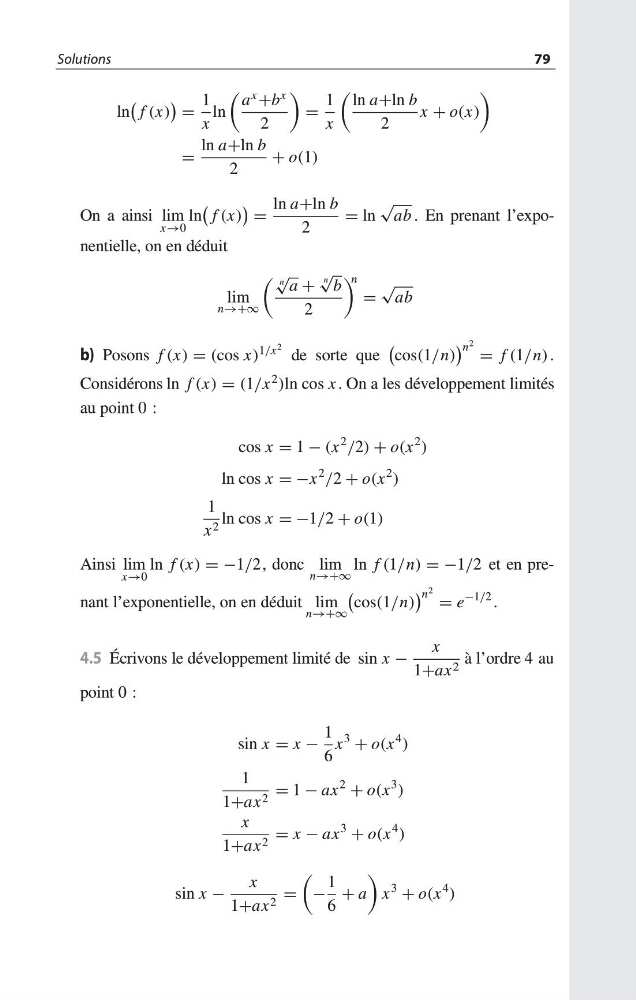
ln
f (x)
=
1
x
ln
a
x +b
x
2
=
1
x
ln a+ln b
2
x + o(x)
=
ln a+ln b
2
+ o(1)
On a ainsi lim
x→0
ln
f (x)
=
ln a+ln b
2
= ln
√
ab . En prenant l’exponentielle, on en déduit
lim
n→+∞
n
√
a +
n
√
b
2
n
=
√
ab
b) Posons f (x) = (cos x)
1/x 2 de sorte que
cos(1/n)
n 2
= f (1/n).
Considérons ln f (x) = (1/x
2 )ln cos x . On a les développement limités
au point 0 :
cos x = 1 − (x
2 /2) + o(x
2 )
ln cos x = −x
2 /2 + o(x
2 )
1
x 2 ln cos x = −1/2 + o(1)
Ainsi lim
x→0
ln f (x) = −1/2, donc lim
n→+∞
ln f (1/n) = −1/2 et en prenant l’exponentielle, on en déduit lim
n→+∞
cos(1/n)
n 2
= e
−1/2
.
4.5 Écrivons le développement limité de sin x −
x
1+ax 2 à l’ordre 4 au
point 0 :
sin x = x −
1
6
x
3 + o(x
4 )
1
1+ax 2 = 1 − ax
2 + o(x
3 )
x
1+ax 2 = x − ax
3 + o(x
4 )
sin x −
x
1+ax 2 =
−
1
6
+ a
x
3 + o(x
4 )
Solutions
79
9782100545636-Liret-C04.qxd 31/03/10 10:32 Page 79
f (x)
=
1
x
ln
a
x +b
x
2
=
1
x
ln a+ln b
2
x + o(x)
=
ln a+ln b
2
+ o(1)
On a ainsi lim
x→0
ln
f (x)
=
ln a+ln b
2
= ln
√
ab . En prenant l’exponentielle, on en déduit
lim
n→+∞
n
√
a +
n
√
b
2
n
=
√
ab
b) Posons f (x) = (cos x)
1/x 2 de sorte que
cos(1/n)
n 2
= f (1/n).
Considérons ln f (x) = (1/x
2 )ln cos x . On a les développement limités
au point 0 :
cos x = 1 − (x
2 /2) + o(x
2 )
ln cos x = −x
2 /2 + o(x
2 )
1
x 2 ln cos x = −1/2 + o(1)
Ainsi lim
x→0
ln f (x) = −1/2, donc lim
n→+∞
ln f (1/n) = −1/2 et en prenant l’exponentielle, on en déduit lim
n→+∞
cos(1/n)
n 2
= e
−1/2
.
4.5 Écrivons le développement limité de sin x −
x
1+ax 2 à l’ordre 4 au
point 0 :
sin x = x −
1
6
x
3 + o(x
4 )
1
1+ax 2 = 1 − ax
2 + o(x
3 )
x
1+ax 2 = x − ax
3 + o(x
4 )
sin x −
x
1+ax 2 =
−
1
6
+ a
x
3 + o(x
4 )
Solutions
79
9782100545636-Liret-C04.qxd 31/03/10 10:32 Page 79