

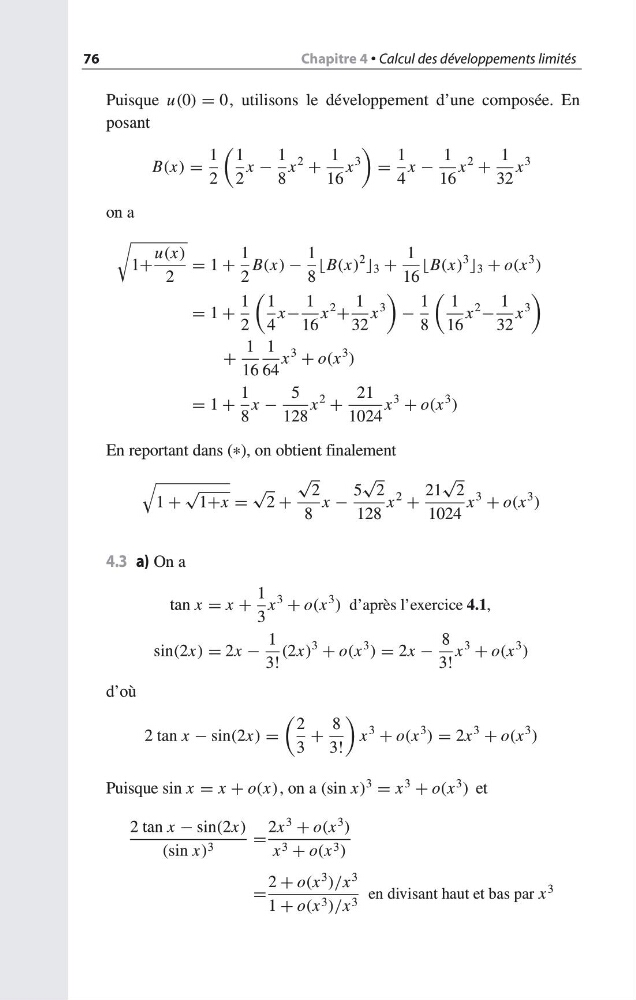
Puisque u(0) = 0, utilisons le développement d’une composée. En
posant
B(x) =
1
2
1
2
x −
1
8
x
2 +
1
16
x
3
=
1
4
x −
1
16
x
2 +
1
32
x
3
on a
1+
u(x)
2
= 1 +
1
2
B(x) −
1
8
B(x)
2 3 +
1
16
B(x)
3 3 + o(x
3 )
= 1 +
1
2
1
4
x−
1
16
x
2 +
1
32
x
3
−
1
8
1
16
x
2 −
1
32
x
3
+
1
16
1
64
x
3 + o(x
3 )
= 1 +
1
8
x −
5
128
x
2 +
21
1024
x
3 + o(x
3 )
En reportant dans ( * ), on obtient finalement
1 +
√
1+x =
√
2 +
√
2
8
x −
5
√
2
128
x
2 +
21
√
2
1024
x
3 + o(x
3 )
4.3 a) On a
tan x = x +
1
3
x
3 + o(x
3 ) d’après l’exercice 4.1,
sin(2x) = 2x −
1
3!
(2x)
3 + o(x
3 ) = 2x −
8
3!
x
3 + o(x
3 )
d’où
2 tan x − sin(2x) =
2
3
+
8
3!
x
3 + o(x
3 ) = 2x
3 + o(x
3 )
Puisque sin x = x + o(x), on a (sin x)
3 = x
3 + o(x
3 ) et
2 tan x − sin(2x)
(sin x) 3
=
2x
3 + o(x
3 )
x 3 + o(x 3 )
=
2 + o(x
3 )/x
3
1 + o(x 3 )/x 3 en divisant haut et bas par x
3
76
Chapitre 4 • Calcul des développements limités
9782100545636-Liret-C04.qxd 31/03/10 10:32 Page 76
posant
B(x) =
1
2
1
2
x −
1
8
x
2 +
1
16
x
3
=
1
4
x −
1
16
x
2 +
1
32
x
3
on a
1+
u(x)
2
= 1 +
1
2
B(x) −
1
8
B(x)
2 3 +
1
16
B(x)
3 3 + o(x
3 )
= 1 +
1
2
1
4
x−
1
16
x
2 +
1
32
x
3
−
1
8
1
16
x
2 −
1
32
x
3
+
1
16
1
64
x
3 + o(x
3 )
= 1 +
1
8
x −
5
128
x
2 +
21
1024
x
3 + o(x
3 )
En reportant dans ( * ), on obtient finalement
1 +
√
1+x =
√
2 +
√
2
8
x −
5
√
2
128
x
2 +
21
√
2
1024
x
3 + o(x
3 )
4.3 a) On a
tan x = x +
1
3
x
3 + o(x
3 ) d’après l’exercice 4.1,
sin(2x) = 2x −
1
3!
(2x)
3 + o(x
3 ) = 2x −
8
3!
x
3 + o(x
3 )
d’où
2 tan x − sin(2x) =
2
3
+
8
3!
x
3 + o(x
3 ) = 2x
3 + o(x
3 )
Puisque sin x = x + o(x), on a (sin x)
3 = x
3 + o(x
3 ) et
2 tan x − sin(2x)
(sin x) 3
=
2x
3 + o(x
3 )
x 3 + o(x 3 )
=
2 + o(x
3 )/x
3
1 + o(x 3 )/x 3 en divisant haut et bas par x
3
76
Chapitre 4 • Calcul des développements limités
9782100545636-Liret-C04.qxd 31/03/10 10:32 Page 76