

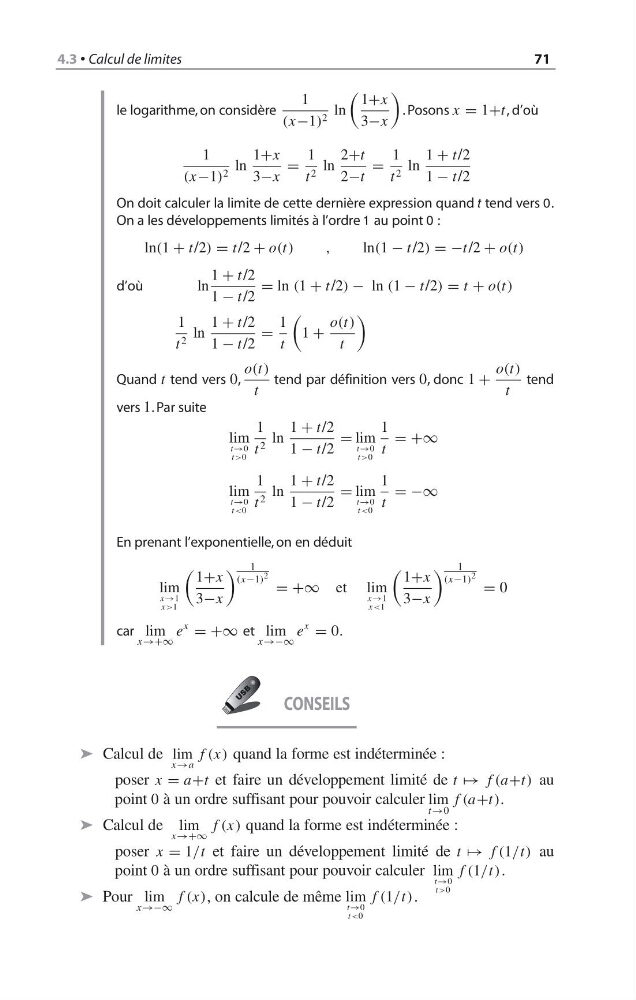
le logarithme, on considère
1
(x−1) 2 ln
1+x
3−x
. Posons x = 1+t , d’où
1
(x−1) 2 ln
1+x
3−x
=
1
t 2 ln
2+t
2−t
=
1
t 2 ln
1 + t/2
1 − t/2
On doit calculer la limite de cette dernière expression quand t tend vers 0.
On a les développements limités à l’ordre 1 au point 0 :
ln(1 + t/2) = t/2 + o(t)
,
ln(1 − t/2) = −t/2 + o(t)
d’où
ln
1 + t/2
1 − t/2
= ln (1 + t/2) − ln (1 − t/2) = t + o(t)
1
t 2 ln
1 + t/2
1 − t/2
=
1
t
1 +
o(t)
t
Quand t tend vers 0,
o(t)
t
tend par définition vers 0, donc 1 +
o(t)
t
tend
vers 1. Par suite
lim
t→0
t>0
1
t 2 ln
1 + t/2
1 − t/2
= lim
t→0
t>0
1
t
= +∞
lim
t→0
t<0
1
t 2 ln
1 + t/2
1 − t/2
= lim
t→0
t<0
1
t
= −∞
En prenant l’exponentielle, on en déduit
lim
x→1
x>1
1+x
3−x
1
(x−1) 2
= +∞ et lim
x→1
x<1
1+x
3−x
1
(x−1) 2
= 0
car lim
x→+∞
e
x = +∞ et lim
x→−∞
e
x = 0.
CONSEILS
® Calcul de lim
x→a
f (x) quand la forme est indéterminée :
poser x = a+t et faire un développement limité de t → f (a+t) au
point 0 à un ordre suffisant pour pouvoir calculer lim
t→0
f (a+t).
® Calcul de lim
x→+∞
f (x) quand la forme est indéterminée :
poser x = 1/t et faire un développement limité de t → f (1/t) au
point 0 à un ordre suffisant pour pouvoir calculer lim
t→0
t>0
f (1/t).
® Pour lim
x→−∞
f (x), on calcule de même lim
t→0
t<0
f (1/t).
4.3 • Calcul de limites
71
9782100545636-Liret-C04.qxd 31/03/10 10:32 Page 71
1
(x−1) 2 ln
1+x
3−x
. Posons x = 1+t , d’où
1
(x−1) 2 ln
1+x
3−x
=
1
t 2 ln
2+t
2−t
=
1
t 2 ln
1 + t/2
1 − t/2
On doit calculer la limite de cette dernière expression quand t tend vers 0.
On a les développements limités à l’ordre 1 au point 0 :
ln(1 + t/2) = t/2 + o(t)
,
ln(1 − t/2) = −t/2 + o(t)
d’où
ln
1 + t/2
1 − t/2
= ln (1 + t/2) − ln (1 − t/2) = t + o(t)
1
t 2 ln
1 + t/2
1 − t/2
=
1
t
1 +
o(t)
t
Quand t tend vers 0,
o(t)
t
tend par définition vers 0, donc 1 +
o(t)
t
tend
vers 1. Par suite
lim
t→0
t>0
1
t 2 ln
1 + t/2
1 − t/2
= lim
t→0
t>0
1
t
= +∞
lim
t→0
t<0
1
t 2 ln
1 + t/2
1 − t/2
= lim
t→0
t<0
1
t
= −∞
En prenant l’exponentielle, on en déduit
lim
x→1
x>1
1+x
3−x
1
(x−1) 2
= +∞ et lim
x→1
x<1
1+x
3−x
1
(x−1) 2
= 0
car lim
x→+∞
e
x = +∞ et lim
x→−∞
e
x = 0.
CONSEILS
® Calcul de lim
x→a
f (x) quand la forme est indéterminée :
poser x = a+t et faire un développement limité de t → f (a+t) au
point 0 à un ordre suffisant pour pouvoir calculer lim
t→0
f (a+t).
® Calcul de lim
x→+∞
f (x) quand la forme est indéterminée :
poser x = 1/t et faire un développement limité de t → f (1/t) au
point 0 à un ordre suffisant pour pouvoir calculer lim
t→0
t>0
f (1/t).
® Pour lim
x→−∞
f (x), on calcule de même lim
t→0
t<0
f (1/t).
4.3 • Calcul de limites
71
9782100545636-Liret-C04.qxd 31/03/10 10:32 Page 71