

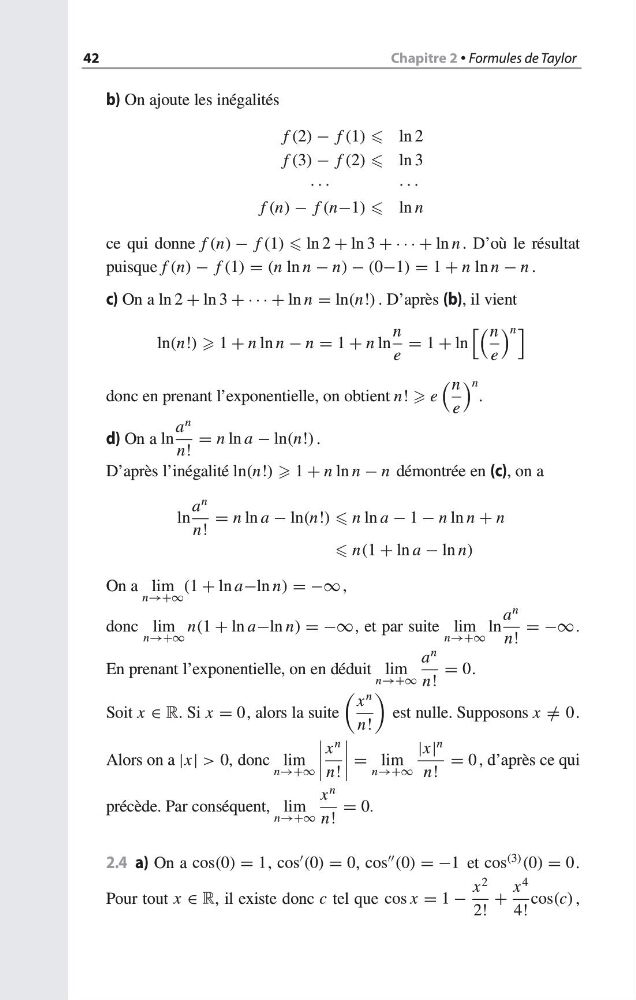
b) On ajoute les inégalités
f (2) − f (1) ln 2
f (3) − f (2) ln 3
· · ·
· · ·
f (n) − f (n−1) ln n
ce qui donne f (n) − f (1) ln 2 + ln 3 + · · · + ln n . D’où le résultat
puisque f (n) − f (1) = (n ln n − n) − (0−1) = 1 + n ln n − n .
c) On a ln 2 + ln 3 + · · · + ln n = ln(n!) . D’après (b), il vient
ln(n!) 1 + n ln n − n = 1 + n ln
n
e
= 1 + ln
n
e
n
donc en prenant l’exponentielle, on obtient n! e
n
e
n .
d) On a ln
a
n
n!
= n ln a − ln(n!) .
D’après l’inégalité ln(n!) 1 + n ln n − n démontrée en (c), on a
ln
a
n
n!
= n ln a − ln(n!) n ln a − 1 − n ln n + n
n(1 + ln a − ln n)
On a lim
n→+∞
(1 + ln a−ln n) = −∞ ,
donc lim
n→+∞
n(1 + ln a−ln n) = −∞, et par suite lim
n→+∞
ln
a
n
n!
= −∞.
En prenant l’exponentielle, on en déduit lim
n→+∞
a
n
n!
= 0.
Soit x ∈ R. Si x = 0, alors la suite
x
n
n!
est nulle. Supposons x = / 0.
Alors on a |x| > 0, donc lim
n→+∞
x
n
n!
= lim
n→+∞
|x|
n
n!
= 0 , d’après ce qui
précède. Par conséquent, lim
n→+∞
x
n
n!
= 0.
2.4 a) On a cos(0) = 1, cos
(0) = 0, cos
(0) = −1 et cos
(3) (0) = 0.
Pour tout x ∈ R, il existe donc c tel que cos x = 1 −
x
2
2!
+
x
4
4!
cos(c) ,
42
Chapitre 2 • Formules de Taylor
9782100545636-Liret-C02.qxd 31/03/10 10:04 Page 42
f (2) − f (1) ln 2
f (3) − f (2) ln 3
· · ·
· · ·
f (n) − f (n−1) ln n
ce qui donne f (n) − f (1) ln 2 + ln 3 + · · · + ln n . D’où le résultat
puisque f (n) − f (1) = (n ln n − n) − (0−1) = 1 + n ln n − n .
c) On a ln 2 + ln 3 + · · · + ln n = ln(n!) . D’après (b), il vient
ln(n!) 1 + n ln n − n = 1 + n ln
n
e
= 1 + ln
n
e
n
donc en prenant l’exponentielle, on obtient n! e
n
e
n .
d) On a ln
a
n
n!
= n ln a − ln(n!) .
D’après l’inégalité ln(n!) 1 + n ln n − n démontrée en (c), on a
ln
a
n
n!
= n ln a − ln(n!) n ln a − 1 − n ln n + n
n(1 + ln a − ln n)
On a lim
n→+∞
(1 + ln a−ln n) = −∞ ,
donc lim
n→+∞
n(1 + ln a−ln n) = −∞, et par suite lim
n→+∞
ln
a
n
n!
= −∞.
En prenant l’exponentielle, on en déduit lim
n→+∞
a
n
n!
= 0.
Soit x ∈ R. Si x = 0, alors la suite
x
n
n!
est nulle. Supposons x = / 0.
Alors on a |x| > 0, donc lim
n→+∞
x
n
n!
= lim
n→+∞
|x|
n
n!
= 0 , d’après ce qui
précède. Par conséquent, lim
n→+∞
x
n
n!
= 0.
2.4 a) On a cos(0) = 1, cos
(0) = 0, cos
(0) = −1 et cos
(3) (0) = 0.
Pour tout x ∈ R, il existe donc c tel que cos x = 1 −
x
2
2!
+
x
4
4!
cos(c) ,
42
Chapitre 2 • Formules de Taylor
9782100545636-Liret-C02.qxd 31/03/10 10:04 Page 42