

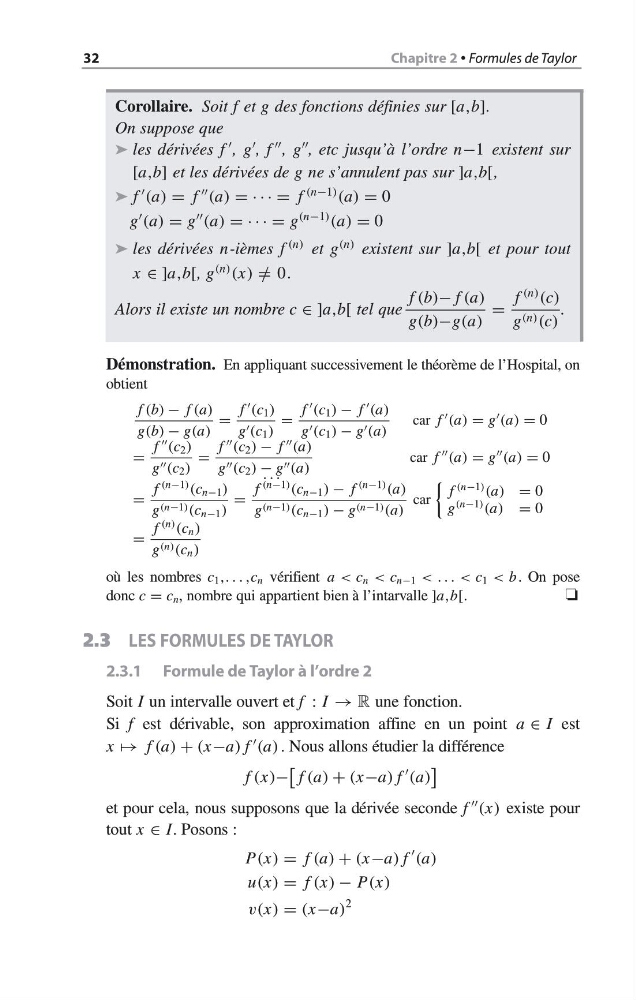
Corollaire. Soit f et g des fonctions définies sur [a,b].
On suppose que
® les dérivées f
, g
, f
, g
, etc jusqu’à l’ordre n−1 existent sur
[a,b] et les dérivées de g ne s’annulent pas sur ]a,b[,
® f
(a) = f
(a) = · · · = f
(n−1) (a) = 0
g
(a) = g
(a) = · · · = g
(n−1) (a) = 0
® les dérivées n-ièmes f
(n)
et g
(n)
existent sur ]a,b[ et pour tout
x ∈ ]a,b[, g
(n) (x) = / 0 .
Alors il existe un nombre c ∈ ]a,b[ tel que
f (b)− f (a)
g(b)−g(a)
=
f
(n) (c)
g (n) (c)
.
Démonstration. En appliquant successivement le théorème de l’Hospital, on
obtient
f (b) − f (a)
g(b) − g(a)
=
f
(c 1 )
g (c 1 )
=
f
(c 1 ) − f
(a)
g (c 1 ) − g (a)
car f
(a) = g
(a) = 0
=
f
(c 2 )
g (c 2 )
=
f
(c 2 ) − f
(a)
g (c 2 ) − g (a)
car f
(a) = g
(a) = 0
. . .
=
f
(n−1) (c n−1 )
g (n−1) (c n−1 )
=
f
(n−1) (c n−1 ) − f
(n−1) (a)
g (n−1) (c n−1 ) − g (n−1) (a)
car
f
(n−1) (a) = 0
g
(n−1) (a) = 0
=
f
(n) (c n )
g (n) (c n )
où les nombres c 1 ,. . . ,c n vérifient a < c n < c n−1 < . . . < c 1 < b . On pose
donc c = c n , nombre qui appartient bien à l’intarvalle ]a,b[.
J
2.3 LES FORMULES DE TAYLOR
2.3.1 Formule de Taylor à l’ordre 2
Soit I un intervalle ouvert et f : I → R une fonction.
Si f est dérivable, son approximation affine en un point a ∈ I est
x → f (a) + (x−a) f
(a) . Nous allons étudier la différence
f (x)−
f (a) + (x−a) f
(a)
et pour cela, nous supposons que la dérivée seconde f
(x) existe pour
tout x ∈ I. Posons :
P(x) = f (a) + (x−a) f
(a)
u(x) = f (x) − P(x)
v(x) = (x−a)
2
32
Chapitre 2 • Formules de Taylor
9782100545636-Liret-C02.qxd 31/03/10 10:04 Page 32
On suppose que
® les dérivées f
, g
, f
, g
, etc jusqu’à l’ordre n−1 existent sur
[a,b] et les dérivées de g ne s’annulent pas sur ]a,b[,
® f
(a) = f
(a) = · · · = f
(n−1) (a) = 0
g
(a) = g
(a) = · · · = g
(n−1) (a) = 0
® les dérivées n-ièmes f
(n)
et g
(n)
existent sur ]a,b[ et pour tout
x ∈ ]a,b[, g
(n) (x) = / 0 .
Alors il existe un nombre c ∈ ]a,b[ tel que
f (b)− f (a)
g(b)−g(a)
=
f
(n) (c)
g (n) (c)
.
Démonstration. En appliquant successivement le théorème de l’Hospital, on
obtient
f (b) − f (a)
g(b) − g(a)
=
f
(c 1 )
g (c 1 )
=
f
(c 1 ) − f
(a)
g (c 1 ) − g (a)
car f
(a) = g
(a) = 0
=
f
(c 2 )
g (c 2 )
=
f
(c 2 ) − f
(a)
g (c 2 ) − g (a)
car f
(a) = g
(a) = 0
. . .
=
f
(n−1) (c n−1 )
g (n−1) (c n−1 )
=
f
(n−1) (c n−1 ) − f
(n−1) (a)
g (n−1) (c n−1 ) − g (n−1) (a)
car
f
(n−1) (a) = 0
g
(n−1) (a) = 0
=
f
(n) (c n )
g (n) (c n )
où les nombres c 1 ,. . . ,c n vérifient a < c n < c n−1 < . . . < c 1 < b . On pose
donc c = c n , nombre qui appartient bien à l’intarvalle ]a,b[.
J
2.3 LES FORMULES DE TAYLOR
2.3.1 Formule de Taylor à l’ordre 2
Soit I un intervalle ouvert et f : I → R une fonction.
Si f est dérivable, son approximation affine en un point a ∈ I est
x → f (a) + (x−a) f
(a) . Nous allons étudier la différence
f (x)−
f (a) + (x−a) f
(a)
et pour cela, nous supposons que la dérivée seconde f
(x) existe pour
tout x ∈ I. Posons :
P(x) = f (a) + (x−a) f
(a)
u(x) = f (x) − P(x)
v(x) = (x−a)
2
32
Chapitre 2 • Formules de Taylor
9782100545636-Liret-C02.qxd 31/03/10 10:04 Page 32