

1.5 FONCTIONS HYPERBOLIQUES
Définitions
® La fonction sinus hyperbolique, notée sh : R → R est définie par
sh x =
e
x − e
−x
2
® La fonction cosinus hyperbolique, notée ch : R → R est définie
par
ch x =
e
x + e
−x
2
® La fonction tangente hyperbolique, notée th : R → R est définie
par
th x =
sh x
ch x
.
1.5.1 Propriétés des fonctions hyperboliques
(1) Les fonctions sh, ch et th sont dérivables et l’on a
sh
(x) = ch x , ch
(x) = sh x
et
th
(x) = 1−( th x)
2
(2) sh(0) = 0, ch(0) = 1 et (ch x)
2 − (sh x)
2 = 1 pour tout x ∈ R.
(3) Pour tout x, on a
sh(−x) = − sh x , ch(−x) = ch x , th(−x) = − th x
ch x 1 et −1 < th x < 1
(4) La fonction sh est impaire et strictement croissante ;
elle définit une bijection sh : R → R.
12
Chapitre 1 • Suites et fonctions
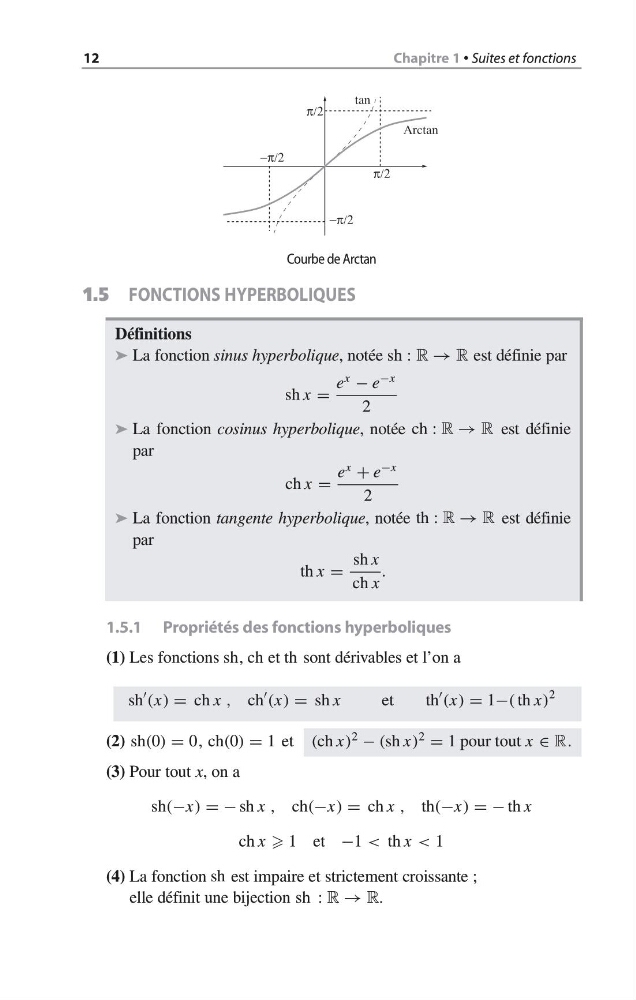
Courbe de Arctan
−π/2
−π/2
π/2
π/2
Arctan
tan
9782100545636-Liret-C01.qxd 31/03/10 10:00 Page 12
Définitions
® La fonction sinus hyperbolique, notée sh : R → R est définie par
sh x =
e
x − e
−x
2
® La fonction cosinus hyperbolique, notée ch : R → R est définie
par
ch x =
e
x + e
−x
2
® La fonction tangente hyperbolique, notée th : R → R est définie
par
th x =
sh x
ch x
.
1.5.1 Propriétés des fonctions hyperboliques
(1) Les fonctions sh, ch et th sont dérivables et l’on a
sh
(x) = ch x , ch
(x) = sh x
et
th
(x) = 1−( th x)
2
(2) sh(0) = 0, ch(0) = 1 et (ch x)
2 − (sh x)
2 = 1 pour tout x ∈ R.
(3) Pour tout x, on a
sh(−x) = − sh x , ch(−x) = ch x , th(−x) = − th x
ch x 1 et −1 < th x < 1
(4) La fonction sh est impaire et strictement croissante ;
elle définit une bijection sh : R → R.
12
Chapitre 1 • Suites et fonctions
Courbe de Arctan
−π/2
−π/2
π/2
π/2
Arctan
tan
9782100545636-Liret-C01.qxd 31/03/10 10:00 Page 12