

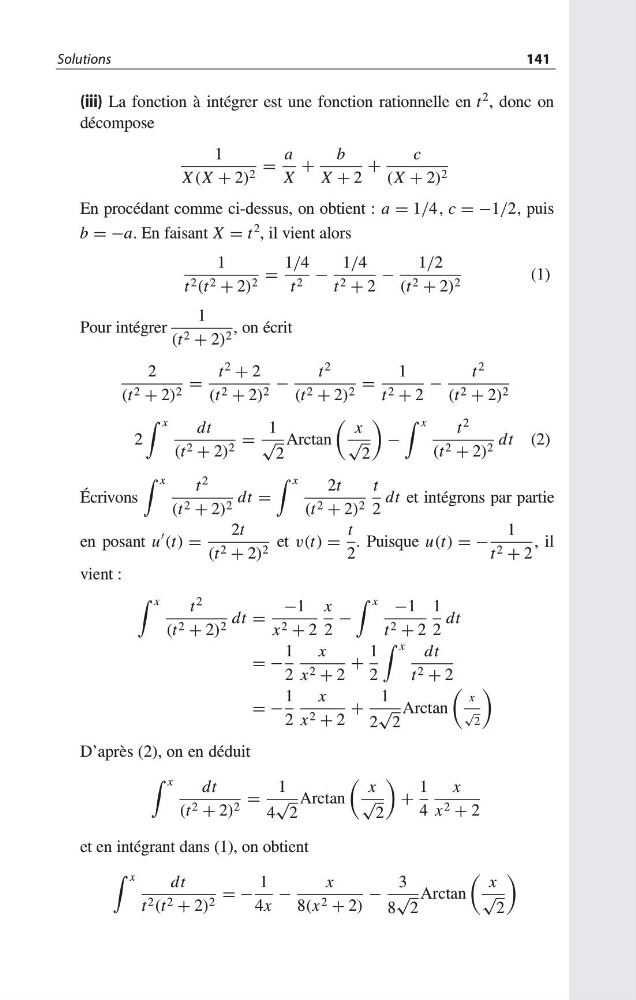
(iii) La fonction à intégrer est une fonction rationnelle en t
2
, donc on
décompose
1
X (X + 2) 2 =
a
X
+
b
X + 2
+
c
(X + 2) 2
En procédant comme ci-dessus, on obtient : a = 1/4, c = −1/2, puis
b = −a. En faisant X = t
2
, il vient alors
1
t 2 (t 2 + 2) 2 =
1/4
t 2 −
1/4
t 2 + 2
−
1/2
(t 2 + 2) 2
(1)
Pour intégrer
1
(t 2 + 2) 2 , on écrit
2
(t 2 + 2) 2 =
t
2 + 2
(t 2 + 2) 2 −
t
2
(t 2 + 2) 2 =
1
t 2 + 2
−
t
2
(t 2 + 2) 2
2
x
dt
(t 2 + 2) 2 =
1
√
2
Arctan
x
√
2
−
x
t
2
(t 2 + 2) 2 dt (2)
Écrivons
x
t
2
(t 2 + 2) 2 dt =
x
2t
(t 2 + 2) 2
t
2
dt et intégrons par partie
en posant u
(t) =
2t
(t 2 + 2) 2 et v(t) =
t
2
. Puisque u(t) = −
1
t 2 + 2
, il
vient :
x
t
2
(t 2 + 2) 2 dt =
−1
x 2 + 2
x
2
−
x −1
t 2 + 2
1
2
dt
= −
1
2
x
x 2 + 2
+
1
2
x dt
t 2 + 2
= −
1
2
x
x 2 + 2
+
1
2
√
2
Arctan
x
√
2
D’après (2), on en déduit
x
dt
(t 2 + 2) 2 =
1
4
√
2
Arctan
x
√
2
+
1
4
x
x 2 + 2
et en intégrant dans (1), on obtient
x
dt
t 2 (t 2 + 2) 2 = −
1
4x
−
x
8(x 2 + 2)
−
3
8
√
2
Arctan
x
√
2
Solutions
141
9782100545636-Liret-C07.qxd 31/03/10 10:43 Page 141
2
, donc on
décompose
1
X (X + 2) 2 =
a
X
+
b
X + 2
+
c
(X + 2) 2
En procédant comme ci-dessus, on obtient : a = 1/4, c = −1/2, puis
b = −a. En faisant X = t
2
, il vient alors
1
t 2 (t 2 + 2) 2 =
1/4
t 2 −
1/4
t 2 + 2
−
1/2
(t 2 + 2) 2
(1)
Pour intégrer
1
(t 2 + 2) 2 , on écrit
2
(t 2 + 2) 2 =
t
2 + 2
(t 2 + 2) 2 −
t
2
(t 2 + 2) 2 =
1
t 2 + 2
−
t
2
(t 2 + 2) 2
2
x
dt
(t 2 + 2) 2 =
1
√
2
Arctan
x
√
2
−
x
t
2
(t 2 + 2) 2 dt (2)
Écrivons
x
t
2
(t 2 + 2) 2 dt =
x
2t
(t 2 + 2) 2
t
2
dt et intégrons par partie
en posant u
(t) =
2t
(t 2 + 2) 2 et v(t) =
t
2
. Puisque u(t) = −
1
t 2 + 2
, il
vient :
x
t
2
(t 2 + 2) 2 dt =
−1
x 2 + 2
x
2
−
x −1
t 2 + 2
1
2
dt
= −
1
2
x
x 2 + 2
+
1
2
x dt
t 2 + 2
= −
1
2
x
x 2 + 2
+
1
2
√
2
Arctan
x
√
2
D’après (2), on en déduit
x
dt
(t 2 + 2) 2 =
1
4
√
2
Arctan
x
√
2
+
1
4
x
x 2 + 2
et en intégrant dans (1), on obtient
x
dt
t 2 (t 2 + 2) 2 = −
1
4x
−
x
8(x 2 + 2)
−
3
8
√
2
Arctan
x
√
2
Solutions
141
9782100545636-Liret-C07.qxd 31/03/10 10:43 Page 141