

5.5 a) Pour tout x = / ± 1 , on a −x = / ± 1et
f (−x) = (x
2 − 1)ln
| − x + 1|
| − x − 1|
= (x
2 − 1)ln
|x − 1|
|x + 1|
= −(x
2 − 1)ln
|x + 1|
|x − 1|
= − f (x)
b) Posons x = 1 + t. Il vient, pour tout t ∈ R \ {0,−2} :
f (1 + t) = t (2 + t)
ln|2 + t| − ln|t|
Quand t tend vers 0, t (2 + t)ln|2 + t| tend vers 0. Puisque
lim
t→0
t ln |t|
= 0, on en déduit lim
x→1
f (x) = lim
t→0
f (1 + t) = 0 .
Comme la fonction f est impaire, on a aussi lim
x→−1
f (x) = 0. Posons
h(x) = f (x) pour tout x ∈ R \ {1,−1} et h(1) = h(−1) = 0. Alors la
fonction h est continue en tout point de R.
Pour tout t = / 0 suffisamment petit, on a
h(1 + t)
t
=
f (1 + t)
t
= (2 + t)
ln|2 + t| − ln|t|
Puisque lim
t→0
ln|t| =−∞ , il vient lim
t→0
ln|2 + t| − ln|t|
= +∞ et donc
lim
x→1
h(x) − h(1)
x − 1
= lim
t→0
h(1 + t)
t
= +∞
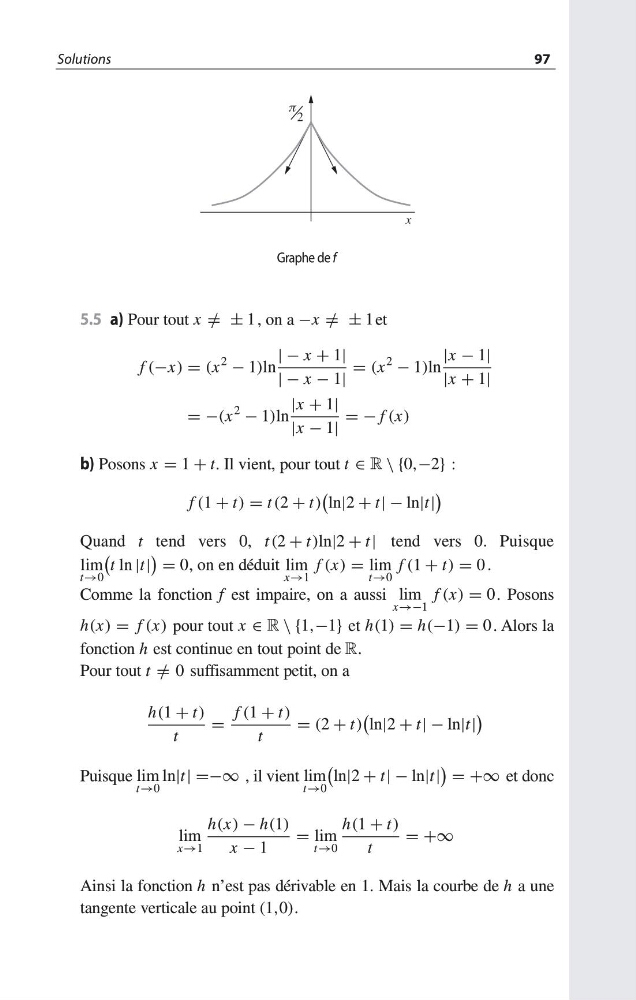
Ainsi la fonction h n’est pas dérivable en 1. Mais la courbe de h a une
tangente verticale au point (1,0).
Solutions
97
Graphe de f
x
2
π
9782100545636-Liret-C05.qxd 31/03/10 11:10 Page 97
f (−x) = (x
2 − 1)ln
| − x + 1|
| − x − 1|
= (x
2 − 1)ln
|x − 1|
|x + 1|
= −(x
2 − 1)ln
|x + 1|
|x − 1|
= − f (x)
b) Posons x = 1 + t. Il vient, pour tout t ∈ R \ {0,−2} :
f (1 + t) = t (2 + t)
ln|2 + t| − ln|t|
Quand t tend vers 0, t (2 + t)ln|2 + t| tend vers 0. Puisque
lim
t→0
t ln |t|
= 0, on en déduit lim
x→1
f (x) = lim
t→0
f (1 + t) = 0 .
Comme la fonction f est impaire, on a aussi lim
x→−1
f (x) = 0. Posons
h(x) = f (x) pour tout x ∈ R \ {1,−1} et h(1) = h(−1) = 0. Alors la
fonction h est continue en tout point de R.
Pour tout t = / 0 suffisamment petit, on a
h(1 + t)
t
=
f (1 + t)
t
= (2 + t)
ln|2 + t| − ln|t|
Puisque lim
t→0
ln|t| =−∞ , il vient lim
t→0
ln|2 + t| − ln|t|
= +∞ et donc
lim
x→1
h(x) − h(1)
x − 1
= lim
t→0
h(1 + t)
t
= +∞
Ainsi la fonction h n’est pas dérivable en 1. Mais la courbe de h a une
tangente verticale au point (1,0).
Solutions
97
Graphe de f
x
2
π
9782100545636-Liret-C05.qxd 31/03/10 11:10 Page 97