

Nguyen, Brunstrom, Grinnemo, and Taheri
38
2.3.1 5G Radio Access Network
The enabling technologies for 5G RAN include mmWave communication, massive
Multiple Input Multiple Output (MIMO), ultra‐dense small cell, Machine‐to‐Machine
(M2M) and Device‐to‐Device (D2D) communications, cloud‐RAN, and mobile edge
and fog computing. These technologies will be described in the following.
2.3.1.1 mmWave Communication
As mentioned previously, one of the key features of the 5G system is to have higher capacity
in terms of data rate, for example, up to tens of Gbps at peak data rate. In order to achieve
those targets, more spectrum availability is required. However, current wireless systems are
typically operating in a spectrum band, ranging from hundreds of MHz (e.g. 700 MHz) to
below 3 GHz (e.g. 2.6 GHz). These spectrum usages are not sufficient enough for 5G. One
of the most effective solutions for expanding the bandwidth range is to exploit the very high
spectrum bands, which have not been occupied yet (e.g. > 10 Ghz). In particular, during the
meeting at the WRC‐15 conference hosted by ITU, several proposed frequency bands
above 10 GHz for 5G have been approved to be studied ahead of the next WRC conference
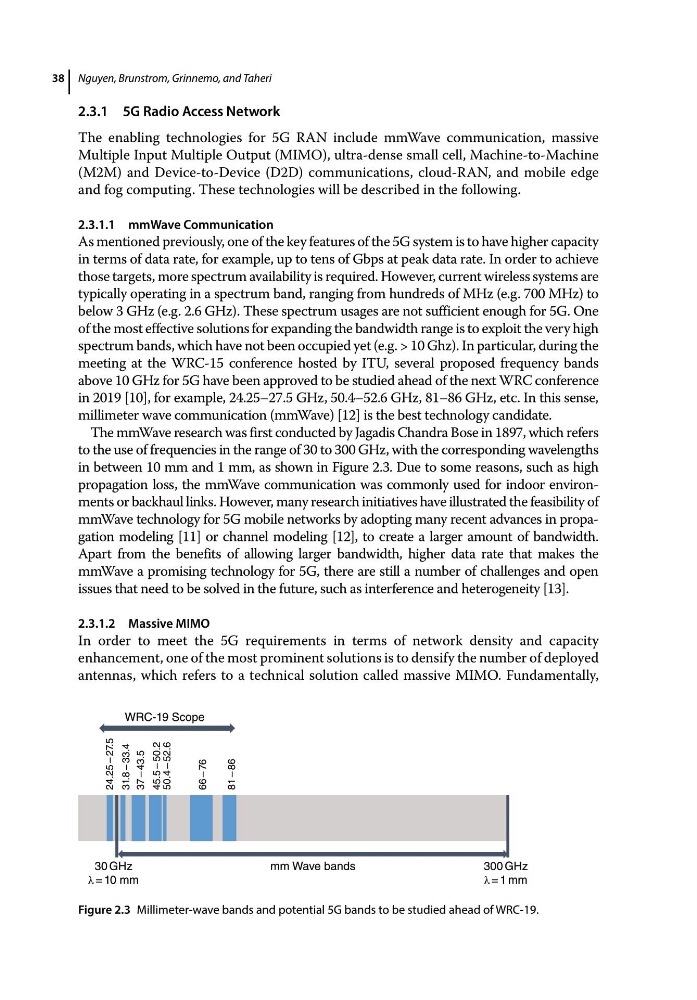
in 2019 [10], for example, 24.25–27.5 GHz, 50.4–52.6 GHz, 81–86 GHz, etc. In this sense,
millimeter wave communication (mmWave) [12] is the best technology candidate.
The mmWave research was first conducted by Jagadis Chandra Bose in 1897, which refers
to the use of frequencies in the range of 30 to 300 GHz, with the corresponding wavelengths
in between 10 mm and 1 mm, as shown in Figure 2.3. Due to some reasons, such as high
propagation loss, the mmWave communication was commonly used for indoor environments or backhaul links. However, many research initiatives have illustrated the feasibility of
mmWave technology for 5G mobile networks by adopting many recent advances in propagation modeling [11] or channel modeling [12], to create a larger amount of bandwidth.
Apart from the benefits of allowing larger bandwidth, higher data rate that makes the
mmWave a promising technology for 5G, there are still a number of challenges and open
issues that need to be solved in the future, such as interference and heterogeneity [13].
2.3.1.2 Massive MIMO
In order to meet the 5G requirements in terms of network density and capacity
enhancement, one of the most prominent solutions is to densify the number of deployed
antennas, which refers to a technical solution called massive MIMO. Fundamentally,
WRC-19 Scope
30 GHz
λ = 10 mm
300 GHz
λ = 1 mm
mm Wave bands
24.25 – 27.5
45.5 – 50.2
50.4 – 52.6
66 – 76
81 – 86
31.8 – 33.4
37 – 43.5
Figure 2.3 Millimeter‐wave bands and potential 5G bands to be studied ahead of WRC‐19.
38
2.3.1 5G Radio Access Network
The enabling technologies for 5G RAN include mmWave communication, massive
Multiple Input Multiple Output (MIMO), ultra‐dense small cell, Machine‐to‐Machine
(M2M) and Device‐to‐Device (D2D) communications, cloud‐RAN, and mobile edge
and fog computing. These technologies will be described in the following.
2.3.1.1 mmWave Communication
As mentioned previously, one of the key features of the 5G system is to have higher capacity
in terms of data rate, for example, up to tens of Gbps at peak data rate. In order to achieve
those targets, more spectrum availability is required. However, current wireless systems are
typically operating in a spectrum band, ranging from hundreds of MHz (e.g. 700 MHz) to
below 3 GHz (e.g. 2.6 GHz). These spectrum usages are not sufficient enough for 5G. One
of the most effective solutions for expanding the bandwidth range is to exploit the very high
spectrum bands, which have not been occupied yet (e.g. > 10 Ghz). In particular, during the
meeting at the WRC‐15 conference hosted by ITU, several proposed frequency bands
above 10 GHz for 5G have been approved to be studied ahead of the next WRC conference
in 2019 [10], for example, 24.25–27.5 GHz, 50.4–52.6 GHz, 81–86 GHz, etc. In this sense,
millimeter wave communication (mmWave) [12] is the best technology candidate.
The mmWave research was first conducted by Jagadis Chandra Bose in 1897, which refers
to the use of frequencies in the range of 30 to 300 GHz, with the corresponding wavelengths
in between 10 mm and 1 mm, as shown in Figure 2.3. Due to some reasons, such as high
propagation loss, the mmWave communication was commonly used for indoor environments or backhaul links. However, many research initiatives have illustrated the feasibility of
mmWave technology for 5G mobile networks by adopting many recent advances in propagation modeling [11] or channel modeling [12], to create a larger amount of bandwidth.
Apart from the benefits of allowing larger bandwidth, higher data rate that makes the
mmWave a promising technology for 5G, there are still a number of challenges and open
issues that need to be solved in the future, such as interference and heterogeneity [13].
2.3.1.2 Massive MIMO
In order to meet the 5G requirements in terms of network density and capacity
enhancement, one of the most prominent solutions is to densify the number of deployed
antennas, which refers to a technical solution called massive MIMO. Fundamentally,
WRC-19 Scope
30 GHz
λ = 10 mm
300 GHz
λ = 1 mm
mm Wave bands
24.25 – 27.5
45.5 – 50.2
50.4 – 52.6
66 – 76
81 – 86
31.8 – 33.4
37 – 43.5
Figure 2.3 Millimeter‐wave bands and potential 5G bands to be studied ahead of WRC‐19.