

5G Mobile Networks: Requirements, Enabling Technologies, and Research Activities 37
guarantee the communication channel between the control and data planes as SDN is
adopted, and how to isolate and manage network slices securely as network slicing is
enabled, etc. At the service level, there will be many kinds of newly defined 5G services, which will require different security levels. For example, some critical services,
such as public safety and eHealth, require more security than other services, such as
virtual reality, augmented reality, etc. In addition, the involvement of new actors, and
the introduction of new business models, will derive new service delivery models
and new trust models. For example, in the current system, the trust model is mostly
formed between users and mobile operators. However, more actors such as vertical
service providers will play an important role in defining new trust models in 5G. The
careful design of these models, together with guaranteeing the aforementioned
requirements, is necessary to provide an end‐to‐end secured communication channel
for users in the 5G ecosystem.
Last but not least, privacy concerns also need to be considered in the development of
5G. Indeed, 5G networks will accommodate massive numbers of user devices, meaning
that a great amount of user privacy information such as user identifiers will be carried
over the 5G network. In addition, new types of device identities such as identifiers for
IoT devices will also be introduced in 5G. Therefore, it requires an efficient way to manage this massive amount of information as well as to protect and prevent the leakage of
user personal information. Research activities and proposals on 5G related security and
privacy will be discussed in detail in other chapters.
2.3 5G Enabling Technologies
In order to meet the strict requirements discussed previously, a number of technology
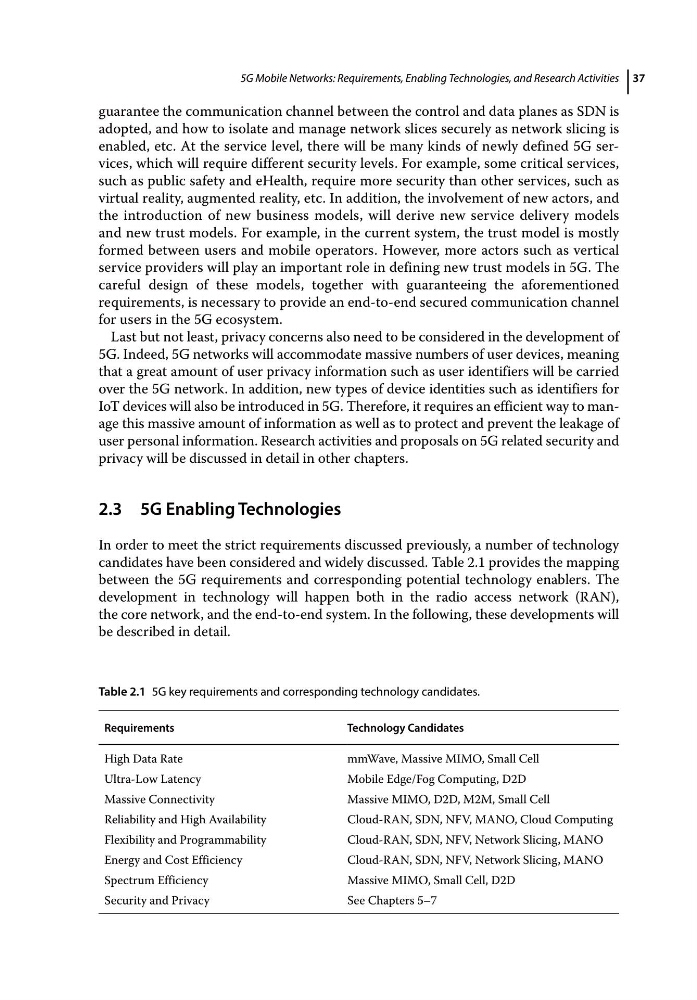
candidates have been considered and widely discussed. Table 2.1 provides the mapping
between the 5G requirements and corresponding potential technology enablers. The
development in technology will happen both in the radio access network (RAN),
the core network, and the end‐to‐end system. In the following, these developments will
be described in detail.
Table 2.1 5G key requirements and corresponding technology candidates.
Requirements
Technology Candidates
High Data Rate
mmWave, Massive MIMO, Small Cell
Ultra‐Low Latency
Mobile Edge/Fog Computing, D2D
Massive Connectivity
Massive MIMO, D2D, M2M, Small Cell
Reliability and High Availability
Cloud‐RAN, SDN, NFV, MANO, Cloud Computing
Flexibility and Programmability
Cloud‐RAN, SDN, NFV, Network Slicing, MANO
Energy and Cost Efficiency
Cloud‐RAN, SDN, NFV, Network Slicing, MANO
Spectrum Efficiency
Massive MIMO, Small Cell, D2D
Security and Privacy
See Chapters 5–7
guarantee the communication channel between the control and data planes as SDN is
adopted, and how to isolate and manage network slices securely as network slicing is
enabled, etc. At the service level, there will be many kinds of newly defined 5G services, which will require different security levels. For example, some critical services,
such as public safety and eHealth, require more security than other services, such as
virtual reality, augmented reality, etc. In addition, the involvement of new actors, and
the introduction of new business models, will derive new service delivery models
and new trust models. For example, in the current system, the trust model is mostly
formed between users and mobile operators. However, more actors such as vertical
service providers will play an important role in defining new trust models in 5G. The
careful design of these models, together with guaranteeing the aforementioned
requirements, is necessary to provide an end‐to‐end secured communication channel
for users in the 5G ecosystem.
Last but not least, privacy concerns also need to be considered in the development of
5G. Indeed, 5G networks will accommodate massive numbers of user devices, meaning
that a great amount of user privacy information such as user identifiers will be carried
over the 5G network. In addition, new types of device identities such as identifiers for
IoT devices will also be introduced in 5G. Therefore, it requires an efficient way to manage this massive amount of information as well as to protect and prevent the leakage of
user personal information. Research activities and proposals on 5G related security and
privacy will be discussed in detail in other chapters.
2.3 5G Enabling Technologies
In order to meet the strict requirements discussed previously, a number of technology
candidates have been considered and widely discussed. Table 2.1 provides the mapping
between the 5G requirements and corresponding potential technology enablers. The
development in technology will happen both in the radio access network (RAN),
the core network, and the end‐to‐end system. In the following, these developments will
be described in detail.
Table 2.1 5G key requirements and corresponding technology candidates.
Requirements
Technology Candidates
High Data Rate
mmWave, Massive MIMO, Small Cell
Ultra‐Low Latency
Mobile Edge/Fog Computing, D2D
Massive Connectivity
Massive MIMO, D2D, M2M, Small Cell
Reliability and High Availability
Cloud‐RAN, SDN, NFV, MANO, Cloud Computing
Flexibility and Programmability
Cloud‐RAN, SDN, NFV, Network Slicing, MANO
Energy and Cost Efficiency
Cloud‐RAN, SDN, NFV, Network Slicing, MANO
Spectrum Efficiency
Massive MIMO, Small Cell, D2D
Security and Privacy
See Chapters 5–7