

Kumar, Liyanage, Ahmad, Braeken, and Ylianttila
276
required to consider the higher level of trust because of the special requirements for
USIM/UICC [10].
From the network operator perspective, Next Generation Mobile Networks (NGMN)
[13] presented three types of business models, that is the Asset provider, Connectivity
Provider and Partner Services Provider. For Asset, XaaS and network‐sharing models
are the most important. The Connectivity provider relies on two business models, that
is basic (projection of current 4G business) and enhanced. There are also two business
models for partner service providers. The first is “operator offer enriched by partner”,
which deals with the services provided by the mobile network operator using the unique
capabilities of third‐party resources. The second one is “partner offer enriched by
operator”, where unique capabilities of an operator is utilized to deliver the services
directly to subscribers.
The existing trust models might not be fully applicable for 5G networks, as in the case
of 5G, where there will be additional entities and actors coming into action to provide
and support numerous novel services. Thus, building the trust model will not be
straightforward and will include far more complexities than one could ever have imagined. For example, one of the possibilities could be to introduce a new entity, such as the
external cloud infrastructure. This is because through virtualization, network operators
can run some operations and applications of the network on the external cloud.
Furthermore, these external clouds might also have their own data centers at different
jurisdictions. Other possibilities to improve the services delivery in 5G are by in sourcing some of the network functionalities, which can be performed by the third party. As
Content Distribution Network (CDN) providers integrate catches in the network operator, it is crucial to consider the fact that the network should not become affected by the
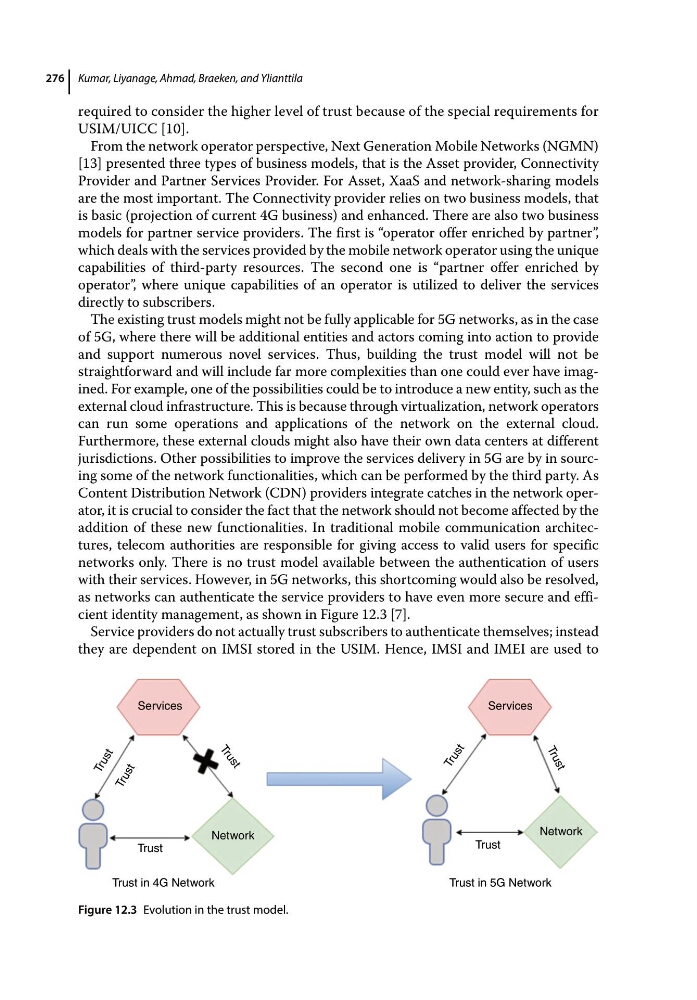
addition of these new functionalities. In traditional mobile communication architectures, telecom authorities are responsible for giving access to valid users for specific
networks only. There is no trust model available between the authentication of users
with their services. However, in 5G networks, this shortcoming would also be resolved,
as networks can authenticate the service providers to have even more secure and efficient identity management, as shown in Figure 12.3 [7].
Service providers do not actually trust subscribers to authenticate themselves; instead
they are dependent on IMSI stored in the USIM. Hence, IMSI and IMEI are used to
T r u s t
T r u s t
T
r
u
s
t
Trust
Trust in 4G Network
T rust in 5G Network
Services
Network
T r u s t
T
r
u
s
t
Trust
Services
Network
Figure 12.3 Evolution in the trust model.
276
required to consider the higher level of trust because of the special requirements for
USIM/UICC [10].
From the network operator perspective, Next Generation Mobile Networks (NGMN)
[13] presented three types of business models, that is the Asset provider, Connectivity
Provider and Partner Services Provider. For Asset, XaaS and network‐sharing models
are the most important. The Connectivity provider relies on two business models, that
is basic (projection of current 4G business) and enhanced. There are also two business
models for partner service providers. The first is “operator offer enriched by partner”,
which deals with the services provided by the mobile network operator using the unique
capabilities of third‐party resources. The second one is “partner offer enriched by
operator”, where unique capabilities of an operator is utilized to deliver the services
directly to subscribers.
The existing trust models might not be fully applicable for 5G networks, as in the case
of 5G, where there will be additional entities and actors coming into action to provide
and support numerous novel services. Thus, building the trust model will not be
straightforward and will include far more complexities than one could ever have imagined. For example, one of the possibilities could be to introduce a new entity, such as the
external cloud infrastructure. This is because through virtualization, network operators
can run some operations and applications of the network on the external cloud.
Furthermore, these external clouds might also have their own data centers at different
jurisdictions. Other possibilities to improve the services delivery in 5G are by in sourcing some of the network functionalities, which can be performed by the third party. As
Content Distribution Network (CDN) providers integrate catches in the network operator, it is crucial to consider the fact that the network should not become affected by the
addition of these new functionalities. In traditional mobile communication architectures, telecom authorities are responsible for giving access to valid users for specific
networks only. There is no trust model available between the authentication of users
with their services. However, in 5G networks, this shortcoming would also be resolved,
as networks can authenticate the service providers to have even more secure and efficient identity management, as shown in Figure 12.3 [7].
Service providers do not actually trust subscribers to authenticate themselves; instead
they are dependent on IMSI stored in the USIM. Hence, IMSI and IMEI are used to
T r u s t
T r u s t
T
r
u
s
t
Trust
Trust in 4G Network
T rust in 5G Network
Services
Network
T r u s t
T
r
u
s
t
Trust
Services
Network
Figure 12.3 Evolution in the trust model.