

User Privacy, Identity and Trust in 5G 277
detect the attempts of attacks by or against stakeholders. Therefore, subscribers and
service providers put their trust in the manufacturers of USIM and Mobile Equipment
(ME) domain equipment. Equipment operators are mainly responsible for its behavior,
whereas the manufacturer has less responsibility. In some cases, contracts reflect the
trust between various stakeholders, such as a roaming agreement of the service provider with other roaming providers, which can permit users to connect to their respective domains. Both the service and roaming providers must have agreements with other
providers (services) to establish a communication path for subscribers. In the 5G (4G)
network, trust relationships exist between various stakeholders, but there may be certain attacks in which trustworthiness of the equipment may not stay according to
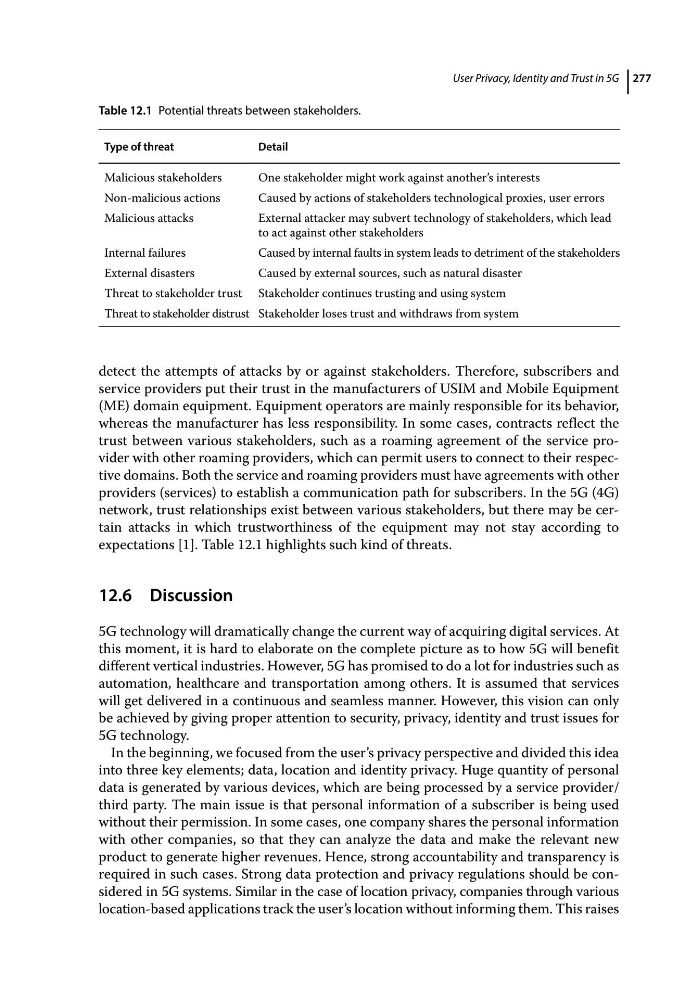
expectations [1]. Table 12.1 highlights such kind of threats.
12.6 Discussion
5G technology will dramatically change the current way of acquiring digital services. At
this moment, it is hard to elaborate on the complete picture as to how 5G will benefit
different vertical industries. However, 5G has promised to do a lot for industries such as
automation, healthcare and transportation among others. It is assumed that services
will get delivered in a continuous and seamless manner. However, this vision can only
be achieved by giving proper attention to security, privacy, identity and trust issues for
5G technology.
In the beginning, we focused from the user’s privacy perspective and divided this idea
into three key elements; data, location and identity privacy. Huge quantity of personal
data is generated by various devices, which are being processed by a service provider/
third party. The main issue is that personal information of a subscriber is being used
without their permission. In some cases, one company shares the personal information
with other companies, so that they can analyze the data and make the relevant new
product to generate higher revenues. Hence, strong accountability and transparency is
required in such cases. Strong data protection and privacy regulations should be considered in 5G systems. Similar in the case of location privacy, companies through various
location‐based applications track the user’s location without informing them. This raises
Table 12.1 Potential threats between stakeholders.
Type of threat
Detail
Malicious stakeholders
One stakeholder might work against another’s interests
Non‐malicious actions
Caused by actions of stakeholders technological proxies, user errors
Malicious attacks
External attacker may subvert technology of stakeholders, which lead
to act against other stakeholders
Internal failures
Caused by internal faults in system leads to detriment of the stakeholders
External disasters
Caused by external sources, such as natural disaster
Threat to stakeholder trust Stakeholder continues trusting and using system
Threat to stakeholder distrust Stakeholder loses trust and withdraws from system
detect the attempts of attacks by or against stakeholders. Therefore, subscribers and
service providers put their trust in the manufacturers of USIM and Mobile Equipment
(ME) domain equipment. Equipment operators are mainly responsible for its behavior,
whereas the manufacturer has less responsibility. In some cases, contracts reflect the
trust between various stakeholders, such as a roaming agreement of the service provider with other roaming providers, which can permit users to connect to their respective domains. Both the service and roaming providers must have agreements with other
providers (services) to establish a communication path for subscribers. In the 5G (4G)
network, trust relationships exist between various stakeholders, but there may be certain attacks in which trustworthiness of the equipment may not stay according to
expectations [1]. Table 12.1 highlights such kind of threats.
12.6 Discussion
5G technology will dramatically change the current way of acquiring digital services. At
this moment, it is hard to elaborate on the complete picture as to how 5G will benefit
different vertical industries. However, 5G has promised to do a lot for industries such as
automation, healthcare and transportation among others. It is assumed that services
will get delivered in a continuous and seamless manner. However, this vision can only
be achieved by giving proper attention to security, privacy, identity and trust issues for
5G technology.
In the beginning, we focused from the user’s privacy perspective and divided this idea
into three key elements; data, location and identity privacy. Huge quantity of personal
data is generated by various devices, which are being processed by a service provider/
third party. The main issue is that personal information of a subscriber is being used
without their permission. In some cases, one company shares the personal information
with other companies, so that they can analyze the data and make the relevant new
product to generate higher revenues. Hence, strong accountability and transparency is
required in such cases. Strong data protection and privacy regulations should be considered in 5G systems. Similar in the case of location privacy, companies through various
location‐based applications track the user’s location without informing them. This raises
Table 12.1 Potential threats between stakeholders.
Type of threat
Detail
Malicious stakeholders
One stakeholder might work against another’s interests
Non‐malicious actions
Caused by actions of stakeholders technological proxies, user errors
Malicious attacks
External attacker may subvert technology of stakeholders, which lead
to act against other stakeholders
Internal failures
Caused by internal faults in system leads to detriment of the stakeholders
External disasters
Caused by external sources, such as natural disaster
Threat to stakeholder trust Stakeholder continues trusting and using system
Threat to stakeholder distrust Stakeholder loses trust and withdraws from system