

Anamalamudi, Sangi, Alkatheiri, Bin Muhaya, and Liu
148
device can be achieved through the concept of optimized Mobile IP. The mobile device
is considered to have moved away from the home network to a foreign network whenever it switches to a new network interface. Using tunneling and encapsulation, it is easy
to ensure that end‐to‐end communication is provided through a “source IP address”.
But this solution requires the WiFi APs and the cellular BSs to support the operation of
Mobile IP protocol (tunneling and encapsulation at Foreign Agents).
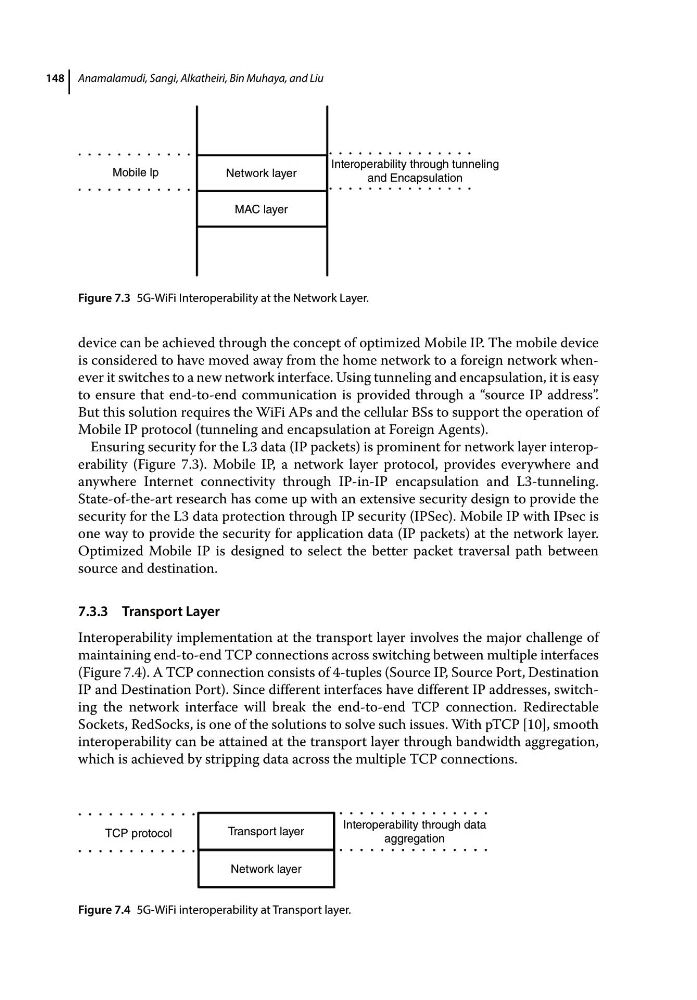
Ensuring security for the L3 data (IP packets) is prominent for network layer interoperability (Figure 7.3). Mobile IP, a network layer protocol, provides everywhere and
anywhere Internet connectivity through IP‐in‐IP encapsulation and L3‐tunneling.
State‐of‐the‐art research has come up with an extensive security design to provide the
security for the L3 data protection through IP security (IPSec). Mobile IP with IPsec is
one way to provide the security for application data (IP packets) at the network layer.
Optimized Mobile IP is designed to select the better packet traversal path between
source and destination.
7.3.3 Transport Layer
Interoperability implementation at the transport layer involves the major challenge of
maintaining end‐to‐end TCP connections across switching between multiple interfaces
(Figure 7.4). A TCP connection consists of 4‐tuples (Source IP, Source Port, Destination
IP and Destination Port). Since different interfaces have different IP addresses, switching the network interface will break the end‐to‐end TCP connection. Redirectable
Sockets, RedSocks, is one of the solutions to solve such issues. With pTCP [10], smooth
interoperability can be attained at the transport layer through bandwidth aggregation,
which is achieved by stripping data across the multiple TCP connections.
Transport layer
Network layer
TCP protocol
Interoperability through data
aggregation
Figure 7.4 5G‐WiFi interoperability at Transport layer.
MAC layer
Interoperability through tunneling
and Encapsulation
Mobile lp
Network layer
Figure 7.3 5G‐WiFi Interoperability at the Network Layer.
148
device can be achieved through the concept of optimized Mobile IP. The mobile device
is considered to have moved away from the home network to a foreign network whenever it switches to a new network interface. Using tunneling and encapsulation, it is easy
to ensure that end‐to‐end communication is provided through a “source IP address”.
But this solution requires the WiFi APs and the cellular BSs to support the operation of
Mobile IP protocol (tunneling and encapsulation at Foreign Agents).
Ensuring security for the L3 data (IP packets) is prominent for network layer interoperability (Figure 7.3). Mobile IP, a network layer protocol, provides everywhere and
anywhere Internet connectivity through IP‐in‐IP encapsulation and L3‐tunneling.
State‐of‐the‐art research has come up with an extensive security design to provide the
security for the L3 data protection through IP security (IPSec). Mobile IP with IPsec is
one way to provide the security for application data (IP packets) at the network layer.
Optimized Mobile IP is designed to select the better packet traversal path between
source and destination.
7.3.3 Transport Layer
Interoperability implementation at the transport layer involves the major challenge of
maintaining end‐to‐end TCP connections across switching between multiple interfaces
(Figure 7.4). A TCP connection consists of 4‐tuples (Source IP, Source Port, Destination
IP and Destination Port). Since different interfaces have different IP addresses, switching the network interface will break the end‐to‐end TCP connection. Redirectable
Sockets, RedSocks, is one of the solutions to solve such issues. With pTCP [10], smooth
interoperability can be attained at the transport layer through bandwidth aggregation,
which is achieved by stripping data across the multiple TCP connections.
Transport layer
Network layer
TCP protocol
Interoperability through data
aggregation
Figure 7.4 5G‐WiFi interoperability at Transport layer.
MAC layer
Interoperability through tunneling
and Encapsulation
Mobile lp
Network layer
Figure 7.3 5G‐WiFi Interoperability at the Network Layer.