

5G-WLAN Security 149
Existing TCP proxies are used by mobile operators to tune the network performance
with respect to the desired requirements. With current end‐to‐end TCP, congestion
control does not work perfectly when it has to bridge the heterogeneous networks
( cellular and wireless networks). This is because of more end‐to‐end delays and packet
loss. In addition, it is noteworthy that existing TCP‐based solutions do not work,
especially in mobile networks, which actually design the system for virtual‐circuit‐like
service. Hence, significant buffering, variable latency, no AQM, and no congestion notification will degrade the performance of traditional TCP in 5G networks. One way to
overcome this issue is with TCP proxies, which can improve the performance of the
cost of interoperability problems. In addition, security at Transport layer interoperability is significant to provide the application data protection for connection‐oriented
(Transmission Control Protocol) or connection‐less (User Datagram Protocol) end‐to‐
end data transmission between source and destination. Ensuring the security for transport layer protocols that provide end‐to‐end service to different applications is
important at Transport layer interoperability. End‐to‐end encryption at the Transport
layer will proliferate rapidly due to the integration of TLS into HTTP/2.
7.3.4 Application Layer
Application‐traffic based optimizers are mostly designed for the caching, pacing and
transcoding of video traffic. The design of an application‐based optimizer can serve
other purposes, such as user behavior analytics and statistics. These kinds of systems
are implemented to provide a transparent chain of traffic classifiers, load balancers and
the functionality of actual application. The traditional TCP/IP solution does not offer a
caching on the network/transport layer and explicit HTTP proxies have interoperability
problems at the application layer. Hence, HTTP/2 is designed to overcome the existing
implementation complexity. However, this will introduce more difficulties due to the
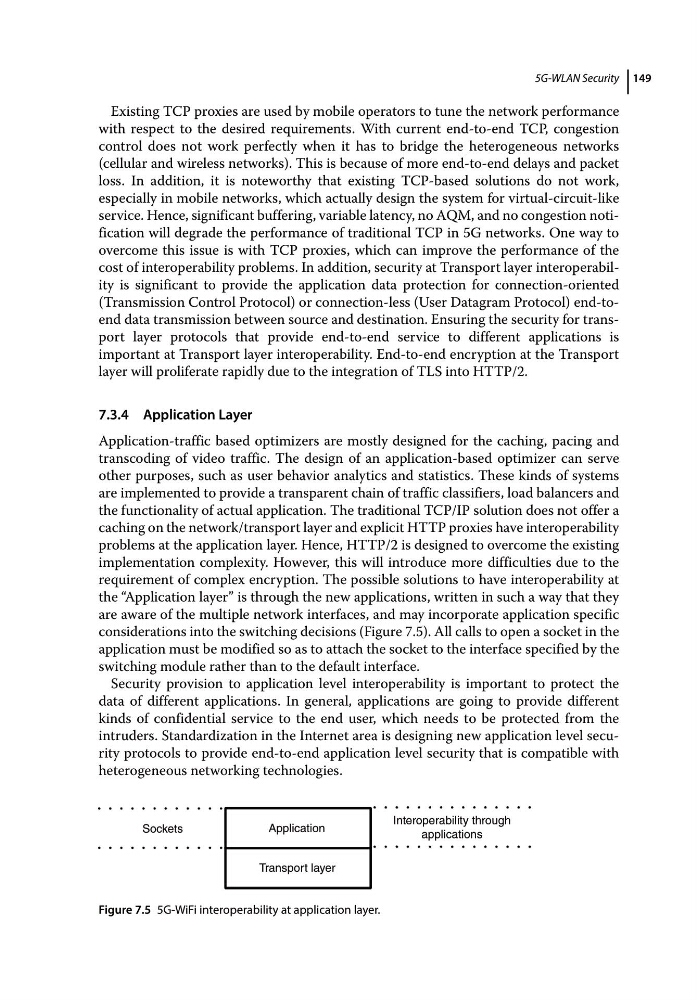
requirement of complex encryption. The possible solutions to have interoperability at
the “Application layer” is through the new applications, written in such a way that they
are aware of the multiple network interfaces, and may incorporate application specific
considerations into the switching decisions (Figure 7.5). All calls to open a socket in the
application must be modified so as to attach the socket to the interface specified by the
switching module rather than to the default interface.
Security provision to application level interoperability is important to protect the
data of different applications. In general, applications are going to provide different
kinds of confidential service to the end user, which needs to be protected from the
intruders. Standardization in the Internet area is designing new application level security protocols to provide end‐to‐end application level security that is compatible with
heterogeneous networking technologies.
Application
Transport layer
Sockets
Interoperability through
applications
Figure 7.5 5G‐WiFi interoperability at application layer.
Existing TCP proxies are used by mobile operators to tune the network performance
with respect to the desired requirements. With current end‐to‐end TCP, congestion
control does not work perfectly when it has to bridge the heterogeneous networks
( cellular and wireless networks). This is because of more end‐to‐end delays and packet
loss. In addition, it is noteworthy that existing TCP‐based solutions do not work,
especially in mobile networks, which actually design the system for virtual‐circuit‐like
service. Hence, significant buffering, variable latency, no AQM, and no congestion notification will degrade the performance of traditional TCP in 5G networks. One way to
overcome this issue is with TCP proxies, which can improve the performance of the
cost of interoperability problems. In addition, security at Transport layer interoperability is significant to provide the application data protection for connection‐oriented
(Transmission Control Protocol) or connection‐less (User Datagram Protocol) end‐to‐
end data transmission between source and destination. Ensuring the security for transport layer protocols that provide end‐to‐end service to different applications is
important at Transport layer interoperability. End‐to‐end encryption at the Transport
layer will proliferate rapidly due to the integration of TLS into HTTP/2.
7.3.4 Application Layer
Application‐traffic based optimizers are mostly designed for the caching, pacing and
transcoding of video traffic. The design of an application‐based optimizer can serve
other purposes, such as user behavior analytics and statistics. These kinds of systems
are implemented to provide a transparent chain of traffic classifiers, load balancers and
the functionality of actual application. The traditional TCP/IP solution does not offer a
caching on the network/transport layer and explicit HTTP proxies have interoperability
problems at the application layer. Hence, HTTP/2 is designed to overcome the existing
implementation complexity. However, this will introduce more difficulties due to the
requirement of complex encryption. The possible solutions to have interoperability at
the “Application layer” is through the new applications, written in such a way that they
are aware of the multiple network interfaces, and may incorporate application specific
considerations into the switching decisions (Figure 7.5). All calls to open a socket in the
application must be modified so as to attach the socket to the interface specified by the
switching module rather than to the default interface.
Security provision to application level interoperability is important to protect the
data of different applications. In general, applications are going to provide different
kinds of confidential service to the end user, which needs to be protected from the
intruders. Standardization in the Internet area is designing new application level security protocols to provide end‐to‐end application level security that is compatible with
heterogeneous networking technologies.
Application
Transport layer
Sockets
Interoperability through
applications
Figure 7.5 5G‐WiFi interoperability at application layer.