

5G-WLAN Security 147
7.3.1 MAC Layer
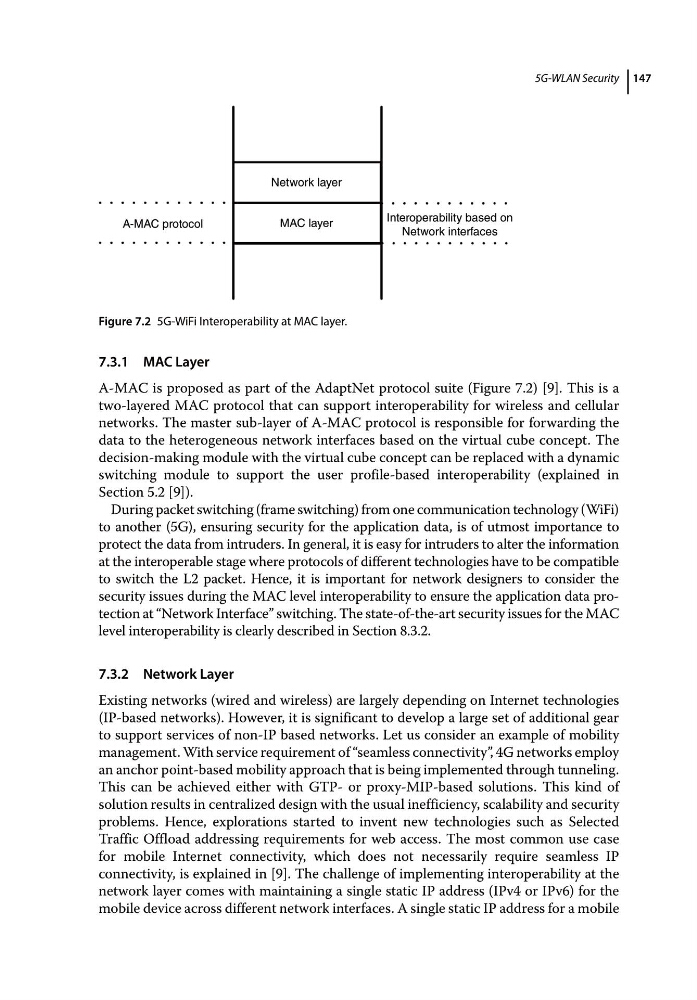
A‐MAC is proposed as part of the AdaptNet protocol suite (Figure 7.2) [9]. This is a
two‐layered MAC protocol that can support interoperability for wireless and cellular
networks. The master sub‐layer of A‐MAC protocol is responsible for forwarding the
data to the heterogeneous network interfaces based on the virtual cube concept. The
decision‐making module with the virtual cube concept can be replaced with a dynamic
switching module to support the user profile‐based interoperability (explained in
Section 5.2 [9]).
During packet switching (frame switching) from one communication technology (WiFi)
to another (5G), ensuring security for the application data, is of utmost importance to
protect the data from intruders. In general, it is easy for intruders to alter the information
at the interoperable stage where protocols of different technologies have to be compatible
to switch the L2 packet. Hence, it is important for network designers to consider the
security issues during the MAC level interoperability to ensure the application data protection at “Network Interface” switching. The state‐of‐the‐art security issues for the MAC
level interoperability is clearly described in Section 8.3.2.
7.3.2 Network Layer
Existing networks (wired and wireless) are largely depending on Internet technologies
(IP‐based networks). However, it is significant to develop a large set of additional gear
to support services of non‐IP based networks. Let us consider an example of mobility
management. With service requirement of “seamless connectivity”, 4G networks employ
an anchor point‐based mobility approach that is being implemented through tunneling.
This can be achieved either with GTP‐ or proxy‐MIP‐based solutions. This kind of
solution results in centralized design with the usual inefficiency, scalability and security
problems. Hence, explorations started to invent new technologies such as Selected
Traffic Offload addressing requirements for web access. The most common use case
for mobile Internet connectivity, which does not necessarily require seamless IP
connectivity, is explained in [9]. The challenge of implementing interoperability at the
network layer comes with maintaining a single static IP address (IPv4 or IPv6) for the
mobile device across different network interfaces. A single static IP address for a mobile
MAC layer
Interoperability based on
Network interfaces
A-MAC protocol
Network layer
Figure 7.2 5G‐WiFi Interoperability at MAC layer.
7.3.1 MAC Layer
A‐MAC is proposed as part of the AdaptNet protocol suite (Figure 7.2) [9]. This is a
two‐layered MAC protocol that can support interoperability for wireless and cellular
networks. The master sub‐layer of A‐MAC protocol is responsible for forwarding the
data to the heterogeneous network interfaces based on the virtual cube concept. The
decision‐making module with the virtual cube concept can be replaced with a dynamic
switching module to support the user profile‐based interoperability (explained in
Section 5.2 [9]).
During packet switching (frame switching) from one communication technology (WiFi)
to another (5G), ensuring security for the application data, is of utmost importance to
protect the data from intruders. In general, it is easy for intruders to alter the information
at the interoperable stage where protocols of different technologies have to be compatible
to switch the L2 packet. Hence, it is important for network designers to consider the
security issues during the MAC level interoperability to ensure the application data protection at “Network Interface” switching. The state‐of‐the‐art security issues for the MAC
level interoperability is clearly described in Section 8.3.2.
7.3.2 Network Layer
Existing networks (wired and wireless) are largely depending on Internet technologies
(IP‐based networks). However, it is significant to develop a large set of additional gear
to support services of non‐IP based networks. Let us consider an example of mobility
management. With service requirement of “seamless connectivity”, 4G networks employ
an anchor point‐based mobility approach that is being implemented through tunneling.
This can be achieved either with GTP‐ or proxy‐MIP‐based solutions. This kind of
solution results in centralized design with the usual inefficiency, scalability and security
problems. Hence, explorations started to invent new technologies such as Selected
Traffic Offload addressing requirements for web access. The most common use case
for mobile Internet connectivity, which does not necessarily require seamless IP
connectivity, is explained in [9]. The challenge of implementing interoperability at the
network layer comes with maintaining a single static IP address (IPv4 or IPv6) for the
mobile device across different network interfaces. A single static IP address for a mobile
MAC layer
Interoperability based on
Network interfaces
A-MAC protocol
Network layer
Figure 7.2 5G‐WiFi Interoperability at MAC layer.