

Soderi, Mucchi, Hämäläinen, Piva, and Iinatti
122
eavesdropper’s channel nor jamming from third‐party nodes [27]. In that paper, authors
exploit the watermarking concept to increase system performance in terms of outage
probability of secrecy capacity.
In the multimedia context, the digital watermarking process is utilized to hide or
embed a desired signal into another signal, for example into pictures and videos. This
process has a lot of similarities with traditional communications. Spread‐spectrum
(SS) watermarking techniques are frequently utilized to implement physical layer
security [22] and we adopt the second paradigm for watermarking described by Cox
et al. [7], where the information to be embedded is modified prior to insertion, to
exploit hidden data.
The truly innovative process for deploying a physical layer security consists of the
steps showed in Algorithm 6.1.
Algorithm 6.1 WBPLSec protocol
1: procedure: PHYSICAL LAYER SECURITY
2: SS Watermarking (ALICE):
A message is first modulated with SS and then embedded into the host signal.
3: Jamming Receiver (BOB):
The receiver jams N W samples for each symbol transmitted by Alice.
4: Watermark Extraction (BOB):
The receiver extracts the watermark.
5: Symbol Rebuild (BOB):
Knowing which samples are jammed, the receiver, i.e. Bob, is able to rebuild a
clean symbol using information contained into the watermark.
6: End procedure.
Note: WBPLSec transmits the information through two independent paths implementing data
decomposition policy. The information is sent via a narrowband signal and through the SS watermarked
signal. The narrowband signal is partially jammed by Bob, but the watermark into the SS signal is utilized
to re‐compose the entire symbol.
iJAM
STITCHING
UNJAMMED
SAMPLES
BOB
ALICE
CLEAN
SYMBOL
BOB
JAMMING
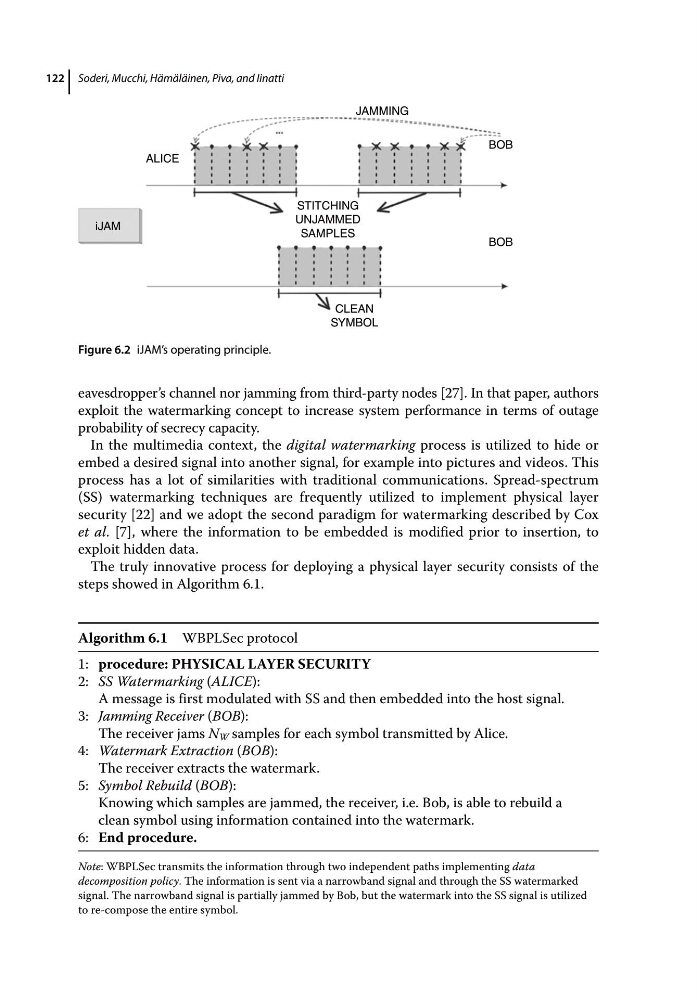
Figure 6.2 iJAM’s operating principle.
122
eavesdropper’s channel nor jamming from third‐party nodes [27]. In that paper, authors
exploit the watermarking concept to increase system performance in terms of outage
probability of secrecy capacity.
In the multimedia context, the digital watermarking process is utilized to hide or
embed a desired signal into another signal, for example into pictures and videos. This
process has a lot of similarities with traditional communications. Spread‐spectrum
(SS) watermarking techniques are frequently utilized to implement physical layer
security [22] and we adopt the second paradigm for watermarking described by Cox
et al. [7], where the information to be embedded is modified prior to insertion, to
exploit hidden data.
The truly innovative process for deploying a physical layer security consists of the
steps showed in Algorithm 6.1.
Algorithm 6.1 WBPLSec protocol
1: procedure: PHYSICAL LAYER SECURITY
2: SS Watermarking (ALICE):
A message is first modulated with SS and then embedded into the host signal.
3: Jamming Receiver (BOB):
The receiver jams N W samples for each symbol transmitted by Alice.
4: Watermark Extraction (BOB):
The receiver extracts the watermark.
5: Symbol Rebuild (BOB):
Knowing which samples are jammed, the receiver, i.e. Bob, is able to rebuild a
clean symbol using information contained into the watermark.
6: End procedure.
Note: WBPLSec transmits the information through two independent paths implementing data
decomposition policy. The information is sent via a narrowband signal and through the SS watermarked
signal. The narrowband signal is partially jammed by Bob, but the watermark into the SS signal is utilized
to re‐compose the entire symbol.
iJAM
STITCHING
UNJAMMED
SAMPLES
BOB
ALICE
CLEAN
SYMBOL
BOB
JAMMING
Figure 6.2 iJAM’s operating principle.