

Physical Layer Security 123
The rest of this chapter is organized as follows: Section 10.2 describes the WBPLSec
system model introducing transmitter and receiver architectures. Section 10.3 introduces
the outage probability of secrecy capacity of a jamming receiver. Then, in Section 10.4, the
application to 5G use case is presented. Finally, the chapter is concluded with Section 10.5.
6.2 WBPLSec System Model
The authors address the general problem of physical layer security presented in [13], in
which any secure communications shall handle secrecy to avoid confidentiality attacks.
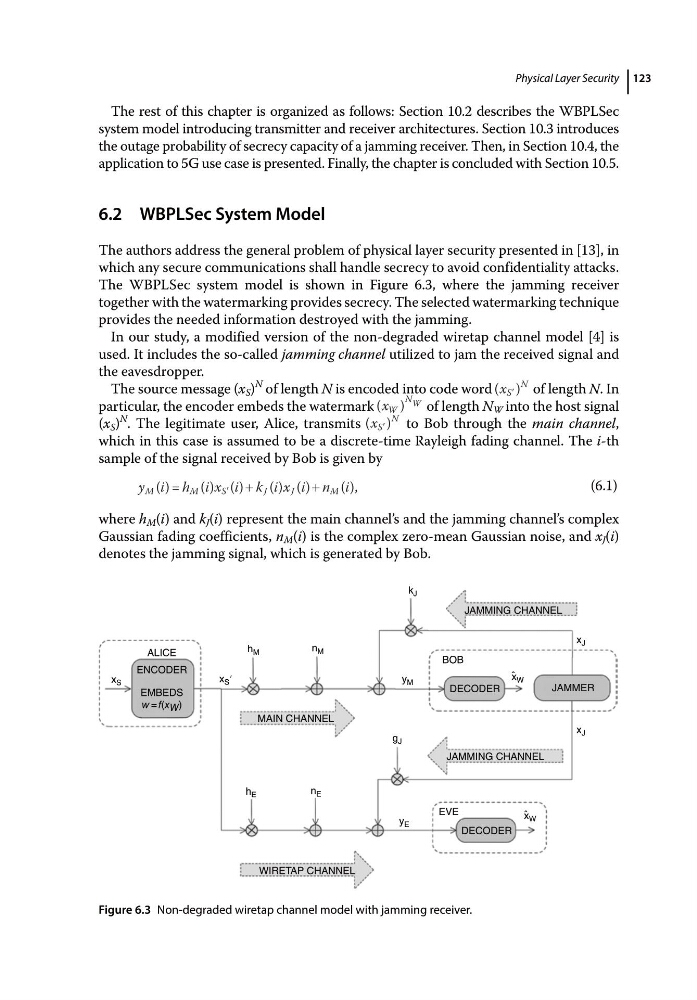
The WBPLSec system model is shown in Figure 6.3, where the jamming receiver
together with the watermarking provides secrecy. The selected watermarking technique
provides the needed information destroyed with the jamming.
In our study, a modified version of the non‐degraded wiretap channel model [4] is
used. It includes the so‐called jamming channel utilized to jam the received signal and
the eavesdropper.
The source message (x S )
N
of length N is encoded into code word ( )
x
N
S
of length N. In
particular, the encoder embeds the watermark ( )
x W
N W of length N W into the host signal
(x S )
N
. The legitimate user, Alice, transmits ( )
x S
N to Bob through the main channel,
which in this case is assumed to be a discrete‐time Rayleigh fading channel. The i‐th
sample of the signal received by Bob is given by
y i h i x i k i x i n i
M
M
S
J
J
M
( )= ( ) ( )
( ) ( )
(),
(6.1)
where h M (i) and k J (i) represent the main channel’s and the jamming channel’s complex
Gaussian fading coefficients, n M (i) is the complex zero‐mean Gaussian noise, and x J (i)
denotes the jamming signal, which is generated by Bob.
JAMMER
JAMMING CHANNEL
JAMMING CHANNEL
x J
k J
g J
y M
BOB
n M
y E
x S ′
x S
x W
x W
n E
WIRETAP CHANNEL
MAIN CHANNEL
h M
h E
DECODER
ALICE
EMBEDS
w = f(x W )
ENCODER
EVE
ˆ
ˆ
x J
DECODER
Figure 6.3 Non‐degraded wiretap channel model with jamming receiver.
The rest of this chapter is organized as follows: Section 10.2 describes the WBPLSec
system model introducing transmitter and receiver architectures. Section 10.3 introduces
the outage probability of secrecy capacity of a jamming receiver. Then, in Section 10.4, the
application to 5G use case is presented. Finally, the chapter is concluded with Section 10.5.
6.2 WBPLSec System Model
The authors address the general problem of physical layer security presented in [13], in
which any secure communications shall handle secrecy to avoid confidentiality attacks.
The WBPLSec system model is shown in Figure 6.3, where the jamming receiver
together with the watermarking provides secrecy. The selected watermarking technique
provides the needed information destroyed with the jamming.
In our study, a modified version of the non‐degraded wiretap channel model [4] is
used. It includes the so‐called jamming channel utilized to jam the received signal and
the eavesdropper.
The source message (x S )
N
of length N is encoded into code word ( )
x
N
S
of length N. In
particular, the encoder embeds the watermark ( )
x W
N W of length N W into the host signal
(x S )
N
. The legitimate user, Alice, transmits ( )
x S
N to Bob through the main channel,
which in this case is assumed to be a discrete‐time Rayleigh fading channel. The i‐th
sample of the signal received by Bob is given by
y i h i x i k i x i n i
M
M
S
J
J
M
( )= ( ) ( )
( ) ( )
(),
(6.1)
where h M (i) and k J (i) represent the main channel’s and the jamming channel’s complex
Gaussian fading coefficients, n M (i) is the complex zero‐mean Gaussian noise, and x J (i)
denotes the jamming signal, which is generated by Bob.
JAMMER
JAMMING CHANNEL
JAMMING CHANNEL
x J
k J
g J
y M
BOB
n M
y E
x S ′
x S
x W
x W
n E
WIRETAP CHANNEL
MAIN CHANNEL
h M
h E
DECODER
ALICE
EMBEDS
w = f(x W )
ENCODER
EVE
ˆ
ˆ
x J
DECODER
Figure 6.3 Non‐degraded wiretap channel model with jamming receiver.