

Physical Layer Security 121
6.1.2 Related Work
In the literature, there are several contributions that deals with a physical layer security
because, due to their nature, wireless communications might suffer eavesdropping attacks.
In 1949, Shannon defined the information theoretic metric for secrecy systems [1] and he
proved the perfect secrecy condition where the eavesdropper cannot pull out any information from the transmitted signal. Afterwards, Wyner introduced a wiretap channel model
defining a secrecy capacity as the maximum transmission rate that is achievable whenever
the eavesdropper’s channel observations are noiser than the legitimate user’s channel
[2,17]. Finally, Csiszár et al. extended Wyner’s results to non‐zero secrecy capacity when a
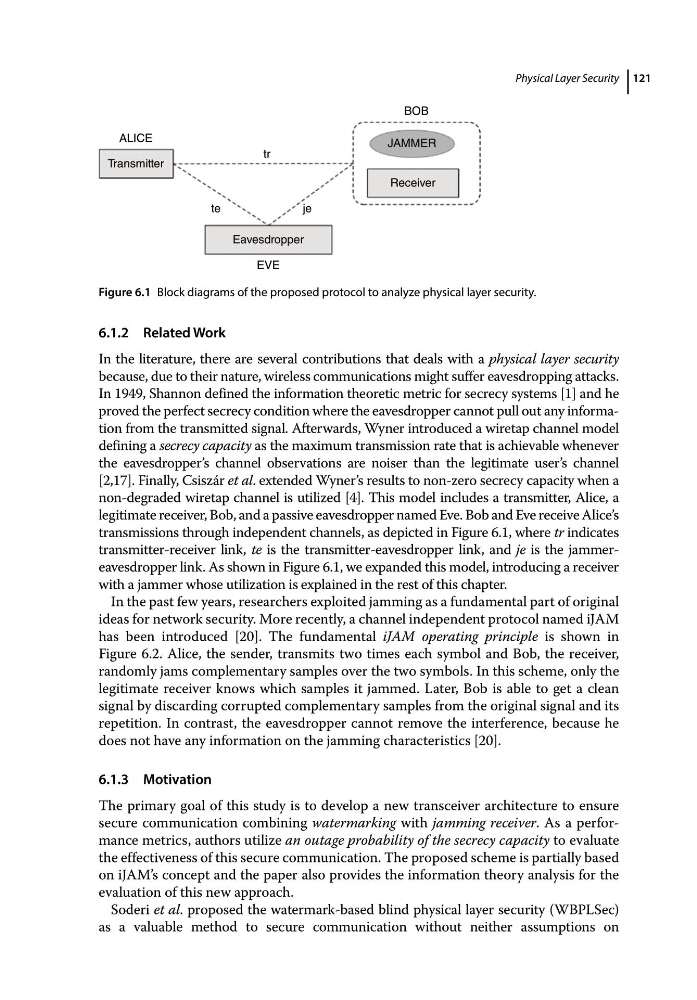
non‐degraded wiretap channel is utilized [4]. This model includes a transmitter, Alice, a
legitimate receiver, Bob, and a passive eavesdropper named Eve. Bob and Eve receive Alice’s
transmissions through independent channels, as depicted in Figure 6.1, where tr indicates
transmitter‐receiver link, te is the transmitter‐eavesdropper link, and je is the jammer‐
eavesdropper link. As shown in Figure 6.1, we expanded this model, introducing a receiver
with a jammer whose utilization is explained in the rest of this chapter.
In the past few years, researchers exploited jamming as a fundamental part of original
ideas for network security. More recently, a channel independent protocol named iJAM
has been introduced [20]. The fundamental iJAM operating principle is shown in
Figure 6.2. Alice, the sender, transmits two times each symbol and Bob, the receiver,
randomly jams complementary samples over the two symbols. In this scheme, only the
legitimate receiver knows which samples it jammed. Later, Bob is able to get a clean
signal by discarding corrupted complementary samples from the original signal and its
repetition. In contrast, the eavesdropper cannot remove the interference, because he
does not have any information on the jamming characteristics [20].
6.1.3 Motivation
The primary goal of this study is to develop a new transceiver architecture to ensure
secure communication combining watermarking with jamming receiver. As a performance metrics, authors utilize an outage probability of the secrecy capacity to evaluate
the effectiveness of this secure communication. The proposed scheme is partially based
on iJAM’s concept and the paper also provides the information theory analysis for the
evaluation of this new approach.
Soderi et al. proposed the watermark‐based blind physical layer security (WBPLSec)
as a valuable method to secure communication without neither assumptions on
tr
te
je
Eavesdropper
EVE
Receiver
BOB
JAMMER
Transmitter
ALICE
Figure 6.1 Block diagrams of the proposed protocol to analyze physical layer security.
6.1.2 Related Work
In the literature, there are several contributions that deals with a physical layer security
because, due to their nature, wireless communications might suffer eavesdropping attacks.
In 1949, Shannon defined the information theoretic metric for secrecy systems [1] and he
proved the perfect secrecy condition where the eavesdropper cannot pull out any information from the transmitted signal. Afterwards, Wyner introduced a wiretap channel model
defining a secrecy capacity as the maximum transmission rate that is achievable whenever
the eavesdropper’s channel observations are noiser than the legitimate user’s channel
[2,17]. Finally, Csiszár et al. extended Wyner’s results to non‐zero secrecy capacity when a
non‐degraded wiretap channel is utilized [4]. This model includes a transmitter, Alice, a
legitimate receiver, Bob, and a passive eavesdropper named Eve. Bob and Eve receive Alice’s
transmissions through independent channels, as depicted in Figure 6.1, where tr indicates
transmitter‐receiver link, te is the transmitter‐eavesdropper link, and je is the jammer‐
eavesdropper link. As shown in Figure 6.1, we expanded this model, introducing a receiver
with a jammer whose utilization is explained in the rest of this chapter.
In the past few years, researchers exploited jamming as a fundamental part of original
ideas for network security. More recently, a channel independent protocol named iJAM
has been introduced [20]. The fundamental iJAM operating principle is shown in
Figure 6.2. Alice, the sender, transmits two times each symbol and Bob, the receiver,
randomly jams complementary samples over the two symbols. In this scheme, only the
legitimate receiver knows which samples it jammed. Later, Bob is able to get a clean
signal by discarding corrupted complementary samples from the original signal and its
repetition. In contrast, the eavesdropper cannot remove the interference, because he
does not have any information on the jamming characteristics [20].
6.1.3 Motivation
The primary goal of this study is to develop a new transceiver architecture to ensure
secure communication combining watermarking with jamming receiver. As a performance metrics, authors utilize an outage probability of the secrecy capacity to evaluate
the effectiveness of this secure communication. The proposed scheme is partially based
on iJAM’s concept and the paper also provides the information theory analysis for the
evaluation of this new approach.
Soderi et al. proposed the watermark‐based blind physical layer security (WBPLSec)
as a valuable method to secure communication without neither assumptions on
tr
te
je
Eavesdropper
EVE
Receiver
BOB
JAMMER
Transmitter
ALICE
Figure 6.1 Block diagrams of the proposed protocol to analyze physical layer security.