

Gomes, Iivari, Ahokangas, Isotalo, Sahlin, and Melén
110
To formulate these scenarios, we first identified four broader schemes of security
provisioning: device‐to‐device (D2D) security, infrastructure security, distributed
security and centralized security. We observe the fundamental distinction between distributed and centralized security, hence putting them at polar opposites of one axis. On
the other hand, we also see the vital difference between D2D security and infrastructure
security and put them at opposite ends of the other axis.
As a result, we find four major drivers of security that will potentially come with new
business opportunities in the 5G era. Device‐driven security comprises distributed and
D2D security techniques. Platform‐driven security will focus on centralized and D2D
security techniques. Network infrastructure‐driven security should focus on centralized and infrastructure security methods. Lastly, location‐driven security should harness distributed and infrastructure security techniques.
5.4.3 Delivering Cyber Security in 5G
So far in this chapter, we have taken a business‐oriented standpoint. At this point we
look at the technical aspects of security delivery from the service and user perspectives,
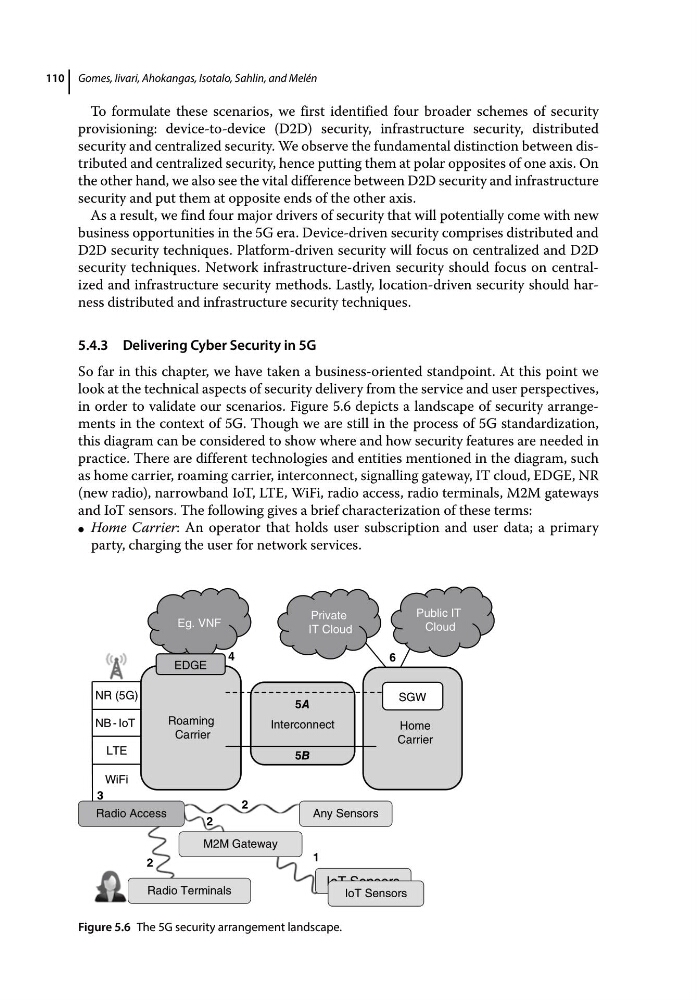
in order to validate our scenarios. Figure 5.6 depicts a landscape of security arrangements in the context of 5G. Though we are still in the process of 5G standardization,
this diagram can be considered to show where and how security features are needed in
practice. There are different technologies and entities mentioned in the diagram, such
as home carrier, roaming carrier, interconnect, signalling gateway, IT cloud, EDGE, NR
(new radio), narrowband IoT, LTE, WiFi, radio access, radio terminals, M2M gateways
and IoT sensors. The following gives a brief characterization of these terms:
● Home Carrier: An operator that holds user subscription and user data; a primary
party, charging the user for network services.
Roaming
Carrier
Interconnect
Home
Carrier
SGW
5A
5B
4
Eg. VNF
EDGE
Private
IT Cloud
NR (5G)
NB - IoT
LTE
WiFi
Radio Access
Any Sensors
Radio Terminals
M2M Gateway
IoT Sensors
IoT Sensors
3
1
2
2
2
Public IT
Cloud
6
Figure 5.6 The 5G security arrangement landscape.
110
To formulate these scenarios, we first identified four broader schemes of security
provisioning: device‐to‐device (D2D) security, infrastructure security, distributed
security and centralized security. We observe the fundamental distinction between distributed and centralized security, hence putting them at polar opposites of one axis. On
the other hand, we also see the vital difference between D2D security and infrastructure
security and put them at opposite ends of the other axis.
As a result, we find four major drivers of security that will potentially come with new
business opportunities in the 5G era. Device‐driven security comprises distributed and
D2D security techniques. Platform‐driven security will focus on centralized and D2D
security techniques. Network infrastructure‐driven security should focus on centralized and infrastructure security methods. Lastly, location‐driven security should harness distributed and infrastructure security techniques.
5.4.3 Delivering Cyber Security in 5G
So far in this chapter, we have taken a business‐oriented standpoint. At this point we
look at the technical aspects of security delivery from the service and user perspectives,
in order to validate our scenarios. Figure 5.6 depicts a landscape of security arrangements in the context of 5G. Though we are still in the process of 5G standardization,
this diagram can be considered to show where and how security features are needed in
practice. There are different technologies and entities mentioned in the diagram, such
as home carrier, roaming carrier, interconnect, signalling gateway, IT cloud, EDGE, NR
(new radio), narrowband IoT, LTE, WiFi, radio access, radio terminals, M2M gateways
and IoT sensors. The following gives a brief characterization of these terms:
● Home Carrier: An operator that holds user subscription and user data; a primary
party, charging the user for network services.
Roaming
Carrier
Interconnect
Home
Carrier
SGW
5A
5B
4
Eg. VNF
EDGE
Private
IT Cloud
NR (5G)
NB - IoT
LTE
WiFi
Radio Access
Any Sensors
Radio Terminals
M2M Gateway
IoT Sensors
IoT Sensors
3
1
2
2
2
Public IT
Cloud
6
Figure 5.6 The 5G security arrangement landscape.