

Cyber Security Business Models in 5G 109
these secured solutions need to ensure personal privacy and safety, and have other
security features. Similarly, if we consider a “secured solution” made for machine users,
device‐unique identification needs to be constantly secured. The quality of service also
needs to be competitive with other commercial devices. Additionally, these secured
solutions for device/machines should ensure relevant security features applicable to
their contextual purposes. In our opinion, cyber security in 5G should solve security
and privacy related issues beyond the conventional data security. By doing so, more and
more business entities will be interested in offering secured solutions and finding new
ways to deliver value to their customers and monetize that.
5.4.2 Scenarios for 5G Security Provisioning
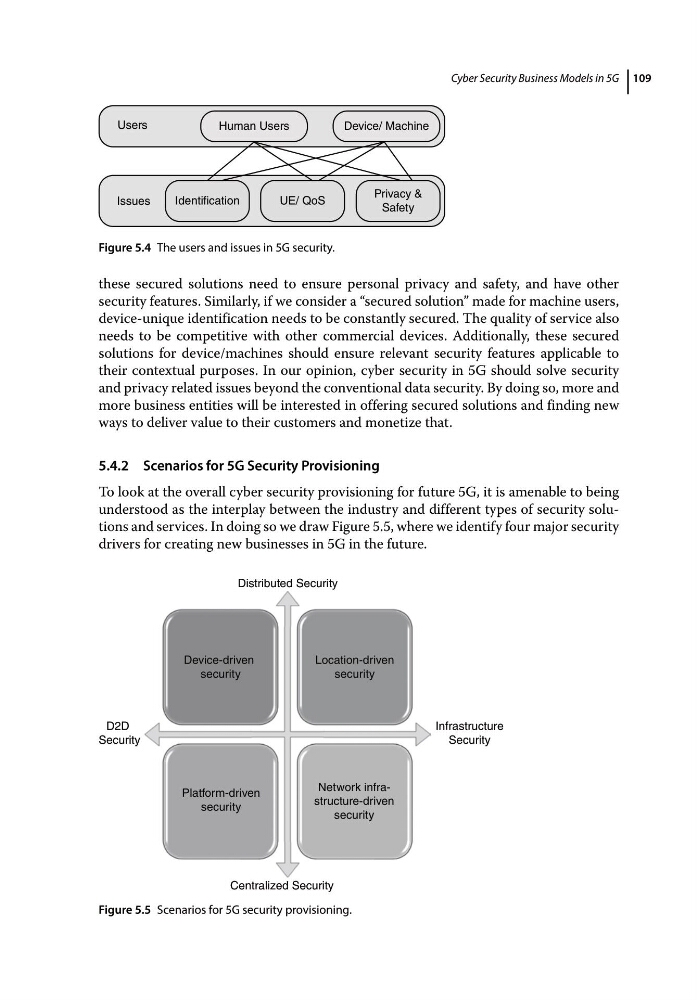
To look at the overall cyber security provisioning for future 5G, it is amenable to being
understood as the interplay between the industry and different types of security solutions and services. In doing so we draw Figure 5.5, where we identify four major security
drivers for creating new businesses in 5G in the future.
Users
Human Users
D evice/ Machine
Issues
Identification
UE/ QoS
Privacy &
Safety
Figure 5.4 The users and issues in 5G security.
D2D
Security
Infrastructure
Security
Distributed Security
Centralized Security
Platform-driven
security
Network infrastructure-driven
security
Location-driven
security
Device-driven
security
Figure 5.5 Scenarios for 5G security provisioning.
these secured solutions need to ensure personal privacy and safety, and have other
security features. Similarly, if we consider a “secured solution” made for machine users,
device‐unique identification needs to be constantly secured. The quality of service also
needs to be competitive with other commercial devices. Additionally, these secured
solutions for device/machines should ensure relevant security features applicable to
their contextual purposes. In our opinion, cyber security in 5G should solve security
and privacy related issues beyond the conventional data security. By doing so, more and
more business entities will be interested in offering secured solutions and finding new
ways to deliver value to their customers and monetize that.
5.4.2 Scenarios for 5G Security Provisioning
To look at the overall cyber security provisioning for future 5G, it is amenable to being
understood as the interplay between the industry and different types of security solutions and services. In doing so we draw Figure 5.5, where we identify four major security
drivers for creating new businesses in 5G in the future.
Users
Human Users
D evice/ Machine
Issues
Identification
UE/ QoS
Privacy &
Safety
Figure 5.4 The users and issues in 5G security.
D2D
Security
Infrastructure
Security
Distributed Security
Centralized Security
Platform-driven
security
Network infrastructure-driven
security
Location-driven
security
Device-driven
security
Figure 5.5 Scenarios for 5G security provisioning.