

Gomes, Iivari, Ahokangas, Isotalo, Sahlin, and Melén
108
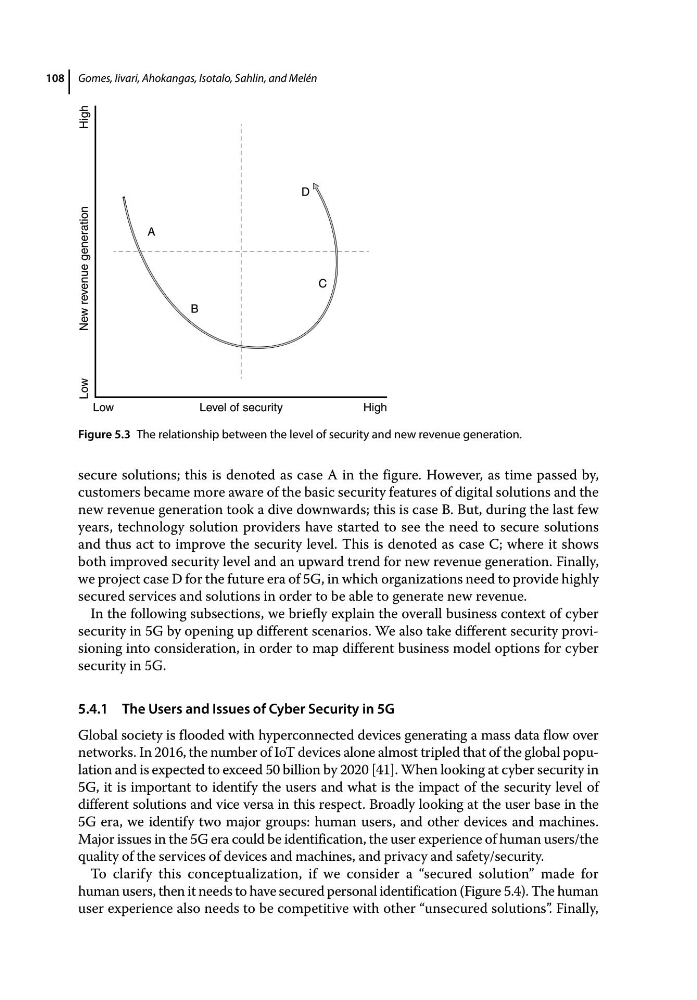
secure solutions; this is denoted as case A in the figure. However, as time passed by,
customers became more aware of the basic security features of digital solutions and the
new revenue generation took a dive downwards; this is case B. But, during the last few
years, technology solution providers have started to see the need to secure solutions
and thus act to improve the security level. This is denoted as case C; where it shows
both improved security level and an upward trend for new revenue generation. Finally,
we project case D for the future era of 5G, in which organizations need to provide highly
secured services and solutions in order to be able to generate new revenue.
In the following subsections, we briefly explain the overall business context of cyber
security in 5G by opening up different scenarios. We also take different security provisioning into consideration, in order to map different business model options for cyber
security in 5G.
5.4.1 The Users and Issues of Cyber Security in 5G
Global society is flooded with hyperconnected devices generating a mass data flow over
networks. In 2016, the number of IoT devices alone almost tripled that of the global population and is expected to exceed 50 billion by 2020 [41]. When looking at cyber security in
5G, it is important to identify the users and what is the impact of the security level of
different solutions and vice versa in this respect. Broadly looking at the user base in the
5G era, we identify two major groups: human users, and other devices and machines.
Major issues in the 5G era could be identification, the user experience of human users/the
quality of the services of devices and machines, and privacy and safety/security.
To clarify this conceptualization, if we consider a “secured solution” made for
human users, then it needs to have secured personal identification (Figure 5.4). The human
user experience also needs to be competitive with other “unsecured solutions”. Finally,
Low
High
Low
High
New revenue generation
Level of security
A
B
C
D
Figure 5.3 The relationship between the level of security and new revenue generation.
108
secure solutions; this is denoted as case A in the figure. However, as time passed by,
customers became more aware of the basic security features of digital solutions and the
new revenue generation took a dive downwards; this is case B. But, during the last few
years, technology solution providers have started to see the need to secure solutions
and thus act to improve the security level. This is denoted as case C; where it shows
both improved security level and an upward trend for new revenue generation. Finally,
we project case D for the future era of 5G, in which organizations need to provide highly
secured services and solutions in order to be able to generate new revenue.
In the following subsections, we briefly explain the overall business context of cyber
security in 5G by opening up different scenarios. We also take different security provisioning into consideration, in order to map different business model options for cyber
security in 5G.
5.4.1 The Users and Issues of Cyber Security in 5G
Global society is flooded with hyperconnected devices generating a mass data flow over
networks. In 2016, the number of IoT devices alone almost tripled that of the global population and is expected to exceed 50 billion by 2020 [41]. When looking at cyber security in
5G, it is important to identify the users and what is the impact of the security level of
different solutions and vice versa in this respect. Broadly looking at the user base in the
5G era, we identify two major groups: human users, and other devices and machines.
Major issues in the 5G era could be identification, the user experience of human users/the
quality of the services of devices and machines, and privacy and safety/security.
To clarify this conceptualization, if we consider a “secured solution” made for
human users, then it needs to have secured personal identification (Figure 5.4). The human
user experience also needs to be competitive with other “unsecured solutions”. Finally,
Low
High
Low
High
New revenue generation
Level of security
A
B
C
D
Figure 5.3 The relationship between the level of security and new revenue generation.