

Biosorption of Ni(II) Using Seeds of Mirabilis Jalapa
61
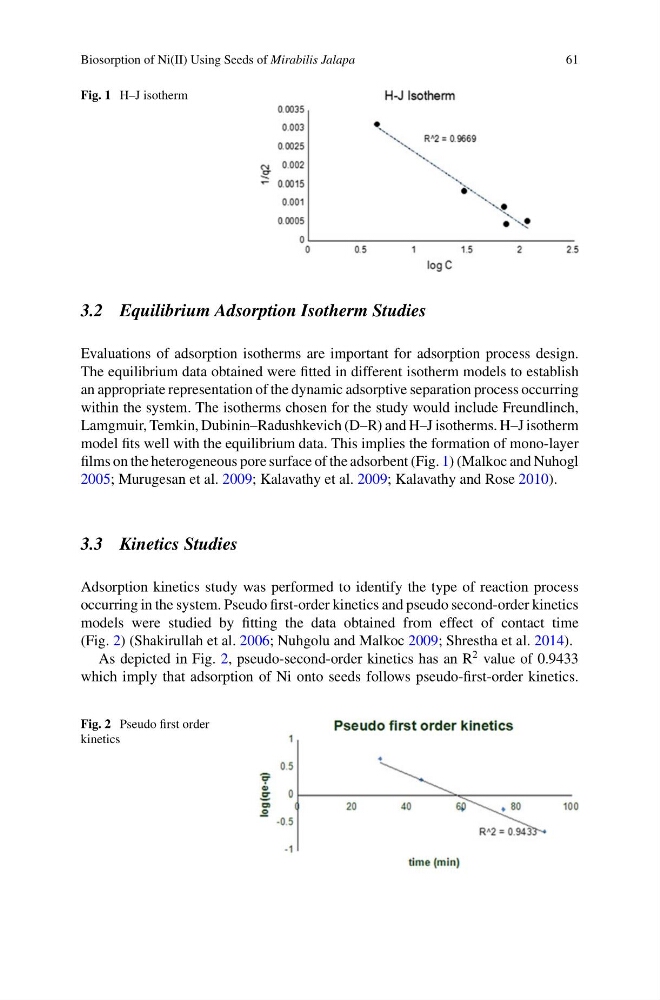
Fig. 1 H–J isotherm
3.2 Equilibrium Adsorption Isotherm Studies
Evaluations of adsorption isotherms are important for adsorption process design.
The equilibrium data obtained were fitted in different isotherm models to establish
an appropriate representation of the dynamic adsorptive separation process occurring
within the system. The isotherms chosen for the study would include Freundlinch,
Lamgmuir, Temkin, Dubinin–Radushkevich (D–R) and H–J isotherms. H–J isotherm
model fits well with the equilibrium data. This implies the formation of mono-layer
films on the heterogeneous pore surface of the adsorbent (Fig. 1) (Malkoc and Nuhogl
2005; Murugesan et al. 2009; Kalavathy et al. 2009; Kalavathy and Rose 2010).
3.3 Kinetics Studies
Adsorption kinetics study was performed to identify the type of reaction process
occurring in the system. Pseudo first-order kinetics and pseudo second-order kinetics
models were studied by fitting the data obtained from effect of contact time
(Fig. 2) (Shakirullah et al. 2006; Nuhgolu and Malkoc 2009; Shrestha et al. 2014).
As depicted in Fig. 2, pseudo-second-order kinetics has an R
2 value of 0.9433
which imply that adsorption of Ni onto seeds follows pseudo-first-order kinetics.
Fig. 2 Pseudo first order
kinetics
61
Fig. 1 H–J isotherm
3.2 Equilibrium Adsorption Isotherm Studies
Evaluations of adsorption isotherms are important for adsorption process design.
The equilibrium data obtained were fitted in different isotherm models to establish
an appropriate representation of the dynamic adsorptive separation process occurring
within the system. The isotherms chosen for the study would include Freundlinch,
Lamgmuir, Temkin, Dubinin–Radushkevich (D–R) and H–J isotherms. H–J isotherm
model fits well with the equilibrium data. This implies the formation of mono-layer
films on the heterogeneous pore surface of the adsorbent (Fig. 1) (Malkoc and Nuhogl
2005; Murugesan et al. 2009; Kalavathy et al. 2009; Kalavathy and Rose 2010).
3.3 Kinetics Studies
Adsorption kinetics study was performed to identify the type of reaction process
occurring in the system. Pseudo first-order kinetics and pseudo second-order kinetics
models were studied by fitting the data obtained from effect of contact time
(Fig. 2) (Shakirullah et al. 2006; Nuhgolu and Malkoc 2009; Shrestha et al. 2014).
As depicted in Fig. 2, pseudo-second-order kinetics has an R
2 value of 0.9433
which imply that adsorption of Ni onto seeds follows pseudo-first-order kinetics.
Fig. 2 Pseudo first order
kinetics