

60
V. Anitha et al.
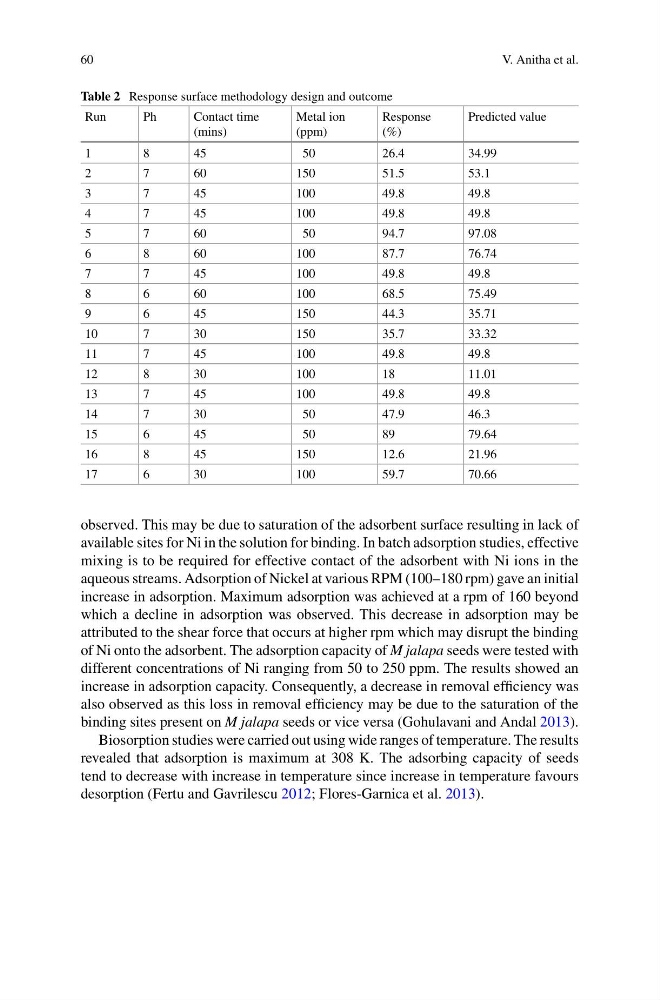
Table 2 Response surface methodology design and outcome
Run
Ph
Contact time
(mins)
Metal ion
(ppm)
Response
(%)
Predicted value
1
8
45
50
26.4
34.99
2
7
60
150
51.5
53.1
3
7
45
100
49.8
49.8
4
7
45
100
49.8
49.8
5
7
60
50
94.7
97.08
6
8
60
100
87.7
76.74
7
7
45
100
49.8
49.8
8
6
60
100
68.5
75.49
9
6
45
150
44.3
35.71
10
7
30
150
35.7
33.32
11
7
45
100
49.8
49.8
12
8
30
100
18
11.01
13
7
45
100
49.8
49.8
14
7
30
50
47.9
46.3
15
6
45
50
89
79.64
16
8
45
150
12.6
21.96
17
6
30
100
59.7
70.66
observed. This may be due to saturation of the adsorbent surface resulting in lack of
available sites for Ni in the solution for binding. In batch adsorption studies, effective
mixing is to be required for effective contact of the adsorbent with Ni ions in the
aqueous streams. Adsorption of Nickel at various RPM (100–180 rpm) gave an initial
increase in adsorption. Maximum adsorption was achieved at a rpm of 160 beyond
which a decline in adsorption was observed. This decrease in adsorption may be
attributed to the shear force that occurs at higher rpm which may disrupt the binding
of Ni onto the adsorbent. The adsorption capacity of M jalapa seeds were tested with
different concentrations of Ni ranging from 50 to 250 ppm. The results showed an
increase in adsorption capacity. Consequently, a decrease in removal efficiency was
also observed as this loss in removal efficiency may be due to the saturation of the
binding sites present on M jalapa seeds or vice versa (Gohulavani and Andal 2013).
Biosorption studies were carried out using wide ranges of temperature. The results
revealed that adsorption is maximum at 308 K. The adsorbing capacity of seeds
tend to decrease with increase in temperature since increase in temperature favours
desorption (Fertu and Gavrilescu 2012; Flores-Garnica et al. 2013).
V. Anitha et al.
Table 2 Response surface methodology design and outcome
Run
Ph
Contact time
(mins)
Metal ion
(ppm)
Response
(%)
Predicted value
1
8
45
50
26.4
34.99
2
7
60
150
51.5
53.1
3
7
45
100
49.8
49.8
4
7
45
100
49.8
49.8
5
7
60
50
94.7
97.08
6
8
60
100
87.7
76.74
7
7
45
100
49.8
49.8
8
6
60
100
68.5
75.49
9
6
45
150
44.3
35.71
10
7
30
150
35.7
33.32
11
7
45
100
49.8
49.8
12
8
30
100
18
11.01
13
7
45
100
49.8
49.8
14
7
30
50
47.9
46.3
15
6
45
50
89
79.64
16
8
45
150
12.6
21.96
17
6
30
100
59.7
70.66
observed. This may be due to saturation of the adsorbent surface resulting in lack of
available sites for Ni in the solution for binding. In batch adsorption studies, effective
mixing is to be required for effective contact of the adsorbent with Ni ions in the
aqueous streams. Adsorption of Nickel at various RPM (100–180 rpm) gave an initial
increase in adsorption. Maximum adsorption was achieved at a rpm of 160 beyond
which a decline in adsorption was observed. This decrease in adsorption may be
attributed to the shear force that occurs at higher rpm which may disrupt the binding
of Ni onto the adsorbent. The adsorption capacity of M jalapa seeds were tested with
different concentrations of Ni ranging from 50 to 250 ppm. The results showed an
increase in adsorption capacity. Consequently, a decrease in removal efficiency was
also observed as this loss in removal efficiency may be due to the saturation of the
binding sites present on M jalapa seeds or vice versa (Gohulavani and Andal 2013).
Biosorption studies were carried out using wide ranges of temperature. The results
revealed that adsorption is maximum at 308 K. The adsorbing capacity of seeds
tend to decrease with increase in temperature since increase in temperature favours
desorption (Fertu and Gavrilescu 2012; Flores-Garnica et al. 2013).