

Biosorption of Ni(II) Using Seeds of Mirabilis Jalapa
59
Table 1 Design of variables
S. No.
Parameter
Assigned Variable
+1 value
-1 value
1
pH
A
6
8
2
Contact time (Min)
B
30
60
3
Ni concentration (ppm)
C
50
150
2.5.6 Effect of Temperature
The temperature optimization studies were performed with different ranges of
temperature (30, 35, 40, 45 and 50 °C) at above optimized conditions and the samples
were filtered to remove adsorbent and are analyzed spectrophotometrically at 450 nm.
2.6 Response Surface Methodology
The purpose of exploring response surface methodology is to study the relationship
between the variables used and to optimize these variables in order to reach desired
adsorption levels. RSM was performed by taking 3 main factors of our experiment
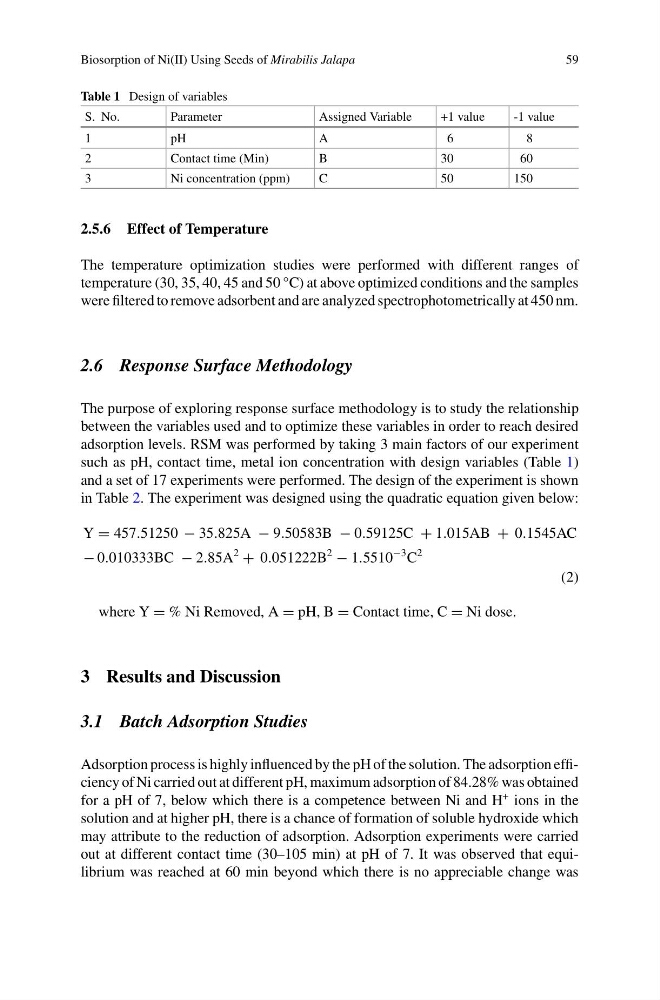
such as pH, contact time, metal ion concentration with design variables (Table 1)
and a set of 17 experiments were performed. The design of the experiment is shown
in Table 2. The experiment was designed using the quadratic equation given below:
Y = 457.51250 − 35.825A − 9.50583B − 0.59125C + 1.015AB + 0.1545AC
− 0.010333BC − 2.85A
2
+ 0.051222B
2
− 1.5510
−3 C
2
(2)
where Y = % Ni Removed, A = pH, B = Contact time, C = Ni dose.
3 Results and Discussion
3.1 Batch Adsorption Studies
Adsorption process is highly influenced by the pH of the solution. The adsorption efficiency of Ni carried out at different pH, maximum adsorption of 84.28% was obtained
for a pH of 7, below which there is a competence between Ni and H
+ ions in the
solution and at higher pH, there is a chance of formation of soluble hydroxide which
may attribute to the reduction of adsorption. Adsorption experiments were carried
out at different contact time (30–105 min) at pH of 7. It was observed that equilibrium was reached at 60 min beyond which there is no appreciable change was
59
Table 1 Design of variables
S. No.
Parameter
Assigned Variable
+1 value
-1 value
1
pH
A
6
8
2
Contact time (Min)
B
30
60
3
Ni concentration (ppm)
C
50
150
2.5.6 Effect of Temperature
The temperature optimization studies were performed with different ranges of
temperature (30, 35, 40, 45 and 50 °C) at above optimized conditions and the samples
were filtered to remove adsorbent and are analyzed spectrophotometrically at 450 nm.
2.6 Response Surface Methodology
The purpose of exploring response surface methodology is to study the relationship
between the variables used and to optimize these variables in order to reach desired
adsorption levels. RSM was performed by taking 3 main factors of our experiment
such as pH, contact time, metal ion concentration with design variables (Table 1)
and a set of 17 experiments were performed. The design of the experiment is shown
in Table 2. The experiment was designed using the quadratic equation given below:
Y = 457.51250 − 35.825A − 9.50583B − 0.59125C + 1.015AB + 0.1545AC
− 0.010333BC − 2.85A
2
+ 0.051222B
2
− 1.5510
−3 C
2
(2)
where Y = % Ni Removed, A = pH, B = Contact time, C = Ni dose.
3 Results and Discussion
3.1 Batch Adsorption Studies
Adsorption process is highly influenced by the pH of the solution. The adsorption efficiency of Ni carried out at different pH, maximum adsorption of 84.28% was obtained
for a pH of 7, below which there is a competence between Ni and H
+ ions in the
solution and at higher pH, there is a chance of formation of soluble hydroxide which
may attribute to the reduction of adsorption. Adsorption experiments were carried
out at different contact time (30–105 min) at pH of 7. It was observed that equilibrium was reached at 60 min beyond which there is no appreciable change was