

Ecofriendly Approach for Bioethanol Production …
309
polymer consists of α-1,4-linked D-glucose residues and α-1,6-linked branch for
each 24–30 residues (Stick and Williams 2009).
Similar to cellulose, starches can be degraded by enzymatic hydrolysis to produce
bioethanol. Amylases are among the most commonly used enzymes to hydrolyse
starch (Simas-Rodrigues et al. 2015).
4 Overview of Processes for Microalgae Bioethanol
Production
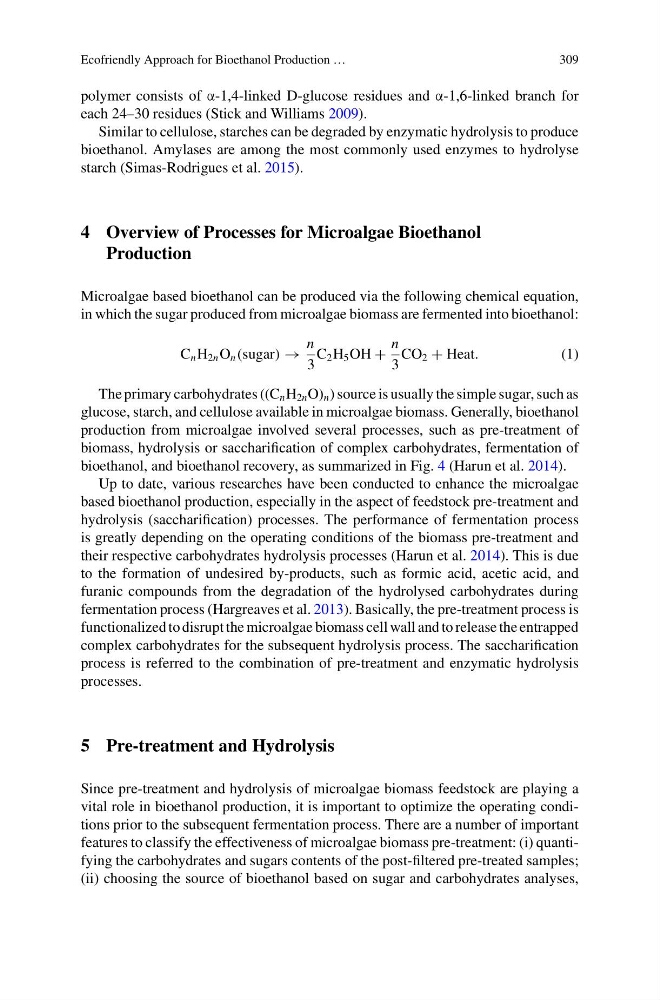
Microalgae based bioethanol can be produced via the following chemical equation,
in which the sugar produced from microalgae biomass are fermented into bioethanol:
C n H 2n O n (sugar) →
n
3
C 2 H 5 OH +
n
3
CO 2 + Heat.
(1)
The primary carbohydrates ((C n H 2n O) n ) source is usually the simple sugar, such as
glucose, starch, and cellulose available in microalgae biomass. Generally, bioethanol
production from microalgae involved several processes, such as pre-treatment of
biomass, hydrolysis or saccharification of complex carbohydrates, fermentation of
bioethanol, and bioethanol recovery, as summarized in Fig. 4 (Harun et al. 2014).
Up to date, various researches have been conducted to enhance the microalgae
based bioethanol production, especially in the aspect of feedstock pre-treatment and
hydrolysis (saccharification) processes. The performance of fermentation process
is greatly depending on the operating conditions of the biomass pre-treatment and
their respective carbohydrates hydrolysis processes (Harun et al. 2014). This is due
to the formation of undesired by-products, such as formic acid, acetic acid, and
furanic compounds from the degradation of the hydrolysed carbohydrates during
fermentation process (Hargreaves et al. 2013). Basically, the pre-treatment process is
functionalized to disrupt the microalgae biomass cell wall and to release the entrapped
complex carbohydrates for the subsequent hydrolysis process. The saccharification
process is referred to the combination of pre-treatment and enzymatic hydrolysis
processes.
5 Pre-treatment and Hydrolysis
Since pre-treatment and hydrolysis of microalgae biomass feedstock are playing a
vital role in bioethanol production, it is important to optimize the operating conditions prior to the subsequent fermentation process. There are a number of important
features to classify the effectiveness of microalgae biomass pre-treatment: (i) quantifying the carbohydrates and sugars contents of the post-filtered pre-treated samples;
(ii) choosing the source of bioethanol based on sugar and carbohydrates analyses,
309
polymer consists of α-1,4-linked D-glucose residues and α-1,6-linked branch for
each 24–30 residues (Stick and Williams 2009).
Similar to cellulose, starches can be degraded by enzymatic hydrolysis to produce
bioethanol. Amylases are among the most commonly used enzymes to hydrolyse
starch (Simas-Rodrigues et al. 2015).
4 Overview of Processes for Microalgae Bioethanol
Production
Microalgae based bioethanol can be produced via the following chemical equation,
in which the sugar produced from microalgae biomass are fermented into bioethanol:
C n H 2n O n (sugar) →
n
3
C 2 H 5 OH +
n
3
CO 2 + Heat.
(1)
The primary carbohydrates ((C n H 2n O) n ) source is usually the simple sugar, such as
glucose, starch, and cellulose available in microalgae biomass. Generally, bioethanol
production from microalgae involved several processes, such as pre-treatment of
biomass, hydrolysis or saccharification of complex carbohydrates, fermentation of
bioethanol, and bioethanol recovery, as summarized in Fig. 4 (Harun et al. 2014).
Up to date, various researches have been conducted to enhance the microalgae
based bioethanol production, especially in the aspect of feedstock pre-treatment and
hydrolysis (saccharification) processes. The performance of fermentation process
is greatly depending on the operating conditions of the biomass pre-treatment and
their respective carbohydrates hydrolysis processes (Harun et al. 2014). This is due
to the formation of undesired by-products, such as formic acid, acetic acid, and
furanic compounds from the degradation of the hydrolysed carbohydrates during
fermentation process (Hargreaves et al. 2013). Basically, the pre-treatment process is
functionalized to disrupt the microalgae biomass cell wall and to release the entrapped
complex carbohydrates for the subsequent hydrolysis process. The saccharification
process is referred to the combination of pre-treatment and enzymatic hydrolysis
processes.
5 Pre-treatment and Hydrolysis
Since pre-treatment and hydrolysis of microalgae biomass feedstock are playing a
vital role in bioethanol production, it is important to optimize the operating conditions prior to the subsequent fermentation process. There are a number of important
features to classify the effectiveness of microalgae biomass pre-treatment: (i) quantifying the carbohydrates and sugars contents of the post-filtered pre-treated samples;
(ii) choosing the source of bioethanol based on sugar and carbohydrates analyses,