

Quorum Sensing Inhibitors as an Alternate …
295
Table 2 Molecular docking energy (kcal/mol) of compounds identified from R. annamalayana
bark extract against receptor proteins of V. harveyi
Against V. harveyi LuxP receptor
Docking score
Furanosyl borate diester (natural ligand)
−7.484
lH-Purin-6-amine
−5.681
Cycloheptasiloxane
−6.027
Cyclooctasiloxane
−6.074
Cyclononasiloxane
−5.919
Cyclononasiloxane octadecamethyl
−8.459
Cyclodecasiloxane eicosamethyl
−8.175
1,1,1,5,7,7,7-Heptamethyl-3,3-bis(trimethylsiloxy)tetrasiloxane
−6.186
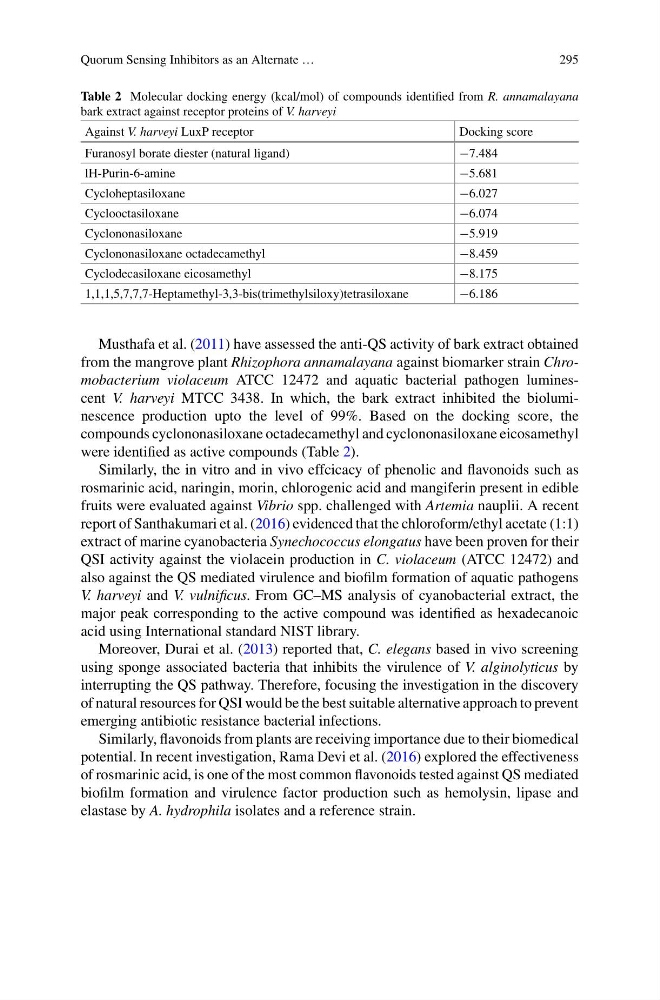
Musthafa et al. (2011) have assessed the anti-QS activity of bark extract obtained
from the mangrove plant Rhizophora annamalayana against biomarker strain Chromobacterium violaceum ATCC 12472 and aquatic bacterial pathogen luminescent V. harveyi MTCC 3438. In which, the bark extract inhibited the bioluminescence production upto the level of 99%. Based on the docking score, the
compounds cyclononasiloxane octadecamethyl and cyclononasiloxane eicosamethyl
were identified as active compounds (Table 2).
Similarly, the in vitro and in vivo effcicacy of phenolic and flavonoids such as
rosmarinic acid, naringin, morin, chlorogenic acid and mangiferin present in edible
fruits were evaluated against Vibrio spp. challenged with Artemia nauplii. A recent
report of Santhakumari et al. (2016) evidenced that the chloroform/ethyl acetate (1:1)
extract of marine cyanobacteria Synechococcus elongatus have been proven for their
QSI activity against the violacein production in C. violaceum (ATCC 12472) and
also against the QS mediated virulence and biofilm formation of aquatic pathogens
V. harveyi and V. vulnificus. From GC–MS analysis of cyanobacterial extract, the
major peak corresponding to the active compound was identified as hexadecanoic
acid using International standard NIST library.
Moreover, Durai et al. (2013) reported that, C. elegans based in vivo screening
using sponge associated bacteria that inhibits the virulence of V. alginolyticus by
interrupting the QS pathway. Therefore, focusing the investigation in the discovery
of natural resources for QSI would be the best suitable alternative approach to prevent
emerging antibiotic resistance bacterial infections.
Similarly, flavonoids from plants are receiving importance due to their biomedical
potential. In recent investigation, Rama Devi et al. (2016) explored the effectiveness
of rosmarinic acid, is one of the most common flavonoids tested against QS mediated
biofilm formation and virulence factor production such as hemolysin, lipase and
elastase by A. hydrophila isolates and a reference strain.
295
Table 2 Molecular docking energy (kcal/mol) of compounds identified from R. annamalayana
bark extract against receptor proteins of V. harveyi
Against V. harveyi LuxP receptor
Docking score
Furanosyl borate diester (natural ligand)
−7.484
lH-Purin-6-amine
−5.681
Cycloheptasiloxane
−6.027
Cyclooctasiloxane
−6.074
Cyclononasiloxane
−5.919
Cyclononasiloxane octadecamethyl
−8.459
Cyclodecasiloxane eicosamethyl
−8.175
1,1,1,5,7,7,7-Heptamethyl-3,3-bis(trimethylsiloxy)tetrasiloxane
−6.186
Musthafa et al. (2011) have assessed the anti-QS activity of bark extract obtained
from the mangrove plant Rhizophora annamalayana against biomarker strain Chromobacterium violaceum ATCC 12472 and aquatic bacterial pathogen luminescent V. harveyi MTCC 3438. In which, the bark extract inhibited the bioluminescence production upto the level of 99%. Based on the docking score, the
compounds cyclononasiloxane octadecamethyl and cyclononasiloxane eicosamethyl
were identified as active compounds (Table 2).
Similarly, the in vitro and in vivo effcicacy of phenolic and flavonoids such as
rosmarinic acid, naringin, morin, chlorogenic acid and mangiferin present in edible
fruits were evaluated against Vibrio spp. challenged with Artemia nauplii. A recent
report of Santhakumari et al. (2016) evidenced that the chloroform/ethyl acetate (1:1)
extract of marine cyanobacteria Synechococcus elongatus have been proven for their
QSI activity against the violacein production in C. violaceum (ATCC 12472) and
also against the QS mediated virulence and biofilm formation of aquatic pathogens
V. harveyi and V. vulnificus. From GC–MS analysis of cyanobacterial extract, the
major peak corresponding to the active compound was identified as hexadecanoic
acid using International standard NIST library.
Moreover, Durai et al. (2013) reported that, C. elegans based in vivo screening
using sponge associated bacteria that inhibits the virulence of V. alginolyticus by
interrupting the QS pathway. Therefore, focusing the investigation in the discovery
of natural resources for QSI would be the best suitable alternative approach to prevent
emerging antibiotic resistance bacterial infections.
Similarly, flavonoids from plants are receiving importance due to their biomedical
potential. In recent investigation, Rama Devi et al. (2016) explored the effectiveness
of rosmarinic acid, is one of the most common flavonoids tested against QS mediated
biofilm formation and virulence factor production such as hemolysin, lipase and
elastase by A. hydrophila isolates and a reference strain.